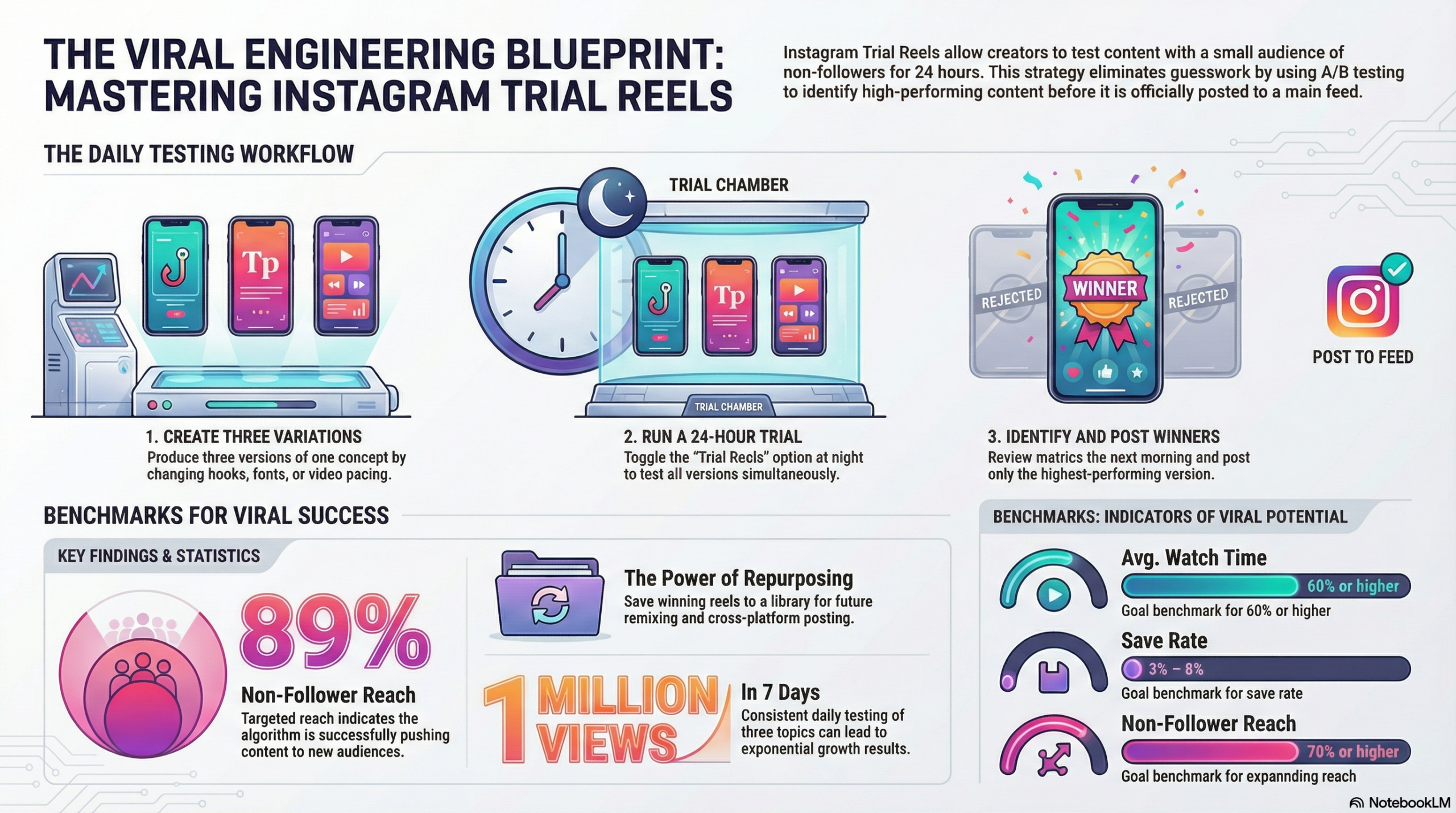
4 Types of Video Content for Instagram Trial Reels: Strategic Framework for Maximum Engagement (2026 Guide)

4 Types of Video Content for Instagram Trial Reels: Strategic Framework for Maximum Engagement (2026 Guide)

4 Types of Video Content for Instagram Trial Reels: Strategic Framework for Maximum Engagement (2026 Guide)

Master the systematic approach to Instagram video content that eliminates guesswork and maximizes performance through strategic testing.

Creating successful Instagram video content used to be about posting and hoping. With Instagram Trial Reels, you can now test your video strategy systematically before committing to your main feed. But not all video content works equally well in the testing environment.

The challenge: Most creators approach Instagram video content randomly, cycling through different formats without understanding which types perform best in Trial Reel testing or how to optimize each format for maximum engagement.

The solution: A strategic framework based on four core video content types, each with specific optimization techniques for Trial Reels testing and proven pitch variations that build trust while driving business results.

This comprehensive guide reveals the video content strategy framework that helps businesses and creators systematically test and optimize their Instagram content for consistent performance. You’ll learn which video types perform best in Trial Reels, how to structure each format for maximum engagement, and how to vary your promotional approach to build audience trust.

Why Instagram Video Content Strategy Matters More Than Ever in 2026

Instagram’s continued evolution toward video-first content has made strategic video creation more important than ever. With Instagram Reels generating significantly higher engagement than static posts, and the platform’s algorithm favoring video content that keeps users engaged, understanding which video formats resonate with your audience has become crucial for sustainable growth.

The Current Instagram Video Landscape:

With over 2 billion monthly active users, Instagram has become primarily a video-focused platform. The introduction of Instagram Trial Reels provides creators and businesses with the opportunity to test video content systematically before committing to their main feed, reducing the guesswork in content creation.

It simultaneously allows users to push out content to all cold users.  This is amazing for gaining new followers, and clients. 

Key Instagram Video Statistics (2026):

  • Video posts receive 38% more engagement than photo posts
  • Instagram Reels generate 22% higher engagement than regular video posts
  • Educational video content shows 65% higher save rates than entertainment content
  • Tutorial videos have the highest completion rates across all industries

Why Systematic Video Testing Works:

Instead of posting video content and hoping for the best, Instagram Trial Reels allow you to test different video formats with small audiences, analyze performance metrics, and only promote content that demonstrates strong engagement potential to your main feed.

This data-driven approach to Instagram video content creation ensures that your time and resources focus on video formats that actually drive results for your business or personal brand.

The 4-Type Instagram Video Content Framework

Based on analysis of high-performing Instagram accounts and extensive Trial Reels testing, four core video content types consistently deliver strong engagement and conversion results when properly executed and strategically tested.

Video Type #1: Talking Head Videos (Direct-to-Camera Content)

What They Are: Direct-to-camera videos where you speak authentically to your audience without additional visual elements, focusing on personal connection and genuine communication.

Why They Work: Talking head videos build immediate trust and authenticity because viewers see the real person behind the brand. This format performs exceptionally well in Trial Reels testing because it creates instant connection and allows for clear message delivery.

Trial Reels Performance Data:

  • Average completion rate: 72-78% across industries
  • Save rate: 8-12% for value-driven content
  • Profile click rate: 6-9% (highest among all video types)

Talking Head Video Optimization for Trial Reels:

Hook Structure (First 3 Seconds): The opening of your talking head video determines whether viewers continue watching. Based on Trial Reels testing data, these hook types consistently perform best:

  1. Question Hooks: “Have you ever wondered why [specific problem]?”
  2. Problem Statement Hooks: “If you’re struggling with [specific issue]…”
  3. Contrarian Hooks: “Everyone tells you to [common advice], but here’s why that’s wrong…”
  4. Authority Hooks: “After [time period] doing [activity], here’s what I learned…”
  5. Story Hooks: “Last week something happened that changed how I think about [topic]…”

Content Structure (4-25 seconds):

  • Value Delivery: Provide specific, actionable insight
  • Personal Experience: Share relevant expertise or story
  • Clear Explanation: Make complex topics understandable
  • Emotional Connection: Show personality and authenticity

The 3-Pitch System for Talking Head Videos:

No Pitch Talking Head Videos: Pure value delivery with no promotional content or call-to-action. These videos build trust and establish expertise without any sales pressure.

Example Structure:

  • Hook: “The biggest mistake I see businesses making with social media…”
  • Content: Share specific mistake and solution
  • Close: “Hope this helps!” (no CTA)

Trial Reels Performance: Highest completion rates (75-82%) but lower conversion rates. Use these to build audience relationship and trust.

Subtle Pitch Talking Head Videos: Valuable content with a gentle invitation to learn more or connect further.

Example Structure:

  • Hook: “Here’s the strategy that doubled our client’s Instagram engagement…”
  • Content: Share high-level strategy overview
  • Close: “DM me ‘STRATEGY’ if you want the complete playbook”

Trial Reels Performance: Balanced completion (68-75%) with moderate conversion rates. Ideal for nurturing audience toward your services.

Hard Pitch Talking Head Videos: Direct promotional content that clearly presents your offer and call-to-action.

Example Structure:

  • Hook: “If you’re ready to stop guessing about your Instagram strategy…”
  • Content: Present specific problem and your solution
  • Close: “Link in bio to book a strategy call this week”

Trial Reels Performance: Lower completion rates (55-65%) but higher conversion rates. Use when you have established audience trust.

Talking Head Video Technical Best Practices:

Lighting and Setup:

  • Natural lighting facing a window or professional ring light
  • Eye-level camera positioning for authentic connection
  • Clean, undistracting background that reflects your brand
  • High-quality audio (external microphone recommended)

Delivery Techniques:

  • Speak directly to the camera as if talking to one person
  • Use natural hand gestures and facial expressions
  • Maintain consistent energy throughout the video
  • Practice key talking points but avoid over-scripting

Video Type #2: B-Roll Videos (Lifestyle and Behind-the-Scenes)

What They Are: Visually-driven videos using lifestyle footage, behind-the-scenes content, or aesthetic visuals with text overlays or voiceovers to tell your story and deliver value.

Why They Work: B-roll videos perform excellently in Trial Reels because they combine visual appeal with strategic messaging. The aesthetic element captures attention while text overlays or voiceovers deliver value efficiently.

Trial Reels Performance Data:

  • Average completion rate: 69-74% across industries
  • Save rate: 6-10% depending on value delivery
  • Share rate: 4-7% (highest among all video types)

B-Roll Video Categories for Instagram Trial Reels:

Behind-the-Scenes B-Roll: Show your actual work process, workspace, or daily routine to build familiarity and trust with your audience.

High-Performing Behind-the-Scenes Concepts:

  • Morning routine or workspace setup
  • Client work process (maintaining confidentiality)
  • Content creation behind-the-scenes
  • Day-in-the-life authentic moments
  • Team collaboration and culture

Lifestyle B-Roll: Aesthetic footage that represents the lifestyle or aspirations connected to your brand or expertise.

Effective Lifestyle B-Roll Approaches:

  • Travel content connected to business lessons
  • Home office or workspace aesthetics
  • Lifestyle moments that reinforce brand values
  • Seasonal content that ties to business themes
  • Personal interests that humanize your brand

Process Documentation B-Roll: Visual documentation of step-by-step processes, transformations, or before-and-after scenarios.

Process Documentation Ideas:

  • Workspace organization or setup
  • Project completion timelines
  • Skill development progression
  • Client transformation journeys (with permission)
  • Business growth milestones

B-Roll Video Text Overlay Strategy:

Text Overlay Best Practices:

  • Use high-contrast colors for readability
  • Keep text on screen for 2-3 seconds minimum
  • Maximum 7 words per text overlay
  • Use consistent font styling throughout video
  • Position text in upper or lower third of frame

Effective Text Overlay Formulas:

Problem-Solution Format:

  • Slide 1: “The problem with [common approach]”
  • Slide 2: “Why this happens [explanation]”
  • Slide 3: “Here’s what works instead [solution]”
  • Slide 4: “The result? [outcome]”

List Format:

  • Slide 1: “3 things I learned from [experience]”
  • Slide 2: “1. [First insight with explanation]”
  • Slide 3: “2. [Second insight with explanation]”
  • Slide 4: “3. [Third insight with takeaway]”

The 3-Pitch System for B-Roll Videos:

No Pitch B-Roll Videos: Focus entirely on providing value, building familiarity, or sharing insights without any promotional elements.

Example: Behind-the-Scenes No Pitch

  • Visual: Morning coffee and workspace setup
  • Text: “How I structure my most productive days”
  • Content: Share actual daily routine insights
  • Close: No call-to-action, pure value sharing

Subtle Pitch B-Roll Videos: Combine valuable content with gentle mentions of your services or expertise.

Example: Process Documentation Subtle Pitch

  • Visual: Client work process (anonymized)
  • Text: “The strategy framework that transformed this client’s results”
  • Content: High-level process overview
  • Close: “Link in bio for more client success stories”

Hard Pitch B-Roll Videos: Use aesthetic visuals to present clear promotional messages and direct calls-to-action.

Example: Lifestyle Hard Pitch

  • Visual: Professional lifestyle moments
  • Text: “Ready to build the business that funds this lifestyle?”
  • Content: Clear connection between service and outcome
  • Close: “DM ‘READY’ to start your transformation”

Video Type #3: Tutorial Videos (Educational and How-To Content)

What They Are: Step-by-step instructional videos that teach specific skills, processes, or concepts to help your audience achieve particular outcomes.

Why They Excel in Trial Reels: Educational content consistently shows the highest performance metrics in Trial Reels testing because it provides immediate, actionable value that audiences save for future reference.

Trial Reels Performance Data:

  • Average completion rate: 78-85% (highest among all types)
  • Save rate: 12-18% (significantly above average)
  • Profile click rate: 6-9%
  • Comment engagement: High-quality questions and implementation feedback

Tutorial Video Categories for Instagram Trial Reels:

Quick Tip Tutorials (15-30 seconds): Concise, actionable advice that viewers can implement immediately.

High-Performing Quick Tip Concepts:

  • “The 30-second fix for [common problem]”
  • “One simple change that [specific benefit]”
  • “The fastest way to [achieve outcome]”
  • “What I wish I knew about [topic] before [situation]”

Process Breakdown Tutorials (30-60 seconds): Step-by-step walkthroughs of specific processes or methodologies.

Effective Process Tutorial Structures:

  • “My 3-step system for [achieving result]”
  • “How to [accomplish task] in [time frame]”
  • “The exact process I use to [specific outcome]”
  • “Step-by-step: [complex process] simplified”

Tool or Software Tutorials (20-45 seconds): Demonstrations of how to use specific tools, apps, or software for better results.

Tool Tutorial Approaches:

  • “How I use [tool] to [achieve result]”
  • “[Tool] features most people miss”
  • “The [tool] workflow that saves me [time/money]”
  • “[Tool] vs [alternative]: which is better?”

Tutorial Video Script Structure for Trial Reels:

Opening Hook (2-3 seconds):

  • “Here’s exactly how to [achieve specific outcome]”
  • “The [tool/method] technique that [specific benefit]”
  • “Stop [doing wrong thing], do this instead”

Value Delivery (15-50 seconds):

  • Step 1: [Specific action with brief explanation]
  • Step 2: [Next action with key insight]
  • Step 3: [Final step with expected outcome]

Reinforcement Close (2-5 seconds):

  • “Try this and let me know how it works!”
  • “Save this for when you need to [situation]”
  • “Which step do you find most challenging?”

The 3-Pitch System for Tutorial Videos:

No Pitch Tutorial Videos: Complete, actionable tutorials with no promotional content. These build maximum trust and authority.

Example: Complete Process No Pitch

  • Hook: “How to audit your Instagram performance in 5 minutes”
  • Content: Complete step-by-step process with specific tools
  • Close: “Hope this helps improve your strategy!”

Trial Reels Performance: Highest save rates and completion rates. Use to establish expertise and build audience trust.

Subtle Pitch Tutorial Videos: Provide partial solution with invitation to get complete methodology or additional resources.

Example: Partial Process Subtle Pitch

  • Hook: “The Instagram audit process that transformed our clients’ results”
  • Content: Share 2-3 key steps of a larger process
  • Close: “DM ‘AUDIT’ for the complete 12-step checklist”

Trial Reels Performance: Strong engagement with moderate conversion rates. Ideal for lead generation and audience building.

Hard Pitch Tutorial Videos: Teach the concept or importance, then direct to your service or product for implementation.

Example: Concept-to-Sale Hard Pitch

  • Hook: “Why most Instagram audits miss the crucial element”
  • Content: Explain what most people miss and why it matters
  • Close: “Ready for a complete audit? Link in bio to book your strategy session”

Trial Reels Performance: Lower completion rates but higher conversion rates. Use when audience understands your expertise.

Video Type #4: Storytelling Videos (Emotional and Relatable)

What They Are: Narrative-driven videos that use personal experiences, client stories, or relatable scenarios to create emotional connection and illustrate important points or lessons.

Why They Work in Trial Reels: Storytelling videos generate high engagement because they create emotional investment. Viewers want to know how stories conclude, leading to strong completion rates and meaningful comments.

Trial Reels Performance Data:

  • Average completion rate: 70-76%
  • Comment engagement: Highest quality responses and discussions
  • Share rate: 5-8% when stories are universally relatable
  • Emotional connection: Strongest brand affinity building

Storytelling Video Categories for Instagram Trial Reels:

Personal Experience Stories: Share your own experiences, failures, successes, or learning moments that provide value to your audience.

High-Impact Personal Story Themes:

  • Failure or mistake that taught important lesson
  • Breakthrough moment that changed your approach
  • Behind-the-scenes struggle that humanizes your journey
  • Unexpected discovery that benefited your business
  • Client interaction that shifted your perspective

Client Success Stories (with permission): Document client transformations, challenges overcome, or results achieved through your work or advice.

Client Story Structures:

  • “When [client] came to us, they were [situation]”
  • “Here’s the exact strategy we implemented…”
  • “The results after [timeframe] were [specific outcomes]”
  • “What this taught us about [broader lesson]”

Relatable Scenario Stories: Create fictional but realistic scenarios that your audience commonly experiences.

Relatable Scenario Approaches:

  • “We’ve all been in this situation…”
  • “Picture this: it’s Monday morning and…”
  • “Every [your audience] has experienced this…”
  • “The conversation every [profession] dreads…”

Storytelling Video Script Structure:

Story Hook (3-5 seconds):

  • “Last month, something happened that completely changed how I…”
  • “I’ll never forget the day a client said this to me…”
  • “This might sound crazy, but hear me out…”
  • “Two years ago, I made a mistake that taught me…”

Story Development (20-45 seconds):

  • Set the scene with specific details
  • Introduce the conflict, challenge, or turning point
  • Build emotional investment through relatable elements
  • Include dialogue or specific actions when relevant

Lesson and Application (5-10 seconds):

  • Extract the universal lesson from your specific story
  • Connect the lesson to your audience’s situation
  • Provide actionable takeaway or perspective shift
  • Close with invitation for audience to share their experiences

The 3-Pitch System for Storytelling Videos:

No Pitch Storytelling Videos: Share complete stories with valuable lessons but no promotional content.

Example: Personal Experience No Pitch

  • Story: Failure that led to important business insight
  • Lesson: What this taught about customer communication
  • Close: “Have you experienced something similar?”

Trial Reels Performance: High emotional engagement and discussion generation. Builds strong audience connection.

Subtle Pitch Storytelling Videos: Let your services naturally emerge from the story’s context or lesson.

Example: Client Success Subtle Pitch

  • Story: How client overcame specific challenge
  • Lesson: The strategy or approach that made the difference
  • Close: “If you’re facing similar challenges, I’d love to help”

Trial Reels Performance: Strong relatability with gentle conversion opportunity. Effective for service-based businesses.

Hard Pitch Storytelling Videos: Use compelling stories to directly illustrate the value of your services or products.

Example: Transformation Hard Pitch

  • Story: Dramatic client or personal transformation
  • Lesson: The specific methodology or service that created results
  • Close: “Ready for your transformation? Link in bio to get started”

Trial Reels Performance: High emotional impact with clear conversion path. Use when story directly connects to your offer.

  •  
The 2026 Instagram Trial Reels Framework infographic showing 4 video content types for maximum engagement: Talking Head videos (72-78% completion rate), Tutorial Educational content (78-85% completion rate), B-Roll Storytelling (70-76% completion rate), and Behind-the-Scenes content (65-72% completion rate). Includes 3-Pitch System strategy, 4-3-2-1 rotation schedule, and video length optimization guidelines.

Advanced Instagram Video Content Strategy

Strategic Video Type Rotation for Maximum Engagement

The 4-3-2-1 Content Rotation System:

Based on Trial Reels performance data, this rotation system optimizes for both audience engagement and business results:

Week 1:

  • 4 Educational videos (high value, authority building)
  • 3 Personal/storytelling videos (connection building)
  • 2 Behind-the-scenes videos (familiarity)
  • 1 Direct promotional video (conversion)

Why This Rotation Works:

  • Educational content establishes expertise and generates saves
  • Personal content builds emotional connection and trust
  • Behind-the-scenes content humanizes your brand
  • Strategic promotion capitalizes on trust and authority built through other content

Video Length Optimization for Trial Reels

Performance by Video Length:

15-30 Second Videos:

  • Best completion rates (75-82%)
  • Moderate save rates (8-12%)
  • Ideal for quick tips, simple tutorials, direct messages
  • Highest performance in Trial Reels testing

30-45 Second Videos:

  • Balanced performance (68-75% completion)
  • Higher save rates (10-15%)
  • Best for process demonstrations, story-driven content
  • Strong overall performance across metrics

45-60 Second Videos:

  • Lower completion rates (58-65%)
  • Highest save rates (15-20%)
  • Best for comprehensive tutorials, detailed stories
  • Use selectively for high-value content

Key Insight: For Trial Reels testing, 15-30 second videos provide the best balance of completion rate and engagement, making them ideal for testing new concepts and approaches.

Seasonal Video Content Strategy

January-March (Planning and Goal Setting):

  • Educational content about planning and strategy
  • Personal transformation or goal-setting stories
  • Behind-the-scenes content showing preparation
  • Tutorial content for skill development

April-June (Implementation and Growth):

  • Process-focused educational content
  • Progress update storytelling
  • Behind-the-scenes work and implementation
  • Tutorial content for optimization

July-September (Results and Reflection):

  • Results-focused storytelling
  • Behind-the-scenes success celebrations
  • Educational content about lessons learned
  • Tutorial content for scaling

October-December (Planning and Preparation):

  • Year-end reflection storytelling
  • Planning-focused educational content
  • Behind-the-scenes preparation for next year
  • Tutorial content for strategic planning

Instagram Video Content Technical Optimization

Video Quality Standards for Trial Reels

Technical Requirements:

  • Minimum 1080p resolution (1920×1080)
  • 9:16 aspect ratio for optimal mobile viewing
  • Clear, high-quality audio (external microphone recommended)
  • Consistent lighting throughout video
  • Stable footage (tripod or gimbal recommended)

Editing Best Practices:

  • Quick cuts every 3-5 seconds to maintain attention
  • Text overlay timing: minimum 2 seconds on screen
  • Captions for accessibility and silent viewing
  • Consistent color grading and visual style
  • Engaging opening frame to stop scrolling

Hashtag Strategy for Video Content

Hashtag Mix for Video Posts (Maximum 5):

Since Instagram now limits hashtags to 5 per post, strategic selection is crucial:

  • 2 niche-specific hashtags (#instagramstrategy, #contentmarketing)
  • 2 broader category hashtags (#digitalmarketing, #videomarketing)
  • 1 community or branded hashtag (#smallbusiness or your branded hashtag)

Video-Specific Hashtag Options:

  • #reels, #instagramreels, #videomarketing
  • #tutorial, #howto (for educational content)
  • #behindthescenes, #bts (for B-roll content)
  • #storytime, #businesstips (for storytelling content)

Strategic Hashtag Selection: With only 5 hashtags available, focus on:

  • High relevance to your specific content
  • Mix of competition levels (2-3 moderate competition, 1-2 lower competition)
  • Audience alignment with hashtags your ideal followers actually search
  • Content type specificity rather than generic tags

Example 5-Hashtag Sets:

For Educational Content: #instagramstrategy #contentmarketing #digitalmarketing #tutorial #smallbusiness

For Behind-the-Scenes Content: #behindthescenes #entrepreneur #contentcreator #businessowner #videomarketing

For Storytelling Content: #storytime #businesstips #entrepreneur #lessons #growth

Caption Strategy for Video Content

Caption Structure for Video Posts:

Hook Line (First Sentence): Grab attention and encourage viewing the video. Use curiosity, questions, or bold statements.

Video Context (2-3 sentences): Provide additional context, backstory, or deeper explanation of the video content.

Call-to-Action: Clear next step for engagement – ask questions, encourage saves, request comments.

Hashtags: Include max of 5  strategic hashtags at the end of the caption.

Performance Metrics and Optimization

Key Video Content Metrics to Track

Primary Metrics (Most Important):

  1. Completion Rate: Percentage of viewers who watch entire video
  2. Save Rate: Percentage who save video for later reference
  3. Share Rate: Percentage who share video with others
  4. Comment Quality: Meaningful engagement vs. superficial reactions

Secondary Metrics: 5. Profile Clicks: Viewers interested in learning more about you 6. Reach Rate: How far beyond your followers the content spreads 7. Replay Rate: Viewers who watch video multiple times

Video Content A/B Testing Strategy

Testing Variables for Video Content:

Hook Testing:

  • Question hooks vs. statement hooks
  • Personal vs. universal hooks
  • Problem-focused vs. solution-focused hooks
  • Direct vs. story-based hooks

Length Testing:

  • 15-second vs. 30-second versions of same content
  • Single concept vs. multiple concept videos
  • Quick tip vs. detailed explanation approaches

Visual Style Testing:

  • Face-to-camera vs. text overlay
  • Static vs. dynamic visual elements
  • Professional vs. casual presentation style
  • Minimalist vs. detailed backgrounds

Content Angle Testing:

  • Beginner vs. advanced positioning
  • Individual vs. business-focused advice
  • Tactical vs. strategic perspectives
  • Problem vs. opportunity framing

Industry-Specific Video Content Strategies

B2B Professional Services

Highest-Performing Video Types:

  1. Educational tutorials (85% avg completion rate)
  2. Behind-the-scenes process videos (78% completion rate)
  3. Client success storytelling (72% completion rate)
  4. Direct expertise talking heads (74% completion rate)

Content Themes That Work:

  • Industry insights and trend analysis
  • Process optimization tutorials
  • Client transformation stories
  • Professional development advice
  • Tool and software demonstrations

E-commerce and Product-Based Businesses

Highest-Performing Video Types:

  1. Product demonstration tutorials (82% avg completion rate)
  2. Behind-the-scenes creation/packaging (76% completion rate)
  3. Customer success storytelling (71% completion rate)
  4. Direct product presentation talking heads (68% completion rate)

Content Themes That Work:

  • Product usage tutorials and tips
  • Behind-the-scenes creation or sourcing
  • Customer transformation stories
  • Seasonal product showcases
  • Comparison and review content

Personal Brands and Coaches

Highest-Performing Video Types:

  1. Personal experience storytelling (79% avg completion rate)
  2. Educational transformation tutorials (81% completion rate)
  3. Behind-the-scenes lifestyle content (73% completion rate)
  4. Direct motivational talking heads (71% completion rate)

Content Themes That Work:

  • Personal transformation journeys
  • Client breakthrough stories
  • Daily routine and lifestyle content
  • Mindset and motivation advice
  • Skill development tutorials

Building Your Instagram Video Content System

30-Day Video Content Implementation Plan

Week 1: Foundation and Testing

  • Day 1-2: Create content calendar based on 4-type framework
  • Day 3-7: Create and test 5 different video concepts using Trial Reels
  • Focus: Establish baseline performance for each video type

Week 2: Optimization and Refinement

  • Day 8-14: Analyze Week 1 Trial Reels data
  • Create variations of best-performing concepts
  • Test different hooks and lengths for top performers
  • Focus: Optimize individual video elements

Week 3: Pitch Variation Testing

  • Day 15-21: Test no pitch, subtle pitch, and hard pitch versions
  • Analyze conversion rates and engagement quality
  • Identify optimal pitch frequency for your audience
  • Focus: Balance value and promotion effectively

Week 4: System Integration and Scaling

  • Day 22-30: Develop sustainable creation workflow
  • Create templates for each successful video type
  • Plan content calendar for following month
  • Focus: Build repeatable, efficient system

Video Content Creation Workflow

Pre-Production (20% of time):

  • Content planning and scripting
  • Location and equipment setup
  • Visual element preparation
  • Trial Reels testing strategy

Production (40% of time):

  • Video recording with multiple takes
  • Various angle and setup options
  • B-roll footage capture
  • Audio quality verification

Post-Production (40% of time):

  • Video editing and optimization
  • Text overlay and caption creation
  • Hashtag research and implementation
  • Trial Reels testing and analysis

Long-Term Video Content Strategy

Month 1-3: Foundation Building Establish your video content types, test extensively with Trial Reels, and identify what works for your specific audience and business goals.

Month 4-6: Optimization and Scaling Refine successful formats, create templates for efficient production, and scale successful content approaches across other platforms.

Month 7-12: Advanced Strategy Integration Integrate video content with broader marketing strategy, develop signature content series, and use video content to drive specific business outcomes.

Measuring ROI and Business Impact

Direct Business Metrics

Lead Generation Tracking:

  • Profile clicks from video content
  • DM inquiries generated by videos
  • Email signups attributed to video CTAs
  • Consultation bookings from video content

Sales and Revenue Tracking:

  • Client acquisitions traced to video content
  • Product sales from video demonstrations
  • Service bookings from educational videos
  • Long-term customer value from video-generated leads

Brand Awareness Metrics:

  • Follower growth rate from video content
  • Share and save rates indicating content value
  • Mention increase in comments and DMs
  • Cross-platform engagement and recognition

Content Performance Analysis

Monthly Video Content Review:

  • Top-performing video types by engagement
  • Conversion rates by video category
  • Audience feedback and comment analysis
  • Technical performance metrics

Quarterly Strategy Assessment:

  • Overall business impact from video content
  • ROI calculation for time and resources invested
  • Competitive analysis and market position
  • Strategy adjustments for next quarter

Advanced Strategies and Future Considerations

Cross-Platform Video Content Strategy

Repurposing Video Content:

  • Adapt Instagram videos for LinkedIn, TikTok, YouTube Shorts
  • Create longer-form versions for YouTube or podcast content
  • Extract key quotes and insights for Twitter/X content
  • Develop email newsletter content from video themes

Platform-Specific Optimization:

  • Adjust video length and format for each platform
  • Modify captions and hashtags for platform culture
  • Test different posting times and frequencies
  • Analyze cross-platform performance correlations

Emerging Video Content Trends

2026 Video Content Predictions:

  • Increased importance of educational content over entertainment
  • Growing demand for behind-the-scenes authenticity
  • Rising value of data-driven content optimization
  • Greater emphasis on accessibility and inclusivity

Technology Integration:

  • AI-assisted video editing and optimization tools
  • Advanced analytics for content performance prediction
  • Automated A/B testing for video elements
  • Enhanced accessibility features and capabilities

Conclusion: Building Your Video Content Success Framework

Instagram video content success isn’t about creating more content, it’s about creating the right content systematically and testing it strategically before committing your time and audience attention.

The four-type video content framework provides a strategic foundation for consistent Instagram growth:

Educational videos establish your expertise and generate the highest save rates, building long-term authority and trust with your audience.

Behind-the-scenes videos humanize your brand and create familiarity, making your audience feel connected to your journey and process.

Direct talking head videos build personal connection and trust, allowing you to communicate directly with your audience and establish authentic relationships.

Storytelling videos create emotional connection and memorability, helping your message resonate and stick with viewers long after they’ve watched your content.

By rotating through these four video types and varying your promotional approach using the no pitch, subtle pitch, and hard pitch system, you create a sustainable content strategy that builds audience trust while driving business results.

The key is systematic testing through Instagram Trial Reels. Instead of guessing what will work, you can test different video approaches, analyze performance data, and make informed decisions about what content to promote to your main audience.

Ready to implement this video content framework? Start by choosing one video type that feels most natural for your expertise and audience, create three variations with different pitch levels, and test them through Instagram Trial Reels. Use the performance data to refine your approach and gradually incorporate the other video types into your content strategy.

Want help implementing a comprehensive Instagram video content strategy? Our Instagram Trial Reels Viral Framework service helps businesses systematically test and optimize their video content for maximum engagement and conversion. Contact our team to discuss how we can help you build a data-driven video content system that consistently drives business results.

For more advanced Instagram strategies, explore our comprehensive guides:


Your Brand Unmuted Blog

Meet Your Brand Unmuted -The AI That Helps You Find Your Voice

Ever wish your content sounded like you - on your best day, with zero second-guessing?

Welcome to Your Brand Unmuted – a custom GPT created for service-based entrepreneurs, creatives, and consultants who are done sounding generic online. This isn’t your average AI. It’s your high-converting copy sidekick built with the Leslie M Lyon messaging framework baked in.

What Is “Your Brand Unmuted”?

It’s a strategic, voice-savvy content tool that doesn’t just write for you – it writes like you.

Whether you’re a coach, designer, or consultant, this GPT helps you:

Think: bios, captions, taglines, and content themes that actually sound like you, not like a corporate buzzword salad.

Why Your Brand Voice Matters: Your brand voice is the thread that ties your entire content strategy together. Whether it’s a Reels caption, email newsletter, or landing page headline, consistency in how you sound builds recognition, trust, and authority. Without it? You’re just noise.

Why It’s Different (And Smarter)

Most plug-and-play AIs spit out bland, bloated content filled with “authentic,” “game-changer,” and “passionate entrepreneur” fluff.

Your Brand Unmuted doesn’t do that. It starts by asking smart, brand-defining questions like:

  • Who do you actually serve?
  • What transformation do you deliver?
  • What phrases or metaphors do you always use?
  • What tone do you hate reading online?

These aren’t fluff prompts. They’re strategy. Learn more about GPT from OpenAI

What It Can Do for You

Here’s what you can create (and nail) with Your Brand Unmuted in just minutes:

  • A bio that makes people say, “Wait, that’s SO you.”
  • Clear content pillars that support your offers and sound like your voice
  • Copy that’s bold, clear, and scroll-stopping
  • A consistent online presence that doesn’t require handholding

Consistency Is King: When your audience hears the same confident tone across your social media, website, and emails, it reinforces your authority. This tool ensures you’re not reinventing the wheel each time, you’re reinforcing your brand.

No more guessing. No more rewriting the same Instagram caption three times. This is how you sound like the expert you are, everywhere.

Why We Called It “Your Brand Unmuted”

Because when your voice is clear, confident, and consistent?

Visibility becomes demand. Period.

Most businesses struggle not because they don’t have a voice, but because they’ve been muting it to “fit in” online.

This GPT helps you ditch the vague, ditch the vanilla, and finally scale your message with clarity. 

Ready to Unmute Your Brand?

If you’re tired of sounding like a template, it’s time to meet the custom GPT that turns your message into momentum.

Try now – and start writing like you, but clearer, more direct and way more strategic.

Your Brand Unmuted 


What 3 Marketing Metrics Matter and which for you can forget.

3 Marketing Metrics That Really Matter (and 4 You Can Ignore)

If you are tracking 37 different marketing metrics right now, congratulations, you are probably wasting your time. Most small businesses are drowning in data and starving for clarity. So let’s cut the fluff and focus on the numbers that actually move sales. We are ditching the vanity numbers and keeping only the metrics that tell you if your marketing is working.

The 3 Metrics That Actually Matter


  1. Conversion Rate
    If you only tracked one thing, make it this. Conversion rate tells you if your funnel, landing page, or offer is doing its job. Track the percentage of leads who take the action you want, whether that is buying, booking a call, or signing up. If your conversion rate is low, test your headlines, tighten your calls to action, and make sure your offer is clear.
  2. Customer Acquisition Cost (CAC)
    If you don’t know what it costs to get a customer, you are flying blind. Add up your ad spend and any related sales costs, then divide by the number of new customers. If CAC is high, look at your targeting, refresh your ad creative, or fix any leaks in your funnel before spending more.
  3. Customer Lifetime Value (CLV)
    This is the number that tells you how much each customer is worth over the long haul. Multiply your average purchase value by the purchase frequency and retention period. If CLV is low, you can increase it by adding upsells, cross-sells, loyalty programs, or retention campaigns.

4 Metrics You Can Stop Obsessing Over

The Three metrics that matter for Marketing
  1. Social Followers
    Having 10k followers looks good on paper but it does not guarantee sales. Focus on engagement and conversions from the audience you do have.
  2. Page Views Without Context
    Traffic is nice, but it means nothing if visitors are not taking the next step. Always pair page views with a conversion metric.
  3. Email Open Rate Alone
    Opens can be inflated by bots and email filters. What matters is clicks and conversions from those emails.
  4. Post Likes
    Likes do not pay the bills. They are a light indicator of interest but should never be your main measure of success.
4 vanity metrics to ignore

The Bottom Line

 Your time and money are too valuable to waste tracking numbers that do not tie directly to growth. Focus on conversion rate, CAC, and CLV. Everything else is a supporting detail, not the main event.

We Don’t Just Track Data — We Translate It Into Money Moves

 One thing built into every package we offer is a deep-dive analysis of the data that actually matters. We track your key metrics, cut the vanity numbers, and break down what’s working, what’s not, and exactly where we can improve.
No generic reports. No dashboard bloat. Just clear, actionable insights that tell you how to tweak, test, and scale for better results, month after month.


What to Post and Why for Conversions on Social Media

What to Post (and Why) for Conversions on Social Media

If you’re posting consistently but still not getting the results you want, the problem isn’t how often you post, it’s what you’re posting and why.

The goal of social media isn’t just visibility. It’s trust, connection, and conversion. And that starts with understanding your content style, your audience, and your strategy

Identify Your Social Media Commitment Level

Before you build a content plan, you need to be honest about how much time, energy, and support you have. There’s no one-size-fits-all approach, and your strategy should reflect your current season of business.

Here are the four core levels of content commitment:

what to post and why, content schedule, output of social media levels

Reminder: You can stay in Light mode and still grow. Just make sure your content is intentional and strategic.

The Four Content Types That Drive Results

No matter how often you post, your content should serve one of four core purposes.

  1. Credibility Content
    This builds trust. Share results, testimonials, transformations, case studies, or behind-the-scenes work that demonstrates your authority and outcomes.
  2. Connection Content
    This builds rapport. Share personal stories, values, experiences, or moments that show your human side and help your audience relate to you.
  3. Educational Content
    This builds authority. Offer tips, how-tos, breakdowns, and insights that help your audience solve small problems and see you as the expert.
  4. Conversion Content
    This drives action. Share clear calls to action, booking opportunities, or prompts to take the next step. Be direct, not pushy.

Each piece of content should move someone closer to working with you. If it doesn’t serve one of these purposes, it’s just noise.

4 types of content that actually covert

Suggested Weekly Content Mix

Match your posting level to the right mix of content types for maximum results.

Light (2–3 posts/week):
1 credibility, 1 connection, 1 educational

Moderate (4–5 posts/week):
1–2 educational, 1 connection, 1 credibility, 1 conversion

Aggressive (daily):
Even mix of all four types, rotating throughout the week

Obsessed (multiple daily):
Cycle through all content types every two to three days, repurposing across platforms

Take Action With Strategy

Once you know your content level and structure, put systems in place to support it.

  • Download a 90-day content planner to map your strategy

  • Use a framework like StoryBrand to clarify your messaging

  • Study carousel and reel strategies that increase engagement

  • Avoid engagement bait or algorithm triggers that limit reach
Content Mix to post, social media posting level and mix

Final Thoughts

Content without a strategy is just noise. Your audience doesn’t need more from you. They need content that is intentional, relevant, and built to convert.

Decide your level. Choose your mix. Create with purpose.


Facebook
Twitter
LinkedIn
Email
Tumblr
Print
8 Pillars of Profitable Marketing

The 8 Pillars of Profitable Marketing: Why Most Businesses Stay Stuck

Feel like you’re marketing your heart out but still not seeing results? You’re not broken—you’re just missing the full system. This post breaks down the 8 Pillars of Marketing Mastery that every business needs to move from chaos to consistent sales. If you’re tired of duct-tape strategies and ready to make marketing work like a machine, this is your blueprint.

Your digital Store Front, Your Website

Your Website: The Digital Storefront of Your Business

Your Website: The Digital Storefront of Your Business

In today’s digital marketplace, your website acts as the digital storefront of your enterprise, mirroring the role of a physical store in the tangible world. It’s the first point of contact for potential customers, setting the stage for their journey with your brand. Let’s delve into how every facet of your website plays a crucial role in showcasing your brand online.

digital store front, brand awareness

The Building: Your Website’s Framework

Consider the framework of your website as the building structure of your store. This foundation is pivotal in determining the layout, functionality, and user experience of your site, much like how a building’s architecture affects a store’s layout and shopper flow. A robust and thoughtfully designed website framework ensures that visitors navigate seamlessly, encouraging them to engage with your content and services.

The Inside: Your Inventory or Services

The essence of your brick-and-mortar store—be it the products on the shelves or the services offered—is what draws customers in. This core offering is mirrored on your website through the detailed presentation of your products or services. Just as a store’s inventory is carefully curated and presented to entice purchases, your website must clearly and attractively display what you have to offer, encouraging visitors to explore further and convert into customers.

The Furnishings: Your Educational Content and Brand Awareness

Furnishings in a physical store are not merely decorative; they enhance the shopping experience, guide customer flow, and highlight key products. Similarly, the educational content on your website enriches your digital space, providing valuable insights, engaging narratives, and helpful information that complement your offerings. This content not only beautifies your site but also positions you as an authority in your niche, builds trust with your audience, and sets you apart from competitors.

Inventory, Website, SEO

Search Engines: The Assessors of Your Offering

In a physical store, the value proposition is visible and tangible to your customers through the quality of your products or the expertise of your staff. In the digital realm, search engines serve as the assessors, evaluating your website’s worth to the general populace. Through a process akin to an inspection, search engines scrutinize your site’s content, structure, and user experience to gauge its relevance and value.

The outcome of this assessment influences how search engines prioritize or rank your site in search results. A content-rich site, optimized for search engines and aligned with your audience’s needs, signals its value, leading to better visibility in search results. This digital visibility is crucial for attracting visitors to your digital storefront.

The Significance of Your Digital Storefront

Just as a well-appointed, welcoming physical store draws customers and fosters sales, a meticulously crafted, content-rich website attracts visitors and converts them into loyal customers. Understanding your website as a digital storefront, and optimizing each element, from its foundational framework to the enriching educational content and search engine optimization (SEO), prepares you for success in the online arena.

Your website is an investment in your digital presence, functioning around the clock to draw in new visitors and nurture them into customers. By viewing your website as more than just a digital space—but as a vital, living extension of your business—you can harness its full potential to build lasting relationships and drive growth.

In essence, your website is not merely an online address; it’s the online embodiment of your business, where first impressions are crafted, connections are formed, and the seeds of success are sown.

Facebook
Twitter
LinkedIn
Pinterest
Reddit
Email
Funnel vs Website

Funnels vs. Websites: Why you need both!

Funnel vs Website: Why you need Both!

While websites have long been the cornerstone of online marketing, sales funnels have emerged as a powerful tool to convert visitors into customers. Understanding the differences between funnels and websites and how to use them both effectively is key to creating the traction you want in your business.

What is a Website?

A website acts as a digital storefront or a comprehensive online brochure for your business. It provides a broad overview of what your company offers, including information about your products or services, company history, blog posts, contact information, and more. Websites are designed to attract organic traffic through search engine optimization (SEO) and serve as a resource for potential and existing customers.

Key Characteristics of Websites:

  • Broad Focus: Aims to cater to various visitor intents, from learning about your business to reading your content.
  • SEO-Driven: Optimized to rank well in search engines for a range of keywords.
  • Informational: Offers detailed information about all aspects of your business.
  • Shares your why and how you and your business show up as a whole in the digital realm
websites, funnels, online marketing

What is a Funnel?

A sales funnel, or marketing funnel, is a strategic process designed to guide potential customers through a series of steps towards a specific action, such as making a purchase or signing up for a newsletter. Funnels are highly targeted and tailored to move prospects from awareness to decision-making efficiently.

Key Characteristics of Funnels:

  • Narrow Focus: Each funnel is designed with a specific goal in mind, targeting a particular segment of your audience.
  • Conversion-Oriented: The primary aim is to convert visitors into leads or customers.
  • Step-by-Step Process: Guides prospects through a carefully planned journey, removing barriers to conversion along the way.
funnels, websites

Funnels vs. Websites: The Main Differences

While websites provide a broad overview and help build brand authority, funnels are all about conversion optimization. Websites attract visitors at various stages of the customer journey, offering them a wide range of information. In contrast, funnels are streamlined to convert visitors into leads or customers by leading them through a specific path designed to increase the likelihood of conversion.

Leveraging Both for Your Business

To maximize your online presence and conversion rates, it’s crucial to understand how to leverage both websites and funnels effectively.

  • Use Your Website for Brand Building and Education: Your website should be the go-to place for anyone looking to learn more about your business and its offerings. It’s where you build your brand, establish authority in your industry, and provide valuable content to your audience.
  • Implement Funnels for Targeted Conversion Goals: Whether you’re launching a new product, promoting an event, promoting your speaking or educational opportunities, or looking to grow your email list, funnels are your best bet for achieving specific conversion goals. 

By directing traffic from your website, social media, or email campaigns to targeted funnels, you can significantly increase your conversion rates.

Both websites and funnels play critical roles in a successful online marketing strategy. By understanding their differences and how to use them together effectively, you can create a cohesive online presence that not only attracts visitors but also converts them into loyal customers. Embrace the power of both, and watch your online success soar. I like to think of my website as my storefront, brand management, and showcase of all that my business offers.  Where my funnels have a very direct purpose to help my ideal clients get to the meat of the meal and get what they want and need in one spot! 

digital store front, brand awareness

Build Both Well and Let the Digital Realm Work For You!

Reality of business ownership is that building both well and to achieve your goals are important.  Do you have a process in place that helps you expand your brand while also marketing your direct offerings?  Is your website always adding content that helps educate and build?  Do you have set services, products, or launches in the que that are coming out regularly to keep your clients in the know?  A fresh set of eyes is always important when you are in business!  Don’t hesitate to have our team take a look for you and see what small elements could be added to bring more awareness to your business. 


Here is a sample of a funnel we have set up for Brand Audits!! What’s a service or product you could use a funnel for?

https://audit.lesliemlyon.com/welcome-page

Previous Blog Post

Elevate CRM – Your One-Stop Solution for Lead Management

Elevate CRM: Unleashing the Power of Unified Lead Management


In the digital marketing world, there’s a need for a tool that simplifies, streamlines, and enhances lead management. Elevate CRM is exactly that – a comprehensive, all-in-one platform that’s transforming the way businesses handle their digital marketing and client relationships.


What Makes Elevate CRM Stand Out


Elevate CRM isn’t just another CRM system; it’s a multifunctional powerhouse:


📇 Comprehensive CRM: A complete system for managing customer data and interactions.


🔄 Marketing Automation & 📈 Sales Funnels: Automate your marketing efforts and create effective sales funnels.


📅 Appointment Scheduling & 📧 Email/SMS Marketing: Coordinate schedules and communicate seamlessly with clients.


📞 Enhanced Communication Tools: Advanced features for calls, recording, and callbacks.


Online Reputation & 🔗 Social Media Integration: Manage your digital presence effortlessly.


🚀 Efficient Pipeline & 📊 Analytics Management: Track your sales pipeline and gain valuable insights from data.


🖥️ Easy Website & 🛠️ Landing Page Creation: Build your online presence with user-friendly tools.


🔒 Membership Sites & 📚 Course Creation: Develop engaging membership areas and educational content.


💬 Chat Widget & ⚙️ Workflow Automation: Engage visitors and automate essential tasks for efficiency.


🎣 Effective Lead Capture & 🔌 Third-Party Integration: Capture leads effectively and integrate with various apps.


Elevate Your Marketing Game

Elevate CRM combines all these features to offer something unique in the market. It’s a tool that brings together every aspect of digital marketing under one roof, from managing customer relationships to automating marketing tasks and everything in between.


Why Choose Elevate CRM?

All-in-One Platform: It centralizes all your marketing and sales activities, making management easier and more efficient.

Customizable and User-Friendly: Tailor it to your business needs and enjoy its easy-to-use interface.

Boosts Efficiency: Automates repetitive tasks, saving you time and effort.

Enhances Customer Engagement: Provides tools to create personalized customer experiences.


Elevate CRM is more than just a software; it’s a complete ecosystem for your marketing and sales needs. It’s designed to help businesses streamline their processes and grow their customer base effectively. In the world of digital marketing, Elevate CRM is indeed the unicorn of lead management – a tool that turns clicks into conversations and conversations into conversions.


Discover the power of Elevate CRM and take your business to new heights!

Elevate Your Brand with Google My Business The Leslie M Lyon Advantage

Elevate Your Brand with Google My Business: The Leslie M Lyon Advantage

Your Google My Business profile might just be the most powerful tool you’re not using to its full potential.

Navigating the digital world can be overwhelming. Yet, amidst the various platforms and tools, one stands out in brand management: Google My Business (GMB). At Leslie M Lyon, we understand its potential and intricacies, ensuring our clients stand out prominently in online searches.

Why Is Google My Business Essential?

Beyond being a mere digital directory, GMB serves as a comprehensive platform. It showcases critical business details, reviews, images, and posts, thus determining how potential clients perceive and interact with brands on Google Search and Maps.

Our Expertise in GMB Brand Management

Launching and Optimization: Getting google verified can feel like a full time job.  Let us take care of that and ensure your brand is off on the right foot.  

Boosted Visibility: We specialize in refining GMB listings for optimal discoverability. Through our methods, your brand becomes easily accessible to customers seeking your services or products.

Reputation Management: Reviews can make or break a brand. Our dedicated team promptly handles feedback, ensuring positive interactions and timely responses.

Engaging Brand Display: Whether it’s launching new products, announcing events, or sharing updates, we curate posts that reflect your brand’s vibrancy.

The Leslie M Lyon Edge in Advanced GMB Features

Expanding Your Digital Footprint: We meticulously update GMB settings, broadening your brand’s search area to captivate a larger audience.

SEO and Meta-tagging: Our team expertly crafts your GMB description with SEO-optimized content and meta-tags, positioning your brand effectively in relevant searches.

Visually Engaging Imagery: At Leslie M Lyon, we believe in holistic brand representation. Our focus extends to integrating high-quality images that echo your brand’s ethos.

Review Automation: Our seamless process encourages contented clients to share positive feedback, while we stay vigilant, ensuring every review receives the attention it deserves.

Data-Driven Strategy Refinement: Leveraging GMB’s insights, we fine-tune strategies to further elevate your brand’s online presence.

The digital realm is vast, but with Leslie M Lyon at your side, the journey is straightforward and effective. We harness Google My Business’s features, from SEO finesse to review monitoring, ensuring your brand remains a preferred choice in a competitive online marketplace.

Comprehensive Digital Audit Can Transform Your Business

How a Comprehensive Digital Audit Can Transform Your Business

In the digital age, understanding and optimizing your online presence is crucial. Every business, no matter how big or small, needs a strategy tailored to its unique needs. But before delving into solutions, it’s essential to know where you stand. This is where a detailed digital audit comes into play.


What is a Digital Audit?


A digital audit is an in-depth analysis of all the digital assets related to your business. From your website’s performance to your social media accounts, this audit provides a clear picture of your online strengths and areas that might need attention.


Brand Details…….


The more specific the information you can provide, the more accurate the audit will be. By asking precise questions, businesses can gain insights into aspects of their digital operations that might otherwise go unnoticed.


Ideal Inclusions…


Personal Details: At the outset, basic information like name, phone number, and email is captured. This establishes a point of contact for any further communication.


Business Information: Knowing the name and website of the business gives a starting point for the audit. The website is often the heart of a company’s digital presence.


Communication Preferences: The way businesses communicate with leads has changed dramatically. Understanding if a business can text leads from a non-personal number provides insights into their communication tools.


Lead Management: Leads are the lifeblood of sales. By determining if a business is generating leads—and how many—helps gauge the effectiveness of their current strategies.


Social Media Presence: Social media is a direct line to customers. Knowing where a business stands on various platforms shows where they’re active and where there might be opportunities to grow.


The Benefits of a Thorough Digital Audit


Tailored Solutions: Once the current landscape is understood, strategies can be personalized to fit a business’s exact needs.


Spotting Overlooked Opportunities: An audit can reveal platforms or strategies a business might have missed.


Improved Efficiency: Knowing where to allocate resources can save time and money.


For businesses looking to grow, understanding their digital footprint is essential. Our comprehensive audit, typically valued at $497, is now available for free for a limited time. Don’t miss this chance to gain invaluable insights into your business’s online performance.