
4 Types of Video Content for Instagram Trial Reels: Strategic Framework for Maximum Engagement (2026 Guide)
4 Types of Video Content for Instagram Trial Reels: Strategic Framework for Maximum Engagement (2026 Guide)
Master the systematic approach to Instagram video content that eliminates guesswork and maximizes performance through strategic testing.
Creating successful Instagram video content used to be about posting and hoping. With Instagram Trial Reels, you can now test your video strategy systematically before committing to your main feed. But not all video content works equally well in the testing environment.
The challenge: Most creators approach Instagram video content randomly, cycling through different formats without understanding which types perform best in Trial Reel testing or how to optimize each format for maximum engagement.
The solution: A strategic framework based on four core video content types, each with specific optimization techniques for Trial Reels testing and proven pitch variations that build trust while driving business results.
This comprehensive guide reveals the video content strategy framework that helps businesses and creators systematically test and optimize their Instagram content for consistent performance. You’ll learn which video types perform best in Trial Reels, how to structure each format for maximum engagement, and how to vary your promotional approach to build audience trust.
Why Instagram Video Content Strategy Matters More Than Ever in 2026
Instagram’s continued evolution toward video-first content has made strategic video creation more important than ever. With Instagram Reels generating significantly higher engagement than static posts, and the platform’s algorithm favoring video content that keeps users engaged, understanding which video formats resonate with your audience has become crucial for sustainable growth.
The Current Instagram Video Landscape:
With over 2 billion monthly active users, Instagram has become primarily a video-focused platform. The introduction of Instagram Trial Reels provides creators and businesses with the opportunity to test video content systematically before committing to their main feed, reducing the guesswork in content creation.
It simultaneously allows users to push out content to all cold users. This is amazing for gaining new followers, and clients.
Key Instagram Video Statistics (2026):
- Video posts receive 38% more engagement than photo posts
- Instagram Reels generate 22% higher engagement than regular video posts
- Educational video content shows 65% higher save rates than entertainment content
- Tutorial videos have the highest completion rates across all industries
Why Systematic Video Testing Works:
Instead of posting video content and hoping for the best, Instagram Trial Reels allow you to test different video formats with small audiences, analyze performance metrics, and only promote content that demonstrates strong engagement potential to your main feed.
This data-driven approach to Instagram video content creation ensures that your time and resources focus on video formats that actually drive results for your business or personal brand.
The 4-Type Instagram Video Content Framework
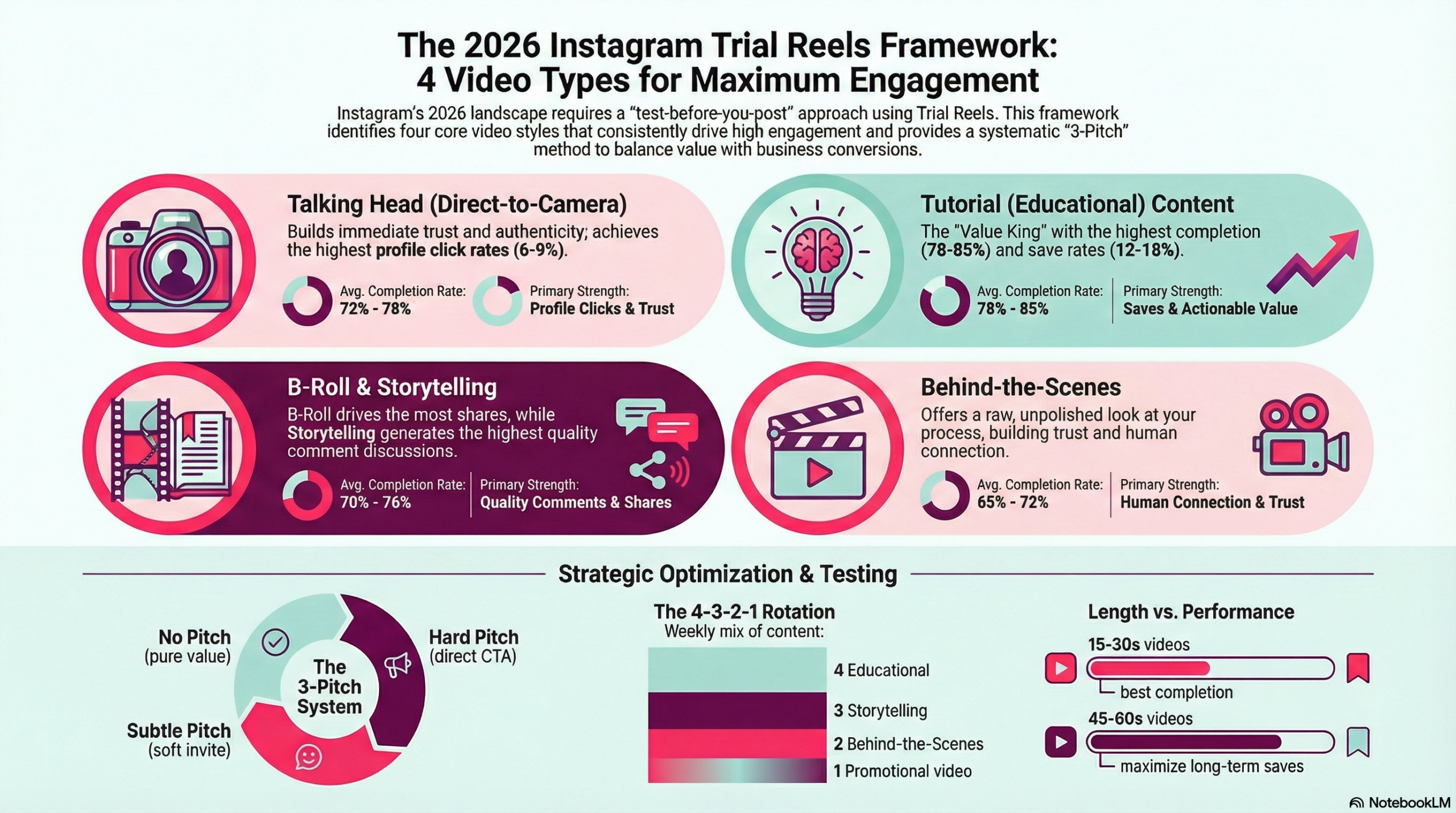
Based on analysis of high-performing Instagram accounts and extensive Trial Reels testing, four core video content types consistently deliver strong engagement and conversion results when properly executed and strategically tested.
Video Type #1: Talking Head Videos (Direct-to-Camera Content)
What They Are: Direct-to-camera videos where you speak authentically to your audience without additional visual elements, focusing on personal connection and genuine communication.
Why They Work: Talking head videos build immediate trust and authenticity because viewers see the real person behind the brand. This format performs exceptionally well in Trial Reels testing because it creates instant connection and allows for clear message delivery.
Trial Reels Performance Data:
- Average completion rate: 72-78% across industries
- Save rate: 8-12% for value-driven content
- Profile click rate: 6-9% (highest among all video types)
Talking Head Video Optimization for Trial Reels:
Hook Structure (First 3 Seconds): The opening of your talking head video determines whether viewers continue watching. Based on Trial Reels testing data, these hook types consistently perform best:
- Question Hooks: “Have you ever wondered why [specific problem]?”
- Problem Statement Hooks: “If you’re struggling with [specific issue]…”
- Contrarian Hooks: “Everyone tells you to [common advice], but here’s why that’s wrong…”
- Authority Hooks: “After [time period] doing [activity], here’s what I learned…”
- Story Hooks: “Last week something happened that changed how I think about [topic]…”
Content Structure (4-25 seconds):
- Value Delivery: Provide specific, actionable insight
- Personal Experience: Share relevant expertise or story
- Clear Explanation: Make complex topics understandable
- Emotional Connection: Show personality and authenticity
The 3-Pitch System for Talking Head Videos:
No Pitch Talking Head Videos: Pure value delivery with no promotional content or call-to-action. These videos build trust and establish expertise without any sales pressure.
Example Structure:
- Hook: “The biggest mistake I see businesses making with social media…”
- Content: Share specific mistake and solution
- Close: “Hope this helps!” (no CTA)
Trial Reels Performance: Highest completion rates (75-82%) but lower conversion rates. Use these to build audience relationship and trust.
Subtle Pitch Talking Head Videos: Valuable content with a gentle invitation to learn more or connect further.
Example Structure:
- Hook: “Here’s the strategy that doubled our client’s Instagram engagement…”
- Content: Share high-level strategy overview
- Close: “DM me ‘STRATEGY’ if you want the complete playbook”
Trial Reels Performance: Balanced completion (68-75%) with moderate conversion rates. Ideal for nurturing audience toward your services.
Hard Pitch Talking Head Videos: Direct promotional content that clearly presents your offer and call-to-action.
Example Structure:
- Hook: “If you’re ready to stop guessing about your Instagram strategy…”
- Content: Present specific problem and your solution
- Close: “Link in bio to book a strategy call this week”
Trial Reels Performance: Lower completion rates (55-65%) but higher conversion rates. Use when you have established audience trust.
Talking Head Video Technical Best Practices:
Lighting and Setup:
- Natural lighting facing a window or professional ring light
- Eye-level camera positioning for authentic connection
- Clean, undistracting background that reflects your brand
- High-quality audio (external microphone recommended)
Delivery Techniques:
- Speak directly to the camera as if talking to one person
- Use natural hand gestures and facial expressions
- Maintain consistent energy throughout the video
- Practice key talking points but avoid over-scripting
Video Type #2: B-Roll Videos (Lifestyle and Behind-the-Scenes)
What They Are: Visually-driven videos using lifestyle footage, behind-the-scenes content, or aesthetic visuals with text overlays or voiceovers to tell your story and deliver value.
Why They Work: B-roll videos perform excellently in Trial Reels because they combine visual appeal with strategic messaging. The aesthetic element captures attention while text overlays or voiceovers deliver value efficiently.
Trial Reels Performance Data:
- Average completion rate: 69-74% across industries
- Save rate: 6-10% depending on value delivery
- Share rate: 4-7% (highest among all video types)
B-Roll Video Categories for Instagram Trial Reels:
Behind-the-Scenes B-Roll: Show your actual work process, workspace, or daily routine to build familiarity and trust with your audience.
High-Performing Behind-the-Scenes Concepts:
- Morning routine or workspace setup
- Client work process (maintaining confidentiality)
- Content creation behind-the-scenes
- Day-in-the-life authentic moments
- Team collaboration and culture
Lifestyle B-Roll: Aesthetic footage that represents the lifestyle or aspirations connected to your brand or expertise.
Effective Lifestyle B-Roll Approaches:
- Travel content connected to business lessons
- Home office or workspace aesthetics
- Lifestyle moments that reinforce brand values
- Seasonal content that ties to business themes
- Personal interests that humanize your brand
Process Documentation B-Roll: Visual documentation of step-by-step processes, transformations, or before-and-after scenarios.
Process Documentation Ideas:
- Workspace organization or setup
- Project completion timelines
- Skill development progression
- Client transformation journeys (with permission)
- Business growth milestones
B-Roll Video Text Overlay Strategy:
Text Overlay Best Practices:
- Use high-contrast colors for readability
- Keep text on screen for 2-3 seconds minimum
- Maximum 7 words per text overlay
- Use consistent font styling throughout video
- Position text in upper or lower third of frame
Effective Text Overlay Formulas:
Problem-Solution Format:
- Slide 1: “The problem with [common approach]”
- Slide 2: “Why this happens [explanation]”
- Slide 3: “Here’s what works instead [solution]”
- Slide 4: “The result? [outcome]”
List Format:
- Slide 1: “3 things I learned from [experience]”
- Slide 2: “1. [First insight with explanation]”
- Slide 3: “2. [Second insight with explanation]”
- Slide 4: “3. [Third insight with takeaway]”
The 3-Pitch System for B-Roll Videos:
No Pitch B-Roll Videos: Focus entirely on providing value, building familiarity, or sharing insights without any promotional elements.
Example: Behind-the-Scenes No Pitch
- Visual: Morning coffee and workspace setup
- Text: “How I structure my most productive days”
- Content: Share actual daily routine insights
- Close: No call-to-action, pure value sharing
Subtle Pitch B-Roll Videos: Combine valuable content with gentle mentions of your services or expertise.
Example: Process Documentation Subtle Pitch
- Visual: Client work process (anonymized)
- Text: “The strategy framework that transformed this client’s results”
- Content: High-level process overview
- Close: “Link in bio for more client success stories”
Hard Pitch B-Roll Videos: Use aesthetic visuals to present clear promotional messages and direct calls-to-action.
Example: Lifestyle Hard Pitch
- Visual: Professional lifestyle moments
- Text: “Ready to build the business that funds this lifestyle?”
- Content: Clear connection between service and outcome
- Close: “DM ‘READY’ to start your transformation”
Video Type #3: Tutorial Videos (Educational and How-To Content)
What They Are: Step-by-step instructional videos that teach specific skills, processes, or concepts to help your audience achieve particular outcomes.
Why They Excel in Trial Reels: Educational content consistently shows the highest performance metrics in Trial Reels testing because it provides immediate, actionable value that audiences save for future reference.
Trial Reels Performance Data:
- Average completion rate: 78-85% (highest among all types)
- Save rate: 12-18% (significantly above average)
- Profile click rate: 6-9%
- Comment engagement: High-quality questions and implementation feedback
Tutorial Video Categories for Instagram Trial Reels:
Quick Tip Tutorials (15-30 seconds): Concise, actionable advice that viewers can implement immediately.
High-Performing Quick Tip Concepts:
- “The 30-second fix for [common problem]”
- “One simple change that [specific benefit]”
- “The fastest way to [achieve outcome]”
- “What I wish I knew about [topic] before [situation]”
Process Breakdown Tutorials (30-60 seconds): Step-by-step walkthroughs of specific processes or methodologies.
Effective Process Tutorial Structures:
- “My 3-step system for [achieving result]”
- “How to [accomplish task] in [time frame]”
- “The exact process I use to [specific outcome]”
- “Step-by-step: [complex process] simplified”
Tool or Software Tutorials (20-45 seconds): Demonstrations of how to use specific tools, apps, or software for better results.
Tool Tutorial Approaches:
- “How I use [tool] to [achieve result]”
- “[Tool] features most people miss”
- “The [tool] workflow that saves me [time/money]”
- “[Tool] vs [alternative]: which is better?”
Tutorial Video Script Structure for Trial Reels:
Opening Hook (2-3 seconds):
- “Here’s exactly how to [achieve specific outcome]”
- “The [tool/method] technique that [specific benefit]”
- “Stop [doing wrong thing], do this instead”
Value Delivery (15-50 seconds):
- Step 1: [Specific action with brief explanation]
- Step 2: [Next action with key insight]
- Step 3: [Final step with expected outcome]
Reinforcement Close (2-5 seconds):
- “Try this and let me know how it works!”
- “Save this for when you need to [situation]”
- “Which step do you find most challenging?”
The 3-Pitch System for Tutorial Videos:
No Pitch Tutorial Videos: Complete, actionable tutorials with no promotional content. These build maximum trust and authority.
Example: Complete Process No Pitch
- Hook: “How to audit your Instagram performance in 5 minutes”
- Content: Complete step-by-step process with specific tools
- Close: “Hope this helps improve your strategy!”
Trial Reels Performance: Highest save rates and completion rates. Use to establish expertise and build audience trust.
Subtle Pitch Tutorial Videos: Provide partial solution with invitation to get complete methodology or additional resources.
Example: Partial Process Subtle Pitch
- Hook: “The Instagram audit process that transformed our clients’ results”
- Content: Share 2-3 key steps of a larger process
- Close: “DM ‘AUDIT’ for the complete 12-step checklist”
Trial Reels Performance: Strong engagement with moderate conversion rates. Ideal for lead generation and audience building.
Hard Pitch Tutorial Videos: Teach the concept or importance, then direct to your service or product for implementation.
Example: Concept-to-Sale Hard Pitch
- Hook: “Why most Instagram audits miss the crucial element”
- Content: Explain what most people miss and why it matters
- Close: “Ready for a complete audit? Link in bio to book your strategy session”
Trial Reels Performance: Lower completion rates but higher conversion rates. Use when audience understands your expertise.
Video Type #4: Storytelling Videos (Emotional and Relatable)
What They Are: Narrative-driven videos that use personal experiences, client stories, or relatable scenarios to create emotional connection and illustrate important points or lessons.
Why They Work in Trial Reels: Storytelling videos generate high engagement because they create emotional investment. Viewers want to know how stories conclude, leading to strong completion rates and meaningful comments.
Trial Reels Performance Data:
- Average completion rate: 70-76%
- Comment engagement: Highest quality responses and discussions
- Share rate: 5-8% when stories are universally relatable
- Emotional connection: Strongest brand affinity building
Storytelling Video Categories for Instagram Trial Reels:
Personal Experience Stories: Share your own experiences, failures, successes, or learning moments that provide value to your audience.
High-Impact Personal Story Themes:
- Failure or mistake that taught important lesson
- Breakthrough moment that changed your approach
- Behind-the-scenes struggle that humanizes your journey
- Unexpected discovery that benefited your business
- Client interaction that shifted your perspective
Client Success Stories (with permission): Document client transformations, challenges overcome, or results achieved through your work or advice.
Client Story Structures:
- “When [client] came to us, they were [situation]”
- “Here’s the exact strategy we implemented…”
- “The results after [timeframe] were [specific outcomes]”
- “What this taught us about [broader lesson]”
Relatable Scenario Stories: Create fictional but realistic scenarios that your audience commonly experiences.
Relatable Scenario Approaches:
- “We’ve all been in this situation…”
- “Picture this: it’s Monday morning and…”
- “Every [your audience] has experienced this…”
- “The conversation every [profession] dreads…”
Storytelling Video Script Structure:
Story Hook (3-5 seconds):
- “Last month, something happened that completely changed how I…”
- “I’ll never forget the day a client said this to me…”
- “This might sound crazy, but hear me out…”
- “Two years ago, I made a mistake that taught me…”
Story Development (20-45 seconds):
- Set the scene with specific details
- Introduce the conflict, challenge, or turning point
- Build emotional investment through relatable elements
- Include dialogue or specific actions when relevant
Lesson and Application (5-10 seconds):
- Extract the universal lesson from your specific story
- Connect the lesson to your audience’s situation
- Provide actionable takeaway or perspective shift
- Close with invitation for audience to share their experiences
The 3-Pitch System for Storytelling Videos:
No Pitch Storytelling Videos: Share complete stories with valuable lessons but no promotional content.
Example: Personal Experience No Pitch
- Story: Failure that led to important business insight
- Lesson: What this taught about customer communication
- Close: “Have you experienced something similar?”
Trial Reels Performance: High emotional engagement and discussion generation. Builds strong audience connection.
Subtle Pitch Storytelling Videos: Let your services naturally emerge from the story’s context or lesson.
Example: Client Success Subtle Pitch
- Story: How client overcame specific challenge
- Lesson: The strategy or approach that made the difference
- Close: “If you’re facing similar challenges, I’d love to help”
Trial Reels Performance: Strong relatability with gentle conversion opportunity. Effective for service-based businesses.
Hard Pitch Storytelling Videos: Use compelling stories to directly illustrate the value of your services or products.
Example: Transformation Hard Pitch
- Story: Dramatic client or personal transformation
- Lesson: The specific methodology or service that created results
- Close: “Ready for your transformation? Link in bio to get started”
Trial Reels Performance: High emotional impact with clear conversion path. Use when story directly connects to your offer.
Advanced Instagram Video Content Strategy
Strategic Video Type Rotation for Maximum Engagement
The 4-3-2-1 Content Rotation System:
Based on Trial Reels performance data, this rotation system optimizes for both audience engagement and business results:
Week 1:
- 4 Educational videos (high value, authority building)
- 3 Personal/storytelling videos (connection building)
- 2 Behind-the-scenes videos (familiarity)
- 1 Direct promotional video (conversion)
Why This Rotation Works:
- Educational content establishes expertise and generates saves
- Personal content builds emotional connection and trust
- Behind-the-scenes content humanizes your brand
- Strategic promotion capitalizes on trust and authority built through other content
Video Length Optimization for Trial Reels
Performance by Video Length:
15-30 Second Videos:
- Best completion rates (75-82%)
- Moderate save rates (8-12%)
- Ideal for quick tips, simple tutorials, direct messages
- Highest performance in Trial Reels testing
30-45 Second Videos:
- Balanced performance (68-75% completion)
- Higher save rates (10-15%)
- Best for process demonstrations, story-driven content
- Strong overall performance across metrics
45-60 Second Videos:
- Lower completion rates (58-65%)
- Highest save rates (15-20%)
- Best for comprehensive tutorials, detailed stories
- Use selectively for high-value content
Key Insight: For Trial Reels testing, 15-30 second videos provide the best balance of completion rate and engagement, making them ideal for testing new concepts and approaches.
Seasonal Video Content Strategy
January-March (Planning and Goal Setting):
- Educational content about planning and strategy
- Personal transformation or goal-setting stories
- Behind-the-scenes content showing preparation
- Tutorial content for skill development
April-June (Implementation and Growth):
- Process-focused educational content
- Progress update storytelling
- Behind-the-scenes work and implementation
- Tutorial content for optimization
July-September (Results and Reflection):
- Results-focused storytelling
- Behind-the-scenes success celebrations
- Educational content about lessons learned
- Tutorial content for scaling
October-December (Planning and Preparation):
- Year-end reflection storytelling
- Planning-focused educational content
- Behind-the-scenes preparation for next year
- Tutorial content for strategic planning
Instagram Video Content Technical Optimization
Video Quality Standards for Trial Reels
Technical Requirements:
- Minimum 1080p resolution (1920×1080)
- 9:16 aspect ratio for optimal mobile viewing
- Clear, high-quality audio (external microphone recommended)
- Consistent lighting throughout video
- Stable footage (tripod or gimbal recommended)
Editing Best Practices:
- Quick cuts every 3-5 seconds to maintain attention
- Text overlay timing: minimum 2 seconds on screen
- Captions for accessibility and silent viewing
- Consistent color grading and visual style
- Engaging opening frame to stop scrolling
Hashtag Strategy for Video Content
Hashtag Mix for Video Posts (Maximum 5):
Since Instagram now limits hashtags to 5 per post, strategic selection is crucial:
- 2 niche-specific hashtags (#instagramstrategy, #contentmarketing)
- 2 broader category hashtags (#digitalmarketing, #videomarketing)
- 1 community or branded hashtag (#smallbusiness or your branded hashtag)
Video-Specific Hashtag Options:
- #reels, #instagramreels, #videomarketing
- #tutorial, #howto (for educational content)
- #behindthescenes, #bts (for B-roll content)
- #storytime, #businesstips (for storytelling content)
Strategic Hashtag Selection: With only 5 hashtags available, focus on:
- High relevance to your specific content
- Mix of competition levels (2-3 moderate competition, 1-2 lower competition)
- Audience alignment with hashtags your ideal followers actually search
- Content type specificity rather than generic tags
Example 5-Hashtag Sets:
For Educational Content: #instagramstrategy #contentmarketing #digitalmarketing #tutorial #smallbusiness
For Behind-the-Scenes Content: #behindthescenes #entrepreneur #contentcreator #businessowner #videomarketing
For Storytelling Content: #storytime #businesstips #entrepreneur #lessons #growth
Caption Strategy for Video Content
Caption Structure for Video Posts:
Hook Line (First Sentence): Grab attention and encourage viewing the video. Use curiosity, questions, or bold statements.
Video Context (2-3 sentences): Provide additional context, backstory, or deeper explanation of the video content.
Call-to-Action: Clear next step for engagement – ask questions, encourage saves, request comments.
Hashtags: Include max of 5 strategic hashtags at the end of the caption.
Performance Metrics and Optimization
Key Video Content Metrics to Track
Primary Metrics (Most Important):
- Completion Rate: Percentage of viewers who watch entire video
- Save Rate: Percentage who save video for later reference
- Share Rate: Percentage who share video with others
- Comment Quality: Meaningful engagement vs. superficial reactions
Secondary Metrics: 5. Profile Clicks: Viewers interested in learning more about you 6. Reach Rate: How far beyond your followers the content spreads 7. Replay Rate: Viewers who watch video multiple times
Video Content A/B Testing Strategy
Testing Variables for Video Content:
Hook Testing:
- Question hooks vs. statement hooks
- Personal vs. universal hooks
- Problem-focused vs. solution-focused hooks
- Direct vs. story-based hooks
Length Testing:
- 15-second vs. 30-second versions of same content
- Single concept vs. multiple concept videos
- Quick tip vs. detailed explanation approaches
Visual Style Testing:
- Face-to-camera vs. text overlay
- Static vs. dynamic visual elements
- Professional vs. casual presentation style
- Minimalist vs. detailed backgrounds
Content Angle Testing:
- Beginner vs. advanced positioning
- Individual vs. business-focused advice
- Tactical vs. strategic perspectives
- Problem vs. opportunity framing
Industry-Specific Video Content Strategies
B2B Professional Services
Highest-Performing Video Types:
- Educational tutorials (85% avg completion rate)
- Behind-the-scenes process videos (78% completion rate)
- Client success storytelling (72% completion rate)
- Direct expertise talking heads (74% completion rate)
Content Themes That Work:
- Industry insights and trend analysis
- Process optimization tutorials
- Client transformation stories
- Professional development advice
- Tool and software demonstrations
E-commerce and Product-Based Businesses
Highest-Performing Video Types:
- Product demonstration tutorials (82% avg completion rate)
- Behind-the-scenes creation/packaging (76% completion rate)
- Customer success storytelling (71% completion rate)
- Direct product presentation talking heads (68% completion rate)
Content Themes That Work:
- Product usage tutorials and tips
- Behind-the-scenes creation or sourcing
- Customer transformation stories
- Seasonal product showcases
- Comparison and review content
Personal Brands and Coaches
Highest-Performing Video Types:
- Personal experience storytelling (79% avg completion rate)
- Educational transformation tutorials (81% completion rate)
- Behind-the-scenes lifestyle content (73% completion rate)
- Direct motivational talking heads (71% completion rate)
Content Themes That Work:
- Personal transformation journeys
- Client breakthrough stories
- Daily routine and lifestyle content
- Mindset and motivation advice
- Skill development tutorials
Building Your Instagram Video Content System
30-Day Video Content Implementation Plan
Week 1: Foundation and Testing
- Day 1-2: Create content calendar based on 4-type framework
- Day 3-7: Create and test 5 different video concepts using Trial Reels
- Focus: Establish baseline performance for each video type
Week 2: Optimization and Refinement
- Day 8-14: Analyze Week 1 Trial Reels data
- Create variations of best-performing concepts
- Test different hooks and lengths for top performers
- Focus: Optimize individual video elements
Week 3: Pitch Variation Testing
- Day 15-21: Test no pitch, subtle pitch, and hard pitch versions
- Analyze conversion rates and engagement quality
- Identify optimal pitch frequency for your audience
- Focus: Balance value and promotion effectively
Week 4: System Integration and Scaling
- Day 22-30: Develop sustainable creation workflow
- Create templates for each successful video type
- Plan content calendar for following month
- Focus: Build repeatable, efficient system
Video Content Creation Workflow
Pre-Production (20% of time):
- Content planning and scripting
- Location and equipment setup
- Visual element preparation
- Trial Reels testing strategy
Production (40% of time):
- Video recording with multiple takes
- Various angle and setup options
- B-roll footage capture
- Audio quality verification
Post-Production (40% of time):
- Video editing and optimization
- Text overlay and caption creation
- Hashtag research and implementation
- Trial Reels testing and analysis
Long-Term Video Content Strategy
Month 1-3: Foundation Building Establish your video content types, test extensively with Trial Reels, and identify what works for your specific audience and business goals.
Month 4-6: Optimization and Scaling Refine successful formats, create templates for efficient production, and scale successful content approaches across other platforms.
Month 7-12: Advanced Strategy Integration Integrate video content with broader marketing strategy, develop signature content series, and use video content to drive specific business outcomes.
Measuring ROI and Business Impact
Direct Business Metrics
Lead Generation Tracking:
- Profile clicks from video content
- DM inquiries generated by videos
- Email signups attributed to video CTAs
- Consultation bookings from video content
Sales and Revenue Tracking:
- Client acquisitions traced to video content
- Product sales from video demonstrations
- Service bookings from educational videos
- Long-term customer value from video-generated leads
Brand Awareness Metrics:
- Follower growth rate from video content
- Share and save rates indicating content value
- Mention increase in comments and DMs
- Cross-platform engagement and recognition
Content Performance Analysis
Monthly Video Content Review:
- Top-performing video types by engagement
- Conversion rates by video category
- Audience feedback and comment analysis
- Technical performance metrics
Quarterly Strategy Assessment:
- Overall business impact from video content
- ROI calculation for time and resources invested
- Competitive analysis and market position
- Strategy adjustments for next quarter
Advanced Strategies and Future Considerations
Cross-Platform Video Content Strategy
Repurposing Video Content:
- Adapt Instagram videos for LinkedIn, TikTok, YouTube Shorts
- Create longer-form versions for YouTube or podcast content
- Extract key quotes and insights for Twitter/X content
- Develop email newsletter content from video themes
Platform-Specific Optimization:
- Adjust video length and format for each platform
- Modify captions and hashtags for platform culture
- Test different posting times and frequencies
- Analyze cross-platform performance correlations
Emerging Video Content Trends
2026 Video Content Predictions:
- Increased importance of educational content over entertainment
- Growing demand for behind-the-scenes authenticity
- Rising value of data-driven content optimization
- Greater emphasis on accessibility and inclusivity
Technology Integration:
- AI-assisted video editing and optimization tools
- Advanced analytics for content performance prediction
- Automated A/B testing for video elements
- Enhanced accessibility features and capabilities
Conclusion: Building Your Video Content Success Framework
Instagram video content success isn’t about creating more content, it’s about creating the right content systematically and testing it strategically before committing your time and audience attention.
The four-type video content framework provides a strategic foundation for consistent Instagram growth:
Educational videos establish your expertise and generate the highest save rates, building long-term authority and trust with your audience.
Behind-the-scenes videos humanize your brand and create familiarity, making your audience feel connected to your journey and process.
Direct talking head videos build personal connection and trust, allowing you to communicate directly with your audience and establish authentic relationships.
Storytelling videos create emotional connection and memorability, helping your message resonate and stick with viewers long after they’ve watched your content.
By rotating through these four video types and varying your promotional approach using the no pitch, subtle pitch, and hard pitch system, you create a sustainable content strategy that builds audience trust while driving business results.
The key is systematic testing through Instagram Trial Reels. Instead of guessing what will work, you can test different video approaches, analyze performance data, and make informed decisions about what content to promote to your main audience.
Ready to implement this video content framework? Start by choosing one video type that feels most natural for your expertise and audience, create three variations with different pitch levels, and test them through Instagram Trial Reels. Use the performance data to refine your approach and gradually incorporate the other video types into your content strategy.
Want help implementing a comprehensive Instagram video content strategy? Our Instagram Trial Reels Viral Framework service helps businesses systematically test and optimize their video content for maximum engagement and conversion. Contact our team to discuss how we can help you build a data-driven video content system that consistently drives business results.
For more advanced Instagram strategies, explore our comprehensive guides: