
How to read your Google Search Console reports, the Instagram Story sequence lifting reach, and how to choose between a fractional CMO and an agency.

HomeInstagram
How to read your Google Search Console reports, the Instagram Story sequence lifting reach, and how to choose between a fractional CMO and an agency.

Can’t find Instagram Trial Reels in your app? You’re not alone, here’s exactly where to look and how to enable this game-changing feature.
You’ve heard about Instagram Trial Reels and want to start testing your content before posting, but there’s one problem: you can’t find the feature anywhere in your Instagram app. Don’t worry, this is incredibly common, and there are specific reasons why the option might not be showing up.
The short answer: Instagram Trial Reels appear in the “Audience” settings when creating a new reel, but only if you meet certain prerequisites and have access to the feature in your region.
This comprehensive guide will walk you through exactly how to turn on Instagram Trial Reels, with step-by-step screenshots for both iOS and Android, plus troubleshooting solutions for when the feature isn’t appearing.
Before diving into the step-by-step process, ensure you meet these requirements. Missing any one of these can prevent Trial Reels from appearing in your Instagram app.
Account Type Requirements: Instagram Trial Reels are primarily available to Business and Creator accounts. Personal accounts have extremely limited access to this feature, and even when available, functionality may be restricted.
📌 Update May 2026: Instagram Trial Reels require a minimum of 1,000 followers to access. If the Trial option is not showing in your Audience settings, your follower count is the first thing to check. All other steps in this guide apply once you hit that threshold.
How to check your account type:
How to switch to Business or Creator account:
Follower Count Requirement: You must have a minimum of 1,000 followers to access Instagram Trial Reels. If your account hasn’t reached this threshold yet, the Trial option will not appear in your Audience settings regardless of your account type or app version.
App Version Requirements: Instagram Trial Reels require a recent version of the Instagram app. Older versions won’t display the feature even if your account qualifies.
For iPhone users:
For Android users:
How to update Instagram:
Regional Availability: Instagram rolls out new features gradually across different regions. Trial Reels are available in most major markets, including the US, Canada, UK, Australia, and much of Europe, but some regions may still be waiting for access.
According to Meta’s developer documentation, feature rollouts can take 3-6 months to reach all global markets.
Here’s exactly how to turn on Instagram Trial Reels on iPhone devices, with specific screenshots for each step.
Step 1: Open Instagram and Create New Reel
Step 2: Navigate to Posting Options
Step 3: Find Audience Settings
Step 4: Enable Trial Reels
Step 5: Critical Step – Turn Off “Also Share On”
Step 6: Complete Trial Setup
The process for Android users is nearly identical to iOS, with minor interface differences.
Step 1: Create Your Reel
Step 2: Access Sharing Screen
Step 3: Modify Audience Settings
Step 4: Activate Trial Mode
Step 5: Disable Cross-Platform Sharing
Step 6: Launch Your Trial
After following the setup steps, you need to verify that Trial Reels are actually working correctly.
What the Interface Should Look Like:
How to Check Your Active Trials:
What You Should See After 24-48 Hours:
Red Flags That Indicate Problems:
Even following the steps perfectly, some users encounter issues. Here are solutions to the most common problems.
Issue #1: “Trial” Option Not Appearing in Audience Settings This is the most common problem. Causes include:
Solution:
Issue #2: Trial Reels Posting to Main Feed If your trial content appears in your regular feed, you didn’t properly disable sharing options.
Solution:
Issue #3: No Performance Data After Trial Period Sometimes trials complete but don’t show metrics.
Solution:
Issue #4: App Crashes When Enabling Trial Mode Occasional technical glitches can cause app crashes.
Solution:
Issue #5: Feature Works Once Then Disappears Some users can access Trial Reels initially but then lose access.
Solution: This often indicates you’re part of Instagram’s A/B testing for the feature. Unfortunately, access may be temporary. You can:
Once you successfully enable Trial Reels, these strategies help maximize your testing effectiveness.
Start with Proven Content Types: Don’t use your first trial to test completely new content formats. Instead, create variations of content that already performs well for you. This helps you understand the feature without the variable of untested content topics.
Keep Initial Trials Short: Your first few trials should be 4-7 seconds maximum. Shorter content generates testing data faster and helps you understand the feature’s feedback loop.
Test During Peak Hours: Post your trials when your audience is most active. This ensures the test audience represents your actual followers’ engagement patterns and provides more accurate performance data.
Create Multiple Variations: Instead of testing one piece of content, create 2-3 slight variations of the same concept. Test different hooks, visual styles, or text overlays to see what resonates most with your audience.
Document Your Results: Keep track of what you test and the results. Create a simple spreadsheet noting:
Don’t Overthink the First Trial: Many users spend too much time perfecting their first trial. The goal is to learn the system, not create perfect content. Use simple, straightforward content to understand how the feature works.
Educational Content Variations: Create the same tip or lesson with three different approaches:
Behind-the-Scenes Content: Test different styles of showing your work process:
Hook Testing: Take one piece of valuable content and test different opening hooks:
Visual Style Testing: Use the same content with different presentation styles:
Once you’re comfortable with basic Trial Reels, these advanced techniques improve your testing strategy.
Timing Strategy: Post trials 2-3 hours before your optimal posting time. This allows you to review results and post winning content during peak engagement hours.
Content Calendar Integration: Build trial testing into your regular content calendar:
Audience Segmentation Testing: While you can’t control who sees trials, you can create content designed to appeal to different segments of your audience, then see which performs best:
Metrics Tracking System: Create a more sophisticated tracking system:
Content Repurposing from Trials: Winning trials become valuable assets for repurposing:
Algorithm Training: By only posting proven content to your main feed, you train Instagram’s algorithm to associate your account with high-engagement content. This can improve the performance of all your content over time.
Risk Reduction: Trial Reels eliminate the risk of posting content that could hurt your account’s algorithm performance. Poor-performing trials don’t affect your account’s standing, while poor-performing public posts can reduce future reach.
Data-Driven Content Strategy: Use trial data to inform your broader content strategy:
Week 1: Learning Phase
Week 2: Optimization Phase
Week 3: Integration Phase
Week 4: Scaling Phase
Instagram Trial Reels are a powerful tool for eliminating guesswork from your content strategy, but only if you can actually access and properly use the feature. By following this step-by-step guide, you should be able to successfully enable Trial Reels and begin testing your content systematically.
Remember, the goal isn’t to create perfect content immediately—it’s to learn what resonates with your audience through real data rather than assumptions.
Want professional help with your Instagram strategy? Contact our team to discuss how we can help you implement systematic content testing and data-driven growth strategies for your business.
Do you need 1,000 followers to use Instagram Trial Reels? Yes. Instagram requires a minimum of 1,000 followers to access the Trial Reels feature. Even if you have a Business or Creator account with the latest app version, the Trial option will not appear in your Audience settings until your account reaches this threshold.
Why can’t I find the Trial option in my Audience settings? The most common reasons are: your account is under 1,000 followers, you’re using a personal account instead of a Business or Creator account, your app version is outdated, or Trial Reels haven’t rolled out to your region yet. Work through each prerequisite in order before assuming the feature isn’t available to you.
Do Trial Reels show up on your profile or main feed? No. Trial Reels are shown to non-followers only and do not appear on your main profile grid or in your followers’ feeds. This is the entire point of the feature — you can test content without it affecting your existing audience or account performance.
How long does an Instagram Trial Reel run? Trial Reels run for up to 30 days. The first 72 hours are the most important. Within that window, Instagram shows your content to non-followers and provides performance data. You can choose to promote a trial to your main feed at any point, or simply let it expire.
Can you run multiple Trial Reels at the same time? Yes. Instagram allows you to run multiple trials simultaneously, which makes it possible to test different content types, hooks, or formats at the same time and compare results directly.
What metrics can you see from a Trial Reel? You can view reach, views, likes, comments, saves, and shares from your trial period. These metrics help you determine whether content is worth posting to your main feed before it ever touches your regular audience.
Will a Trial Reel hurt your account if it performs poorly? No. Poor performance during a trial does not negatively impact your account’s algorithm standing. That’s the primary advantage of using trials — only content that has already proven itself gets posted to your main feed.
Can personal accounts use Instagram Trial Reels? Personal accounts have extremely limited access to Trial Reels, and functionality is restricted even when available. To fully use the feature, switch to a Business or Creator account through your account settings.
What should you do if your Trial Reel accidentally posted to your main feed? Delete it immediately. This happens when the “Also share on” toggles are left on before posting. Recreate the reel, turn off all cross-platform sharing options, and confirm your Audience setting shows “Trial” before tapping Share.
How do you know when a Trial Reel is ready to post to your main feed? Instagram will notify you when your trial has enough data to evaluate. As a general benchmark, strong completion rates, save rates above 5%, and profile visits are positive signals that the content is worth sharing with your full audience.
What are trial reels and how do they work. Discover the hidden key to success on isntagram

Social media is shifting in a way most business owners haven’t noticed yet.
And 2026 is going to separate those who adapt from those who disappear.
Here’s what’s changing: people aren’t just scrolling anymore. They’re searching.
TikTok, Instagram, and YouTube have become search engines. When someone needs a service provider, wants to learn a skill, or has a problem to solve, they’re not opening Google first.
They’re typing it into TikTok, Instagram Search, or YouTube.
This changes everything about your social media strategy.
Platforms are now using your captions, keywords, hashtags, and on-screen text to decide if your content shows up in searches or gets buried.
This is the biggest shift in social media since Reels launched.
Add to that: AI is crawling social content the same way it’s always crawled blogs and websites. Your posts aren’t just reaching your followers anymore.
They’re creating a digital footprint that tells AI:
Your social media strategy in 2026 can’t just focus on engagement. It needs to focus on discoverability.
The shift didn’t happen overnight. Here’s what led to it:
Younger audiences never developed the habit of “Googling everything.” They grew up with:
Studies show that 40% of Gen Z uses TikTok or Instagram as their primary search engine instead of Google. Google’s internal research confirms this shift, with their own senior executives acknowledging that young people increasingly bypass Google Maps and Search in favor of TikTok and Instagram for discovery.
Research by Adobe reveals that 64% of Gen Z specifically uses TikTok for search, with nearly 10% preferring it over Google entirely – making TikTok optimization critical for reaching younger audiences.
Reading through text-heavy blog posts feels outdated when you can:
Social platforms deliver answers faster and more authentically.
Instagram, TikTok, and YouTube didn’t just allow search. They built entire systems around it:
These platforms now function like Google for specific types of queries.
Your content isn’t just competing for attention in the feed anymore.
It’s competing for visibility in search results.
That requires a completely different approach to how you create, caption, and structure your content.
The businesses winning in 2026 won’t be posting more. They’ll be posting smarter
Instagram is no longer just a photo-sharing app. It’s a full-scale search engine with over 2 billion users actively searching for content.
Here’s how to optimize your Instagram strategy:
Your Instagram captions need to include:
Example: ❌ “Feeling inspired today ✨” ✅ “3 marketing strategies for small business owners who want to scale without paid ads”
The second caption is searchable. Instagram’s algorithm knows exactly what your post is about and who needs to see it.
Stop using random trending hashtags. Start using keyword-focused hashtags that align with search intent.
Ask yourself: “What would someone type into Instagram Search if they needed my solution?”
Then use those phrases as hashtags:
Instagram now treats hashtags like search filters. Use them strategically. Only 5 atm this is a new adjustment by instagram.
Instagram’s OCR (optical character recognition) technology reads the text you put on your Reels.
That means your on-screen text should include:
This text isn’t just for viewers. It’s for Instagram’s algorithm to understand and categorize your content.
Yes, you should be writing alt text for your Instagram images. It helps with:
Describe your image with relevant keywords, but make it natural and helpful.
Instagram is no longer just a photo-sharing app. It’s a full-scale search engine with over 2 billion users actively searching for content. Instagram optimization experts confirm that the platform now functions like Google for specific queries, with users typing exact search terms like “best fine dining Dubai” or “marketing tips” directly into Instagram’s search bar.
Lorem ipsum dolor sit amet,
TikTok isn’t just for viral dances anymore. It’s where millions of people search for:
40% of young people now use TikTok as their primary search engine.
Just like Instagram, your TikTok captions need to include searchable keywords.
Think about what someone would type into TikTok search:
Use those exact phrases in your captions.
TikTok’s algorithm recognizes spoken words. When you say keywords out loud in your video, TikTok understands the content topic better.
Example: If your video is about email marketing, actually say “email marketing strategy” in the video.
Start your videos by directly addressing what someone searched for:
This signals to TikTok that your video answers a specific search query.
How-to content dominates TikTok search results. Structure your videos to answer specific questions:
These formats perform well in both the feed AND search results.
Your video title should include the exact phrase someone would search for.
Examples:
Write 200-300 word descriptions that include:
YouTube loves structured content. Add chapters to your videos so viewers can jump to specific sections. This also helps YouTube understand your content better.
If you have webinars, trainings, podcasts, or presentations sitting in Google Drive, upload them to YouTube.
That content has value beyond the moment you created it. Make it discoverable.
Here’s where most people are getting social media strategy wrong in 2026:
They’re hiding behind AI-generated content.
AI can be your co-pilot, not your main character.
The brands winning in 2026 aren’t posting perfectly polished AI-generated content. They’re showing up:
People can smell AI content from a mile away.
And while AI can help you:
It should never replace:
✅ Use AI to:
❌ Don’t use AI to:
Your audience follows you for YOU. Don’t let AI dilute that.
If you have long-form content sitting in your Google Drive, on old hard drives, or in forgotten folders, get it live on YouTube.
Why this matters:
Action steps:
Instagram isn’t just for pretty posts anymore. It’s for searchable, valuable, keyword-rich content that shows up when your ideal client is actively looking for answers.
What matters now:
If your Instagram content isn’t structured to be found, you’re missing the entire shift.
Action steps:
You cannot create fresh content for every platform every day and maintain your sanity.
Repurposing isn’t lazy. It’s strategic.
One piece of content should live in multiple formats:
Example 1: Blog post → Carousel → Reel → Email → Thread → Quote graphic
Example 2: Podcast episode → YouTube video → Shorts → Newsletter → Social captions
Example 3: Webinar → Blog series → Lead magnet → Email sequence
Same core message. Different formats. Maximum reach without burnout.
Search industry analysis shows that over half of business owners now use TikTok to promote their companies, recognizing its evolution into a legitimate search platform.
The businesses thriving in 2026 won’t be the ones posting more.
They’ll be the ones showing up smarter with:
✅ Searchable content optimized for platform algorithms
✅ Repurposed assets that work across multiple channels
✅ Human, authentic content that stands out from AI-generated noise
✅ Strategic keywords in captions, titles, and on-screen text
✅ Problem-solving content that answers real search queries
Your social media strategy needs to evolve from “post and hope” to “create and be found.”
Social media isn’t just about the feed anymore. It’s about search.
If your content isn’t optimized to be discovered, you’re invisible.
The platforms have changed. Your strategy needs to change with them.
Stop creating content just to scroll past.
Start creating content designed to be found.
This is exactly what we map out in my Marketing Flywheel Strategy Call.
We’ll build:
✅ Your searchable content strategy
✅ Your platform optimization plan
✅ Your repurposing system
✅ Your keyword and hashtag strategy
✅ Your 90-day action plan
Book Your Marketing Flywheel Intro Call →
Stop posting into the void. Start showing up where your ideal clients are searching.
More information on my marketing strategy here.

You spend hours creating one great piece of content. You post it. Maybe a few people see it. Then you move on to create something new from scratch.
That’s exhausting. And it’s inefficient.
Smart content creators don’t just post once and move on. They repurpose strategically. One strong piece of content can become 15+ assets across multiple platforms, reaching different audiences in different ways, without starting from zero every time.
Here’s exactly how to repurpose content effectively without burning out.
Most businesses and creators are stuck on the content hamster wheel:
This approach leads to:
There’s a better way.
Instead of creating new content every day, create one strong pillar piece and repurpose it into 15+ smaller assets.
Here’s the mindset shift:
This is how you scale content production without scaling effort.
Your pillar content is the foundation. This is substantial, high-value content that you can break down into smaller pieces.
Examples of pillar content:
This is the asset you’ll repurpose into everything else.
Let’s say you write a 1,500-word blog post or LinkedIn article. Here’s how to turn that into 15+ pieces of content:
Creating 15+ assets from one piece of content sounds overwhelming. It’s not—if you have a system.
Write the blog post. Record the video. Publish the LinkedIn article. This is your foundation. Invest time here to make it strong.
Don’t try to repurpose over multiple days. Set aside 1-2 hours immediately after creating your pillar content and knock out all the repurposing at once.
What to create in your batching session:
Batching saves mental energy and prevents this from dragging on for days.
Speed up the process by creating Canva templates for:
Once you have templates, you’re just plugging in new text and images instead of designing from scratch every time.
Use a scheduler like Later, Metricool, Buffer, or Hootsuite to spread your repurposed content over 2-4 weeks.
You’re not dumping everything at once. You’re strategically distributing it so your audience sees different formats at different times.
Store all your repurposed assets in Google Drive, Dropbox, or Notion organized by topic or date.
When you need content later—or when you want to remix something that performed well—you have a library to pull from instead of starting over.
They think repurposing means copying and pasting the exact same thing everywhere.
That’s not repurposing. That’s lazy distribution.
Real content repurposing means adapting the core idea for different platforms and formats.
The message stays the same. The execution changes based on where it’s being posted and who’s seeing it.
Example:
Same core idea. Different formats. Different audiences. All driving back to the same message.
Content repurposing isn’t just about efficiency. It’s a growth strategy.
One pillar piece becomes weeks of content. You’re not stuck on the content creation hamster wheel, constantly scrambling for new ideas.
Repetition builds authority. When people see your ideas across multiple platforms and formats, your message sticks.
You’re not starting from scratch every day. You’re maximizing the value of what you’ve already created.
Some people prefer video. Some prefer reading. Some prefer quick social posts. Content repurposing ensures you reach all of them without creating entirely new content for each preference.
Over time, you accumulate a massive library of proven content you can remix, update, and reuse whenever you need it.
Ready to implement this content repurposing strategy? Here’s your action plan:
This week:
This month:
This quarter:
Stop creating content once and moving on. Start repurposing strategically.
One strong piece of content can fuel your entire content strategy for a month. You don’t need to create more. You need to repurpose smarter.
Work smarter, not harder. That’s how you scale content without burnout.
Ready to take your content strategy to the next level? Check out our other resources on using trial reels effectively and building credibility with LinkedIn articles.
Need help building a sustainable content repurposing system for your business? Learn how we can help you create a strategy that drives results without the overwhelm.

📌 See the entire Instagram Trial Reels Resource Library
📌 Quick Definition:
Instagram Trial Reels are a testing feature that shows your Reel to non-followers first for 24 hours. Based on engagement metrics, Instagram decides whether to push your Reel to a wider audience or limit its reach.
Already know how Trial Reels work? Check out our [complete step-by-step video guide →]
At Leslie M Lyon for our own content and for our customers we consistently have viral content.
This is not a one time thing. Leslie M Lyon has consistently generated viral frameworks for our brand and our clients.
Posting content on Instagram and hoping it performs is a gamble. What if you could test your content before it goes live and only post what you know will work?
That’s exactly what Instagram trial reels let you do. And it’s the strategy I used to hit 1 million views with 89% of those views coming from people who don’t follow me. All in 7 days.
This isn’t about luck or going viral by accident. This is a systematic approach to content testing that removes guesswork and maximizes reach.
Here’s the exact process.
If you are needing support on why trends are important in 2026 check that out here.
Trial reels are Instagram’s built-in A/B testing feature. When you post a reel, you can toggle on “trial reels” before publishing. Instagram will show your reel to a small test audience first and give you performance data before it goes live to your full audience.
This is Instagram literally giving you free content testing. Most creators don’t use it. That’s their mistake. For more information, check out Instagram’s official Creator Center.
Here’s what most people do: Create one reel, post it, hope it works, feel disappointed when it doesn’t, repeat.
Here’s what I do: Create three variations of the same reel concept, test them all using trial reels, then post only the winner.
I create three different versions of the same core concept every single day. The topic stays the same, but the execution changes.
What I change between variations:
This works for both b-roll reels and talking head videos. The message is consistent. The presentation has three different angles.
Example: If my reel topic is “3 mistakes new real estate investors make,” I create:
Each version tests a different hypothesis about what will grab attention and hold viewers.
Every night, I post all three variations of each reel topic to trial reels. If I’m creating content around three different topics per day, that’s 9 total videos being tested (3 topics x 3 variations each).
How to use trial reels:
Instagram will show your trial reel to a smaller test audience and track performance metrics. You’ll get data on views, completion rate, engagement, and more.
This is how you let your audience tell you what works instead of guessing.
The next morning, I review which version of each reel performed best. I’m looking at:
Out of each set of three variations, one always performs better than the others. That’s the version I post to my main feed.
Once I know which reel won the test, I go back into my drafts and post that winning version to my main Instagram feed.
At this stage, I also cross-post to Facebook. (I’m currently testing whether cross-posting helps or hurts individual post performance, and I’ll update on those findings.)
The key here is that I’m not posting blind. I’m posting content that already proved it resonates with an audience.
This is the step most people skip, and it’s critical for long-term content success.
Every winning reel gets added to my video repurposing folder in Google Drive. This creates a library of proven, high-performing content that I can remix, repurpose, or recreate later.
If you have a team member managing content, this is invaluable. They’re not guessing what to create. They’re working from a folder of content that already delivered results.
What to save:
This becomes your content gold mine.
I did this every single day for 7 days straight:
No overthinking. No perfectionism. Just testing, data, and execution.
During that 7-day period, three of my reels went viral. When I saw one taking off, I didn’t just celebrate and move on.
I remixed it. I created new variations with slight tweaks and posted them again.
If something works, milk it:
One viral reel can become five more high-performing pieces of content if you’re strategic about it.
By following this trial reels strategy for 7 days straight, here’s what happened:
1 million total views across all posted reels 89% of those views came from non-followers
That second stat is the most important one. The Instagram algorithm pushed my content to new audiences because I gave it content that was already proven to perform well.
I wasn’t hoping for reach. I was engineering it.
Trial reels eliminate guesswork. You’re not crossing your fingers and hoping your content resonates. You’re testing it with real data before committing to a full post.
Here’s why this approach is so effective:
Ready to implement this Instagram trial reels strategy? Here’s your action plan:
Week 1:
Week 2:
Week 3 and beyond:
If you’re not using Instagram trial reels, you’re guessing what will work. If you’re guessing, you’re losing opportunities for reach and growth.
Start testing. Post the winners. Build your repurposing library. Repeat.
This is how you scale reach without scaling effort. This is how you go from hoping your content works to knowing it will.
Repurposing your content with SEO optimization built in is one of the best ways to keep your content by being indexed from all platforms like Pinterest, Youtube, and Tiktok.
What makes a Trial Reel perform well?
High-performing Trial Reels typically have three things in common: a strong hook in the first 1-2 seconds that stops scrolling, content that delivers on the hook’s promise, and a format that encourages saves or shares (tutorials, tips, relatable humor). Instagram’s algorithm during the trial period heavily weights watch time and save rate.
How do I know if my Trial Reel is performing well?
Check your Insights 3-6 hours after posting. Look for: 60%+ average watch time, 3-5%+ save rate, 5-10%+ share rate, and 70%+ non-follower reach. If you’re hitting these benchmarks during the trial period, your Reel is likely to get pushed to a larger audience after 24 hours.
Should I post Trial Reels at specific times?
Post Trial Reels during your audience’s most active hours for maximum initial engagement during the test period. However, since Trial Reels prioritize non-followers, your usual “best posting time” may matter less. Test different posting times and track which ones yield the strongest 24-hour trial performance.
Can I use trending audio on Trial Reels?
Yes, and you should. Trending audio increases your chances of appearing on Explore pages and in non-follower feeds. During the trial period, Instagram is testing whether your content resonates with broader audiences—trending audio helps you reach those audiences more effectively.
What types of content work best for Trial Reels?
Educational content (tutorials, tips, how-tos), value-driven posts (list-style content, “things I wish I knew”), and highly relatable content (common pain points, humor) tend to perform best. These formats naturally encourage saves and shares, which are weighted heavily during the trial period.
How is non-follower reach calculated for Trial Reels?
Non-follower reach is the percentage of people who saw your Reel who don’t follow you. For Trial Reels, you’re aiming for 70-90%+ non-follower reach, which indicates Instagram is successfully testing your content with new audiences. You can find this metric in your Instagram Insights under the specific Reel’s analytics.
Should I respond to comments during the trial period?
Yes, absolutely. Engagement signals (including comment responses) tell Instagram your content is sparking conversation. Respond to comments quickly during the 24-hour trial period to boost engagement metrics and increase the likelihood Instagram pushes your Reel wider.
Can I edit a Trial Reel after posting?
No, you cannot edit a Reel after it’s published (whether it’s a Trial Reel or regular Reel). You can only delete it and repost with corrections. Make sure your content is polished before hitting publish on a Trial Reel.
What’s a good save rate for Trial Reels?
Aim for 3-5% or higher. A save rate means people found your content valuable enough to reference later. Instagram interprets high save rates as a strong quality signal. Content like tutorials, templates, and resource lists naturally earn higher save rates.
Why did my Trial Reel stop getting views after 24 hours?
If your Trial Reel had weak engagement during the test period (low watch time, few saves/shares), Instagram decided not to push it to a wider audience. This is the feature working as intended—it prevented a low-performer from taking up valuable distribution. Use the data to improve your next Reel.
Can I use hashtags on Trial Reels?
Yes, use 3-5 highly relevant hashtags. However, during the trial period, Instagram is primarily testing your content with non-followers through algorithmic distribution rather than hashtag discovery. Hashtags still matter, but content quality and engagement metrics matter more for Trial Reels.
How do Trial Reels affect the Instagram algorithm long-term?
Trial Reels help you identify high-quality content before committing to full distribution. By consistently posting Trial Reels that perform well, you’re training Instagram’s algorithm to recognize your content as valuable, which can improve your overall account reach over time.
Should I archive poorly performing Trial Reels?
Many creators delete or archive Trial Reels that performed poorly during the test period. Since the Reel won’t get significant reach anyway, removing it keeps your profile clean and prevents low-performing content from sitting in your grid. However, keep the analytics data for learning purposes.
Can Trial Reels go viral?
Yes. If your Trial Reel performs exceptionally well during the 24-hour test period, Instagram will push it to a massive audience, often resulting in viral reach (millions of views). The 1 million view example in this post came from a Trial Reel that showed strong early engagement signals.
What’s the ideal length for a Trial Reel?
Keep Trial Reels between 7-15 seconds when possible. Shorter Reels have higher completion rates, which boosts your average watch time percentage—a key metric Instagram tracks during the trial period. Only go longer if the content absolutely requires it.
Do I need a large following to use Trial Reels effectively?
No. Trial Reels are designed to test content with non-followers, so your existing follower count matters less. Small accounts can achieve massive reach through Trial Reels if the content resonates with new audiences. This levels the playing field for newer creators.
Can I cross-post Trial Reels to other platforms?
Yes, but wait until after the 24-hour trial period. You want Instagram’s algorithm to have accurate data about how your content performs natively on Instagram. After the trial period, feel free to repurpose high-performing Trial Reels on TikTok, YouTube Shorts, or other platforms.
How often should I use Trial Reels vs regular Reels?
Use Trial Reels for 50-70% of your content, especially when testing new formats, topics, or styles. Reserve regular Reels for time-sensitive content or posts where you want immediate distribution to your existing followers. Trial Reels are best for evergreen, high-quality content you want to maximize reach on.
What if my Trial Reel performs well but I want to delete it anyway?
If a Trial Reel performed well during testing, Instagram will likely continue pushing it to larger audiences. Deleting it means losing that momentum and reach. However, if there’s a compelling reason to remove it (error, outdated info), you can delete it at any time.
Can I see examples of successful Trial Reels from other creators?
Instagram doesn’t publicly label which Reels were tested as Trial Reels. However, you can identify likely Trial Reels by looking for posts from smaller creators that suddenly got massive reach (1M+ views with only 10K followers). These often started as Trial Reels that performed exceptionally during testing.
How do you get Instagram Trial Reels?
To get Instagram Trial Reels, make sure your app is updated to the latest version. When creating a Reel, tap “Advanced Settings” before publishing and toggle on the “Trial” option. If you don’t see it yet, your account may not have the feature – keep updating the app as Instagram is still rolling it out. Business and Creator accounts tend to get access first.
How many Trial Reels can I post a day?
Instagram doesn’t publish an official daily limit for Trial Reels. In practice, 3-9 per day is manageable and effective for testing. At Leslie M Lyon, we test 9 Trial Reels per day (3 topics x 3 variations each) as our standard content testing process. Quality over quantity – each variation should test a specific hypothesis about hooks, pacing, or format.

If you’ve been ignoring social media trends because you think they’re just for influencers and dance videos, you’re leaving serious growth on the table. Trends aren’t a gimmick. They’re one of the most powerful tools for growing your reach, attracting new customers, and beating the algorithm in 2026.
Whether you run a real estate company, a law firm, an accounting practice, or any other business, trends can work for you. Here’s exactly why social media trends matter and how they can transform your organic reach.
When you use trending audio on Instagram or TikTok, the platform pushes your content harder. Period.
Instagram and TikTok prioritize content that uses popular sounds because it keeps people on the app longer. Your video gets shown to more people simply because you’re riding that wave.
This isn’t a hack or a trick. It’s how the algorithm is designed to work. Platforms want people to engage with what’s popular, and when you participate in trends, you’re working with the algorithm instead of against it.
“But I sell insurance/real estate/accounting services. Trends don’t apply to me.”
They absolutely do. Every trend can be adapted to any business or industry.
Take the Jackass trend going viral right now. People are using that iconic theme song to call out the wild, uncomfortable, or straight-up ridiculous parts of their industry:
The trend gives you the format and the audio. You just plug in your reality. That’s what makes social media trends work for ANY business.

This is the big one. The algorithm rewards trend participation by pushing your content to people who don’t follow you yet.
That’s how you break out of only reaching the same 200 people every time you post. Social media trends are how you get discovered by new potential customers who have never heard of you before.
When you use trending audio or participate in trending formats, you’re essentially getting free distribution to people outside your existing audience. That’s the entire point of organic growth.
You don’t need to jump on a trend the second it starts. Actually, catching it on the upswing or even at its peak can work better for smaller accounts because that’s when the audio has maximum momentum.
Jump in when you see a trend 3 to 5 times on your feed, not when it’s brand new or completely dead.
Early adopters get credit for being first, but mid-cycle participants often get better reach because the trend has proven itself and the algorithm is pushing it hard.
Trends are inherently casual and human. When you participate, you’re showing up as part of the conversation, not above it.
People connect with businesses that feel like they’re in the mix, not just broadcasting perfectly curated content. Social media trends give you permission to be less perfect and more present.
This matters because today’s consumers want to buy from businesses they feel connected to. Trends help you build that connection faster than traditional branded content ever could.
Check out both Instagram and Tiktok Creators.
You can and should if your content is relatable. You might need outside eyes if you aren’t getting some viral posts. HOLLER, I’m open to reviewing your socials with you.
Even if your trend video gets 500 views instead of 50,000, you’ve likely reached 300 new people who’ve never seen your account before.
That’s 300 potential clients who now know you exist. Social media trends aren’t just about going viral. They’re about consistent discovery and steadily expanding your reach over time.
If you’re not incorporating trends into your content strategy, you’re leaving reach on the table. And in 2026, reach equals growth.
If you are curious what all we do here at LML, if it is digital we do it.
Social media trends give you:
Start with one trend this week. Adapt it to your business. Watch what happens.
Next step: Learn which platform you should focus on for maximum SEO impact in our next post: [Instagram vs TikTok: Choosing Your Hero Channel for Trends]
Resourses:
Instagram Creators: https://creators.instagram.com/
Tiktok Creators: https://www.tiktok.com/creators/
Social Media Algorithms: https://blog.hootsuite.com/social-media-algorithm/


Let’s talk about results, because trends mean nothing if they don’t translate into traction.
Recently, I hit 2.5 million views in just 7 days, and it wasn’t luck, virality magic, or selling my soul to the algorithm. It came from a very intentional mix of:
I didn’t just follow trends. I applied the right ones at the right time. I used trending formats, audios, angles, and timing that aligned with what my audience was already thinking about. Trends aren’t about copying. They’re about riding momentum with intention.
I showed up as myself. Voice, personality, opinions, and all. People are not engaging with perfect content anymore. They are engaging with real humans. That alone can multiply your reach.
I leveraged Trail Reels, which push your content out to non-followers. That means fresh eyes, new leads, and audience growth without boosting. If you aren’t using Trail Reels yet, you are missing one of the easiest organic visibility tools available right now.
Instagram is my Hero Platform. It is the place where my content hits hardest and where I show up the strongest. Instead of trying to be everywhere, I mastered one platform. Then I expanded.
I took the winning content and repurposed it across all my channels:
TikTok
Pinterest
Facebook
Email
YouTube Shorts
LinkedIn
One piece of content became multiple touchpoints and massive visibility.
You do not need virality.
You need clarity, consistency, and a strategy aligned with the platforms that carry the most weight for you.
Apply these steps and you will increase visibility without burning yourself out or posting 14 times a day.
One of the reasons my strategy works so well, for me and for my clients, is that I’m not teaching theory. I have built, launched, and scaled five businesses in the last eight years.
Here is what that means:
Most marketing advice comes from people who have never worried about payroll, client churn, or doing everything alone or with a small team. I have lived it, more than once.
Running businesses in different industries taught me exactly what moves people, what converts, and what is simply noise. My strategies come from experience, not guesswork.
Funnels, content systems, CRMs, branding, offers, ads. I have broken things, rebuilt things, optimized things, and refined every system I teach today.
When you have built multiple businesses, you learn very quickly that complexity kills momentum. Everything I teach is designed to be simple, repeatable, and profitable.
Starting from scratch repeatedly gives you the kind of clarity that no course can teach. You learn what matters and what doesn’t. You learn how to get traction fast. You learn how to build systems that do not fall apart.
That is why my marketing works.
It is built on real life, not “Instagram guru” theory.
Creating successful Instagram video content used to be about posting and hoping. With Instagram Trial Reels, you can now test your video strategy systematically before committing to your main feed. But not all video content works equally well in the testing environment.
The challenge: Most creators approach Instagram video content randomly, cycling through different formats without understanding which types perform best in Trial Reel testing or how to optimize each format for maximum engagement.
The solution: A strategic framework based on four core video content types, each with specific optimization techniques for Trial Reels testing and proven pitch variations that build trust while driving business results.
This comprehensive guide reveals the video content strategy framework that helps businesses and creators systematically test and optimize their Instagram content for consistent performance. You’ll learn which video types perform best in Trial Reels, how to structure each format for maximum engagement, and how to vary your promotional approach to build audience trust.
Why Instagram Video Content Strategy Matters More Than Ever in 2026
Instagram’s continued evolution toward video-first content has made strategic video creation more important than ever. With Instagram Reels generating significantly higher engagement than static posts, and the platform’s algorithm favoring video content that keeps users engaged, understanding which video formats resonate with your audience has become crucial for sustainable growth.
The Current Instagram Video Landscape:
With over 2 billion monthly active users, Instagram has become primarily a video-focused platform. The introduction of Instagram Trial Reels provides creators and businesses with the opportunity to test video content systematically before committing to their main feed, reducing the guesswork in content creation.
It simultaneously allows users to push out content to all cold users. This is amazing for gaining new followers, and clients.
Key Instagram Video Statistics (2026):
Why Systematic Video Testing Works:
Instead of posting video content and hoping for the best, Instagram Trial Reels allow you to test different video formats with small audiences, analyze performance metrics, and only promote content that demonstrates strong engagement potential to your main feed.
This data-driven approach to Instagram video content creation ensures that your time and resources focus on video formats that actually drive results for your business or personal brand.
Based on analysis of high-performing Instagram accounts and extensive Trial Reels testing, four core video content types consistently deliver strong engagement and conversion results when properly executed and strategically tested.
What They Are: Direct-to-camera videos where you speak authentically to your audience without additional visual elements, focusing on personal connection and genuine communication.
Why They Work: Talking head videos build immediate trust and authenticity because viewers see the real person behind the brand. This format performs exceptionally well in Trial Reels testing because it creates instant connection and allows for clear message delivery.
Trial Reels Performance Data:
Talking Head Video Optimization for Trial Reels:
Hook Structure (First 3 Seconds): The opening of your talking head video determines whether viewers continue watching. Based on Trial Reels testing data, these hook types consistently perform best:
Content Structure (4-25 seconds):
The 3-Pitch System for Talking Head Videos:
No Pitch Talking Head Videos: Pure value delivery with no promotional content or call-to-action. These videos build trust and establish expertise without any sales pressure.
Example Structure:
Trial Reels Performance: Highest completion rates (75-82%) but lower conversion rates. Use these to build audience relationship and trust.
Subtle Pitch Talking Head Videos: Valuable content with a gentle invitation to learn more or connect further.
Example Structure:
Trial Reels Performance: Balanced completion (68-75%) with moderate conversion rates. Ideal for nurturing audience toward your services.
Hard Pitch Talking Head Videos: Direct promotional content that clearly presents your offer and call-to-action.
Example Structure:
Trial Reels Performance: Lower completion rates (55-65%) but higher conversion rates. Use when you have established audience trust.
Talking Head Video Technical Best Practices:
Lighting and Setup:
Delivery Techniques:
What They Are: Visually-driven videos using lifestyle footage, behind-the-scenes content, or aesthetic visuals with text overlays or voiceovers to tell your story and deliver value.
Why They Work: B-roll videos perform excellently in Trial Reels because they combine visual appeal with strategic messaging. The aesthetic element captures attention while text overlays or voiceovers deliver value efficiently.
Trial Reels Performance Data:
B-Roll Video Categories for Instagram Trial Reels:
Behind-the-Scenes B-Roll: Show your actual work process, workspace, or daily routine to build familiarity and trust with your audience.
High-Performing Behind-the-Scenes Concepts:
Lifestyle B-Roll: Aesthetic footage that represents the lifestyle or aspirations connected to your brand or expertise.
Effective Lifestyle B-Roll Approaches:
Process Documentation B-Roll: Visual documentation of step-by-step processes, transformations, or before-and-after scenarios.
Process Documentation Ideas:
B-Roll Video Text Overlay Strategy:
Text Overlay Best Practices:
Effective Text Overlay Formulas:
Problem-Solution Format:
List Format:
The 3-Pitch System for B-Roll Videos:
No Pitch B-Roll Videos: Focus entirely on providing value, building familiarity, or sharing insights without any promotional elements.
Example: Behind-the-Scenes No Pitch
Subtle Pitch B-Roll Videos: Combine valuable content with gentle mentions of your services or expertise.
Example: Process Documentation Subtle Pitch
Hard Pitch B-Roll Videos: Use aesthetic visuals to present clear promotional messages and direct calls-to-action.
Example: Lifestyle Hard Pitch
What They Are: Step-by-step instructional videos that teach specific skills, processes, or concepts to help your audience achieve particular outcomes.
Why They Excel in Trial Reels: Educational content consistently shows the highest performance metrics in Trial Reels testing because it provides immediate, actionable value that audiences save for future reference.
Trial Reels Performance Data:
Tutorial Video Categories for Instagram Trial Reels:
Quick Tip Tutorials (15-30 seconds): Concise, actionable advice that viewers can implement immediately.
High-Performing Quick Tip Concepts:
Process Breakdown Tutorials (30-60 seconds): Step-by-step walkthroughs of specific processes or methodologies.
Effective Process Tutorial Structures:
Tool or Software Tutorials (20-45 seconds): Demonstrations of how to use specific tools, apps, or software for better results.
Tool Tutorial Approaches:
Tutorial Video Script Structure for Trial Reels:
Opening Hook (2-3 seconds):
Value Delivery (15-50 seconds):
Reinforcement Close (2-5 seconds):
The 3-Pitch System for Tutorial Videos:
No Pitch Tutorial Videos: Complete, actionable tutorials with no promotional content. These build maximum trust and authority.
Example: Complete Process No Pitch
Trial Reels Performance: Highest save rates and completion rates. Use to establish expertise and build audience trust.
Subtle Pitch Tutorial Videos: Provide partial solution with invitation to get complete methodology or additional resources.
Example: Partial Process Subtle Pitch
Trial Reels Performance: Strong engagement with moderate conversion rates. Ideal for lead generation and audience building.
Hard Pitch Tutorial Videos: Teach the concept or importance, then direct to your service or product for implementation.
Example: Concept-to-Sale Hard Pitch
Trial Reels Performance: Lower completion rates but higher conversion rates. Use when audience understands your expertise.
What They Are: Narrative-driven videos that use personal experiences, client stories, or relatable scenarios to create emotional connection and illustrate important points or lessons.
Why They Work in Trial Reels: Storytelling videos generate high engagement because they create emotional investment. Viewers want to know how stories conclude, leading to strong completion rates and meaningful comments.
Trial Reels Performance Data:
Storytelling Video Categories for Instagram Trial Reels:
Personal Experience Stories: Share your own experiences, failures, successes, or learning moments that provide value to your audience.
High-Impact Personal Story Themes:
Client Success Stories (with permission): Document client transformations, challenges overcome, or results achieved through your work or advice.
Client Story Structures:
Relatable Scenario Stories: Create fictional but realistic scenarios that your audience commonly experiences.
Relatable Scenario Approaches:
Storytelling Video Script Structure:
Story Hook (3-5 seconds):
Story Development (20-45 seconds):
Lesson and Application (5-10 seconds):
The 3-Pitch System for Storytelling Videos:
No Pitch Storytelling Videos: Share complete stories with valuable lessons but no promotional content.
Example: Personal Experience No Pitch
Trial Reels Performance: High emotional engagement and discussion generation. Builds strong audience connection.
Subtle Pitch Storytelling Videos: Let your services naturally emerge from the story’s context or lesson.
Example: Client Success Subtle Pitch
Trial Reels Performance: Strong relatability with gentle conversion opportunity. Effective for service-based businesses.
Hard Pitch Storytelling Videos: Use compelling stories to directly illustrate the value of your services or products.
Example: Transformation Hard Pitch
Trial Reels Performance: High emotional impact with clear conversion path. Use when story directly connects to your offer.
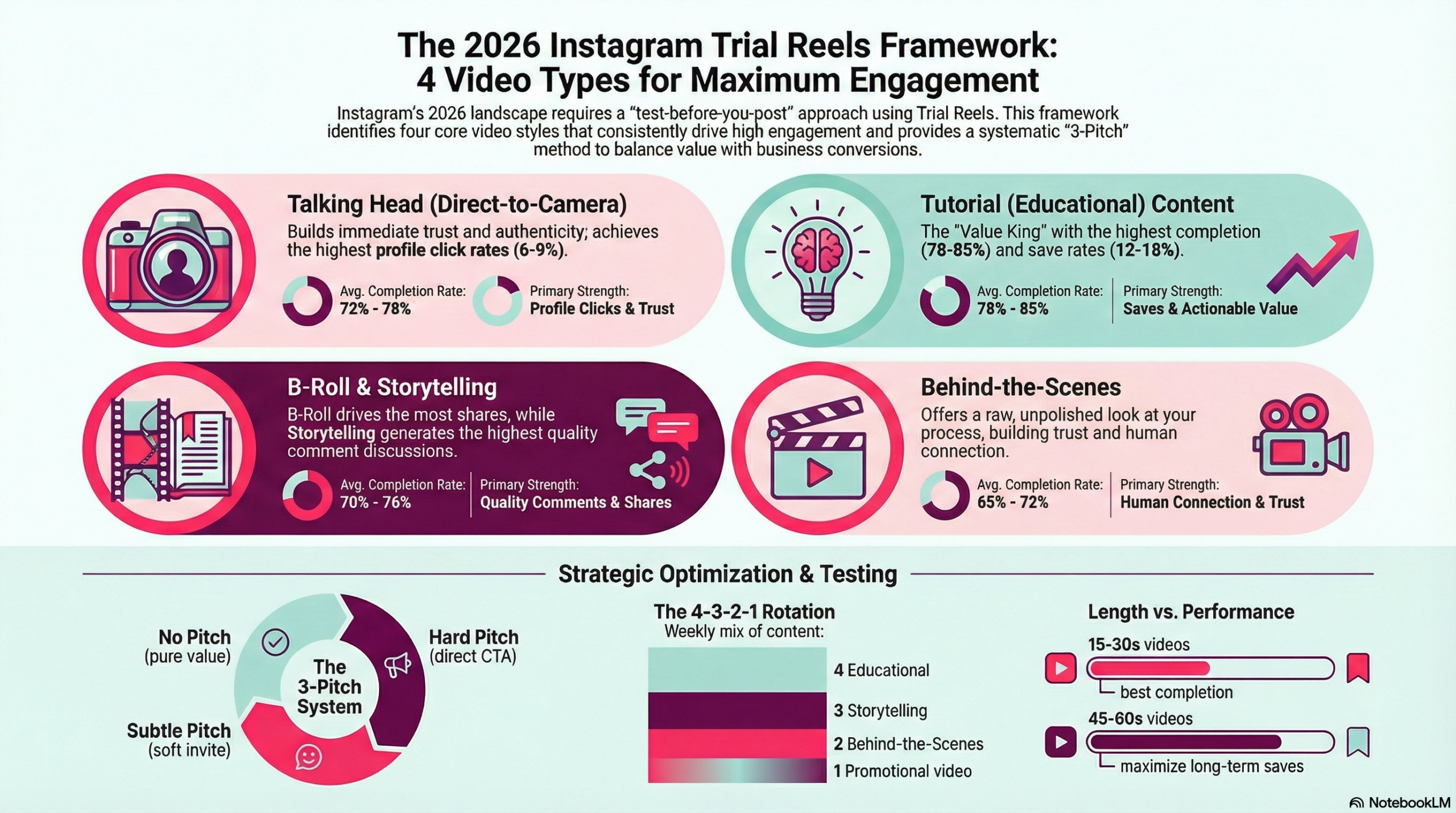
The 4-3-2-1 Content Rotation System:
Based on Trial Reels performance data, this rotation system optimizes for both audience engagement and business results:
Week 1:
Why This Rotation Works:
Performance by Video Length:
15-30 Second Videos:
30-45 Second Videos:
45-60 Second Videos:
Key Insight: For Trial Reels testing, 15-30 second videos provide the best balance of completion rate and engagement, making them ideal for testing new concepts and approaches.
January-March (Planning and Goal Setting):
April-June (Implementation and Growth):
July-September (Results and Reflection):
October-December (Planning and Preparation):
Technical Requirements:
Editing Best Practices:
Hashtag Mix for Video Posts (Maximum 5):
Since Instagram now limits hashtags to 5 per post, strategic selection is crucial:
Video-Specific Hashtag Options:
Strategic Hashtag Selection: With only 5 hashtags available, focus on:
Example 5-Hashtag Sets:
For Educational Content: #instagramstrategy #contentmarketing #digitalmarketing #tutorial #smallbusiness
For Behind-the-Scenes Content: #behindthescenes #entrepreneur #contentcreator #businessowner #videomarketing
For Storytelling Content: #storytime #businesstips #entrepreneur #lessons #growth
Caption Structure for Video Posts:
Hook Line (First Sentence): Grab attention and encourage viewing the video. Use curiosity, questions, or bold statements.
Video Context (2-3 sentences): Provide additional context, backstory, or deeper explanation of the video content.
Call-to-Action: Clear next step for engagement – ask questions, encourage saves, request comments.
Hashtags: Include max of 5 strategic hashtags at the end of the caption.
Primary Metrics (Most Important):
Secondary Metrics: 5. Profile Clicks: Viewers interested in learning more about you 6. Reach Rate: How far beyond your followers the content spreads 7. Replay Rate: Viewers who watch video multiple times
Testing Variables for Video Content:
Hook Testing:
Length Testing:
Visual Style Testing:
Content Angle Testing:
Highest-Performing Video Types:
Content Themes That Work:
Highest-Performing Video Types:
Content Themes That Work:
Highest-Performing Video Types:
Content Themes That Work:
Week 1: Foundation and Testing
Week 2: Optimization and Refinement
Week 3: Pitch Variation Testing
Week 4: System Integration and Scaling
Pre-Production (20% of time):
Production (40% of time):
Post-Production (40% of time):
Month 1-3: Foundation Building Establish your video content types, test extensively with Trial Reels, and identify what works for your specific audience and business goals.
Month 4-6: Optimization and Scaling Refine successful formats, create templates for efficient production, and scale successful content approaches across other platforms.
Month 7-12: Advanced Strategy Integration Integrate video content with broader marketing strategy, develop signature content series, and use video content to drive specific business outcomes.
Lead Generation Tracking:
Sales and Revenue Tracking:
Brand Awareness Metrics:
Monthly Video Content Review:
Quarterly Strategy Assessment:
Repurposing Video Content:
Platform-Specific Optimization:
2026 Video Content Predictions:
Technology Integration:
Instagram video content success isn’t about creating more content, it’s about creating the right content systematically and testing it strategically before committing your time and audience attention.
The four-type video content framework provides a strategic foundation for consistent Instagram growth:
Educational videos establish your expertise and generate the highest save rates, building long-term authority and trust with your audience.
Behind-the-scenes videos humanize your brand and create familiarity, making your audience feel connected to your journey and process.
Direct talking head videos build personal connection and trust, allowing you to communicate directly with your audience and establish authentic relationships.
Storytelling videos create emotional connection and memorability, helping your message resonate and stick with viewers long after they’ve watched your content.
By rotating through these four video types and varying your promotional approach using the no pitch, subtle pitch, and hard pitch system, you create a sustainable content strategy that builds audience trust while driving business results.
The key is systematic testing through Instagram Trial Reels. Instead of guessing what will work, you can test different video approaches, analyze performance data, and make informed decisions about what content to promote to your main audience.
Ready to implement this video content framework? Start by choosing one video type that feels most natural for your expertise and audience, create three variations with different pitch levels, and test them through Instagram Trial Reels. Use the performance data to refine your approach and gradually incorporate the other video types into your content strategy.
Want help implementing a comprehensive Instagram video content strategy? Our Instagram Trial Reels Viral Framework service helps businesses systematically test and optimize their video content for maximum engagement and conversion. Contact our team to discuss how we can help you build a data-driven video content system that consistently drives business results.
For more advanced Instagram strategies, explore our comprehensive guides: