
How to Use Trial Reels Effectively: The Testing System That Works
Most people treat Trial Reels like a posting feature. They turn it on, upload a video, and wait to see what happens. Then they wonder why nothing changes.
Trial Reels is not a posting feature. It is a testing system. And like any system, it only produces results when you know how to read what it is telling you and what to do with that information.
I have built my and my client’s entire organic social media framework around Trial Reels, and I have used it to take client accounts from zero traction to millions of views, thousands of new leads, and pipelines that compound month over month. Not because I got lucky with one video. Because I run a repeatable testing process that tells me exactly what the algorithm wants to push, and I give it more of that.
This is the framework. All of it.
What Trial Reels Is and What It Is Not
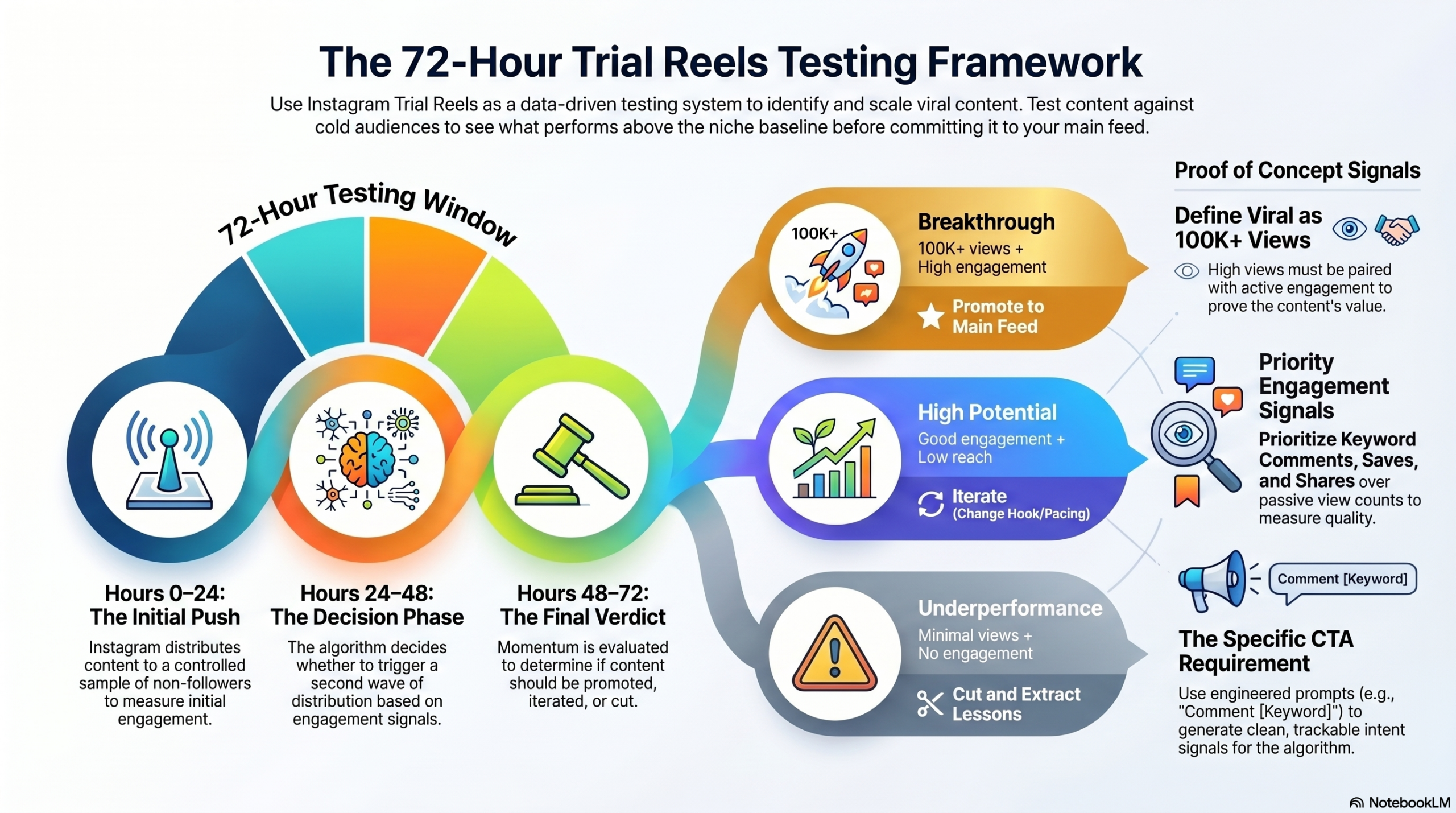
Trial Reels is Instagram’s mechanism for distributing your content to a non-follower audience for a 72-hour testing window. During that window, Instagram measures how that cold audience responds to your content and compares the performance against a niche-specific baseline.
If your content performs above that baseline, Instagram pushes it further. If it does not, the test ends quietly and your existing followers never see it. Nothing is wasted. No damage is done to your account. The test simply slows.
Trial Reels is not about going viral and it can be hard to in that format. It is about finding out which content deserves to go viral before you commit it to your main feed. It is a filter, not a guarantee. It is also a way to push out your popular content to non-followers.
The guarantee comes from what you do with the data.
The Two Things That Define Viral in This Framework
Before I explain how the testing system works, I need to establish exactly what viral means, because most people define it wrong.
In my framework, viral is defined by two things working together. The first is view count. Content that crosses 100,000 views has reached a threshold where Instagram has made a deliberate decision to distribute it beyond your existing audience. That is the signal that something is working.
The second is engagement signals. Views alone are passive. What the algorithm reads alongside view count is the quality of the engagement behind those views. Specifically:
- Keyword comments: when your CTA prompts a specific word or phrase and people comment it, that tells Instagram the content created enough of a response for someone to stop scrolling and type
- Saves: when someone saves your content they are signaling they found it valuable enough to return to. Saves are one of the strongest quality signals the algorithm reads
- Shares: when someone shares your content into their own network they are endorsing it. Shares extend your reach organically and signal to the algorithm that the content has value beyond the person who watched it
Views plus these engagement signals together is what I call proof of concept. It is the combination that tells the algorithm your content deserves to be pushed aggressively to a larger audience. Views without the engagement signals is just reach. Views with keyword comments, saves, and shares is the system working.
Content that crosses 100K views with strong engagement signals is viral. Content that crosses 1M views is a different category. Both start with the same testing process.
If your content doesn’t go viral it isn’t a big deal. It’s data.
The 72-Hour Testing Window
Every Trial Reel gets 72 hours. That is the window Instagram uses to measure how a cold audience responds to your content. Within that window, there are three distinct phases worth paying attention to.
Hours 0 to 24: The Initial Push
Instagram begins distributing your content to a small sample of non-followers in your niche. This is not massive distribution. It is a controlled sample. The algorithm is watching to see if the content generates any signal at all in the first few hours.
If you see the view count climbing steadily in this phase, that is a good sign. If it spikes and then flatlines, pay attention to when the spike happened and what the engagement looked like during it. A spike with strong comments, saves, and shares means Instagram tested it, liked what it saw, and is deciding whether to push it further. A spike with passive views and no engagement is the algorithm testing and stepping back.
Hours 24 to 48: The Decision Phase
This is the most important window in the entire testing process. By the midpoint of the 72-hour test, Instagram has enough data to start making real decisions about the content. If the engagement signals are strong, you will often see a second wave of distribution begin in this phase.
A piece of content that is still climbing at the 24-hour mark is worth watching closely. Content that has already flatlined by hour 24 is giving you a clear signal. The test is not working. Note what the content was, why you thought it would perform, and what the engagement signals looked like before you make any decisions about rotating or scrapping it.
Hours 48 to 72: The Verdict
By the end of the 72-hour window, the test result is clear. Either the content has built momentum and Instagram is continuing to push it, or the test has wound down and the content sits in a natural stopping place.
Content that is still building at the 72-hour mark is content the algorithm has validated. Content that stopped building before that point has still given you data. It is not a failure. It is information.
This is where I disagree a little with what Instagram will tell you. They say if after the 72 hour mark it is still humming your should push it out to your main feed.
I don’t do that. With one caveat. I usually wait for it to wind down and then I post it at a later date.
- so you don’t slow the engagement on the trial or on your feed.
- let that puppy cook and do the work getting to people you don’t normally.
Now my caveat. If you have a viral post popping off in trials it can’t be automated. If we push over 60k and my team can’t keep up with lead engagement we push it out and we automate is instantly.
If we can keep up we manually handle the leads.
Reading the Signals: What to Look for During the Test
The mistake most accounts make is checking the view count and stopping there. View count tells you reach. It does not tell you quality. Here is what I look at when I am evaluating a Trial Reel during the 72-hour window.
Watch Time and Completion Rate
How long are people watching? If views are high but people are dropping off in the first three seconds, the hook is not working. The content is getting distributed but it is not holding attention. That is a hook problem, not a content problem. The underlying topic or format may be strong, but the opening needs to be rebuilt.
If watch time is strong and people are completing the video, that is the foundation for everything else. High completion rate tells Instagram the content is worth watching all the way through, which is a significant quality signal.
Keyword Comments
Your CTA should always prompt a specific keyword comment. Not a generic response. A specific word or short phrase that someone has to actively type to participate.
When keyword comments come in, they tell you several things at once. The CTA worked. The content held attention long enough for someone to act on it. And Instagram is reading that engagement as intent, not passive consumption. Keyword comments are one of the clearest proof signals in the entire testing system.
If your Trial Reel is getting views but no keyword comments, look at your CTA first. Is it specific enough? Is it compelling enough to make someone stop and type? Is it appearing early enough in the video before people drop off?
Saves
Saves are quiet but powerful. Most people do not notice them because they do not show up as visibly as comments. But the algorithm weights saves heavily because they represent explicit intent. Someone watched your content, decided it was valuable enough to find again later, and took an action to keep it.
High save rates on Trial Reels often precede content that breaks out significantly. If you are seeing strong saves alongside growing view counts, you are watching proof of concept build in real time.
Shares and Reposts
Shares and Reposts are the most powerful organic reach multiplier in the testing system. When someone shares your content, they are distributing it into their own network without any effort on your part. The algorithm reads shares as an endorsement and responds by pushing the content to more of the sharer’s audience, not just your target audience.
A Trial Reel with strong shares will often outperform one with strong comments, because the reach compounds. Every share is a new distribution event the algorithm can measure and respond to.
What to Do After the 72-Hour Window
The test is over. Now the real decision-making begins. There are three outcomes and three responses.
The Content Performed: Promote to Main Feed
If your Trial Reel built momentum during the 72-hour window, crossed the 100K view threshold, and generated strong engagement signals, promote it to your main feed. This is not a complicated decision. The algorithm has already validated the content with a cold audience. Promoting it to your followers gives them access to content that has already proven itself, and it signals to the algorithm that you have confidence in the content.
When you promote, the content carries its existing engagement history with it. All the views, comments, saves, and shares it generated during the trial period count. You are not starting from zero. You are extending a piece of content that already has momentum.
The Content Showed Promise but Did Not Break Through: Iterate
Sometimes a Trial Reel generates real engagement signals but does not hit the view threshold in trials. Strong comments, good saves, decent watch time, but the distribution never scaled the way you hoped.
This is the most valuable result in the testing system. The content showed that something is working. The topic resonated. The format worked. The CTA drove action. But something about the hook, the opening seconds, the pacing, or the framing did not trigger wider distribution.
The response is iteration. Take the same content concept and rebuild it with a stronger hook. Test it again. You already know the underlying idea has an audience. You are just finding the version of it that makes the algorithm push it further.
The Content Did Not Perform: Cut and Learn with one disclaimer
If the 72-hour window closes with minimal views, no engagement signals, and no momentum, cut it. Do not promote it to your main feed. Do not spend time trying to understand why it underperformed beyond extracting the lesson.
The lesson is almost always one of three things. The topic did not resonate with the cold audience the algorithm placed it in front of. The hook did not hold attention long enough to generate any engagement. Or the CTA was too weak to prompt action from people who were otherwise engaged.
Each failed test narrows what you try next. That is the system working. You are not wasting content by cutting it. You are getting smarter about what your audience responds to, which makes every subsequent test more targeted.
Sometimes I have shared trials that didn’t perform well and they perform excellent on my feed. WHY? I’m going to venture that my audience likes what I do sometimes that’s enough to push it out and see what it does.
Not every loss is a loss to your followers. That’s your judgement call to make and I have found it can work in your favor to push it out anyways.
The Rotation System: Volume as a Strategy
One of the most common questions I get about Trial Reels is how many to post and how often. The answer is more than you think, and the reasoning matters.
Trial Reels is a testing system. Testing systems produce better results with more data. If you are running one Trial Reel per week, you are getting one data point per week. That is not enough to build momentum or identify patterns quickly enough to accelerate growth.
The accounts I run on this framework are producing content at high volume consistently. Not because more is always better, but because volume gives you faster feedback loops. The more tests you run, the faster you find the content that the algorithm wants to push, and the faster you can give it more of that.
Within that volume, the rotation follows a framework built around three types of content in every cycle:
- Proof of concept content: topics and formats that have already performed. You are not repeating the same video. You are returning to a proven theme with a fresh angle, a new hook, or updated information
- Test content: new topics, new formats, new hooks you have not tried before. This is how you find the next breakout. Not every test will work but every test that works becomes proof of concept for the next cycle
- CTA content: content specifically designed to drive the keyword comments, saves, and shares that prove your audience is engaged. This is the content that keeps your engagement signals healthy across the account so the algorithm continues to trust your distribution
The ratio of these three types shifts as your account matures. Early on, you are running more test content to find what works. As patterns emerge, you weight more heavily toward proof of concept content because you know what your audience responds to. CTA content runs consistently throughout.
For a specific number. Last I heard you can post 20 trial reels a day. I personally have not tested this to see.
I do anywhere from 3-12 a day depending on the account. If you have bandwidth and enough quality content I would 100% do 20 a day.
If that creates friction chill out and do what works best for you!
The CTA: The Part Most Accounts Get Wrong
Your CTA is not a suggestion at the end of a video. It is an engineered prompt designed to generate a specific engagement signal from a cold audience who has never seen your account before.
A weak CTA sounds like this: follow me for more, drop a comment below, share this with someone who needs it. These are passive. They ask someone to do something without giving them a specific reason or a specific thing to do.
A strong CTA sounds like this: comment the word “KEYWORD” if you want the full breakdown. Or: save this so you have it when you are ready to start. Or: share this with the person on your team who handles social. Or: DM “KEYWORD” Those are direct call to actions.
The specify the point. When someone comments a specific keyword, saves with intention, or shares to a specific person, the engagement signal is cleaner and stronger than a generic response. The algorithm reads the pattern of these signals across your Trial Reels and starts to understand what type of content your audience actively responds to versus passively consumes.
Your CTA should appear in every Trial Reel. It should be specific. It should be early enough in the video that people who do not watch to the end still see it. And it should ask for exactly the engagement signal you want the algorithm to read.
What the Algorithm Is Doing
Understanding the mechanism helps you work with it instead of guessing at it.
When you submit a Trial Reel, Instagram places your content in front of a sample audience that it has identified as likely to find your content relevant based on niche, topic, and format signals. That sample audience is not random. It is calibrated.
The algorithm then measures how that calibrated audience responds. It is not just counting views. It is reading the ratio of views to engagement, the depth of engagement within those interactions, the speed at which engagement comes in, and whether the engagement signals are sustained or spike and drop.
Sustained, quality engagement signals across the 72-hour window tell the algorithm that the content is worth distributing more broadly. The algorithm is asking one question: does this content create a response in the people I put it in front of? Keyword comments, saves, and shares are the clearest yes to that question.
This is why volume matters, why CTA specificity matters, and why the 72-hour reading of your data matters. You are not just making videos. You are building a track record of proof signals that the algorithm uses to calibrate how much it trusts your content. The more proof you give it, the more aggressively it distributes what you produce.
Building the Proof of Concept That Compounds
The goal of this framework is not to go viral once. It is to build a track record with the algorithm that results in consistent, compounding organic reach over time.
When you run Trial Reels consistently, generate strong engagement signals regularly, and promote content that has already proven itself, the algorithm begins to treat your account differently. It starts distributing your new content more aggressively from the moment it goes live because it has learned that your content tends to perform.
That is the compound effect this framework is designed to produce. Not a single viral moment. A sustained elevated ceiling where the algorithm is actively working with your content instead of making you prove yourself from scratch every time.
The RE case study I share on this site is the most direct evidence of this. A boutique Caribbean real estate firm that could not run paid ads went from 331 followers on a founder Instagram account to 2.3 million views on a single video and 8,400 CRM opportunities in a six-month period. The 2.3 million view video did not happen in isolation. It happened because the testing system had been running consistently for months, building the proof of concept track record that made the algorithm ready to push that content when it arrived.
You can read the full breakdown of how that system was built and what the data looked like month over month at.
Where to Start
If you are new to Trial Reels or you have been using it without a real system behind it, here is where to start.
First, establish your CTA before you post anything. Decide what keyword you want people to comment, what content you want them to save, and how you want them to share. Build that prompt into every Trial Reel before it goes live. I personally build my automations first even before trials.
Second, commit to the 72-hour reading. Do not check your view count once and make a decision. Watch the engagement signals across the full window. Look for the pattern of how your content builds or does not build and use that to inform the next test.
Third, build volume. You are not going to find your breakout content by testing one reel per week. Get your production cadence up to a place where you are testing consistently enough to identify patterns and give the algorithm enough signal to work with.
Fourth, promote what performs. Do not leave validated content in the Trial Reels system. When something crosses the viral threshold with strong engagement signals, promote it to your main feed and let the momentum carry.
If you want the full framework including how I build the content rotation, how I connect Trial Reels to a CRM pipeline, and how I structure the testing cadence for different types of businesses, that is covered in detail here.
And if you want to talk about what this looks like built specifically for your business, this is where that conversation starts.
Frequently Asked Questions
How long does a Trial Reel stay in the testing phase?
The Trial Reels testing window is 72 hours. During that period Instagram distributes your content to a non-follower audience and measures engagement signals including watch time, keyword comments, saves, and shares. After 72 hours the test concludes and you can review the data and decide whether to promote the content to your main feed or move on to the next test.
What counts as a good Trial Reels result?
A good result is not just a high view count. It is a combination of strong views alongside meaningful engagement signals. Content that crosses 100,000 views with keyword comments, saves, and shares is performing well. Content that gets views but no engagement signals is reaching people but not converting passive watching into active response, which is the signal the algorithm needs to push distribution further.
If you don’t go viral that doesn’t mean it’s not worth sharing see detailed explainer above.
Should I post my Trial Reel to my main feed at the same time?
No. This will actually diminish your reach on both. The point of Trial Reels is to test content against a cold audience before committing it to your followers. If you post to your main feed simultaneously you are bypassing the testing mechanism. Let the 72-hour window run, evaluate the results, and then promote the content to your main feed if it performs. Content that earns promotion has already proven itself with a cold audience, which is a stronger signal than content that has only been seen by people who already follow you.
How many Trial Reels should I post per week?
More than most accounts are currently posting. Last I heard it was 20 per day. I do 3-12 per account. The testing system produces better results with more data and faster feedback loops. I build content rotation systems that run high volumes consistently because volume is what accelerates the pattern recognition that tells you what your audience responds to. Starting point depends on your production capacity, but one per week is not enough to build meaningful momentum quickly.
What should my CTA be on a Trial Reel?
Specific and action-oriented. Your CTA should prompt a specific keyword comment, a save, or a share rather than a generic response. The more specific the prompt, the cleaner the engagement signal the algorithm reads. Avoid vague CTAs like follow for more or drop a comment below. Instead, give people a specific word to comment, a specific reason to save, or a specific person to share it with. Specificity is what separates passive reach from the proof signals the algorithm is looking for.
Does Trial Reels work for every type of business?
Trial Reels works for any business that can produce short-form video content and has a defined audience. It works particularly well for service-based businesses, real estate, hospitality, and any brand built around a person or founder voice. The framework adapts to any niche because the algorithm is measuring your content against others in your specific space, not against a universal standard. What matters is that your content is built to generate the engagement signals that prove concept within your niche audience.