
Trial Reels
Can Trial Reels Go Viral? What the Algorithm Rewards
Yes. Trial Reels can absolutely go viral.
I would like to explain right out the gate that viral in trials. It is a huge accomplishment if you get a viral piece of content in Trials.
- You do not have follower push like you do in your feed.
- Your hook is gold if you hit viral.
- Your content is to be commended when you accomplish this and you should be stoked af!
But “going viral” is not the goal. Understanding what the algorithm rewards is the goal. Viral reach is what happens when you consistently produce content that hits the right signals. It is an outcome, not a strategy.
Most businesses approach Instagram Reels with a vague hope that something will take off. They post, check the view count, feel discouraged when it does not explode, and either push harder or give up. Neither of those responses is informed by what the algorithm is looking for.
This post is about what the algorithm is looking for. Specifically, how Trial Reels fit into the distribution system, what signals trigger wider reach, and what consistently separates content that gets pushed to thousands of non-followers from content that quietly disappears.
How the Instagram Reels Algorithm Works in 2026
Before we can talk about Trial Reels specifically, you need to understand how Instagram evaluates and distributes Reels content at the algorithm level.
Instagram’s Head, Adam Mosseri, has been increasingly transparent about how the ranking system works. In 2026, the algorithm evaluates Reels on three primary signals confirmed directly by Mosseri: watch time, sends per reach, and likes per reach. These three signals carry different weight depending on whether you are trying to reach your existing followers or expand to new audiences.
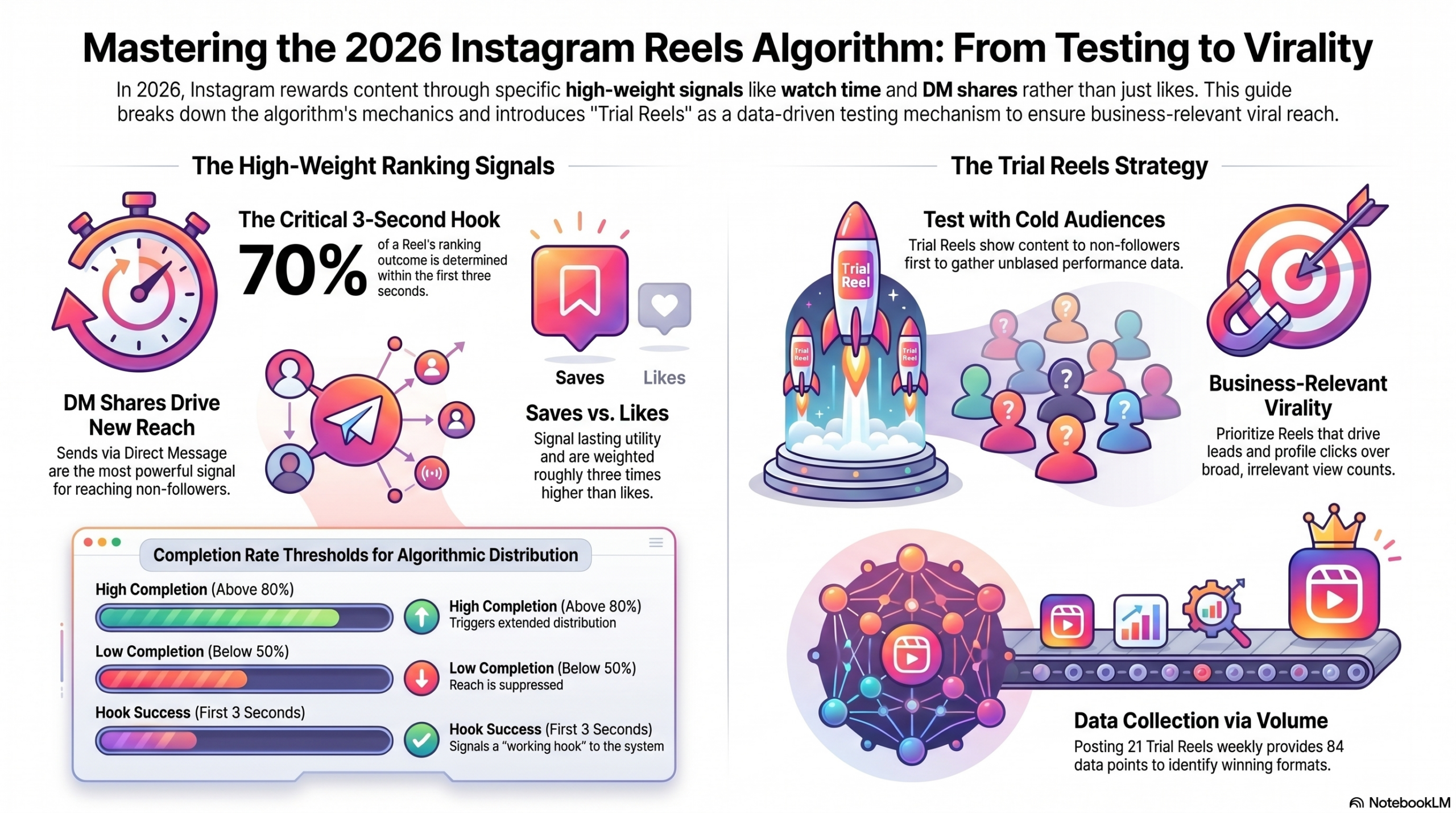
Watch time is the number one ranking factor. Instagram tracks total seconds watched, completion rate, and whether viewers rewatch your content. The critical threshold is the first three seconds. If viewers continue past the three-second mark, Instagram interprets that as a working hook and begins distributing the Reel more widely. Completion rates above 80 percent trigger extended distribution. Completion rates below 50 percent get suppressed. A 15-second Reel watched all the way through by 90 percent of viewers will outperform a 45-second Reel that 60 percent of viewers abandon halfway.
DM shares are the most powerful signal for reaching new audiences. When someone sends your Reel to a friend via direct message, Instagram treats that as a quality endorsement of the highest order. Mosseri has confirmed explicitly that sends per reach carry more weight for unconnected reach than any other signal. Research from Metricool shows that 694,000 Instagram Reels are sent via DM every single minute. DM shares are weighted significantly higher than likes for reaching people who do not already follow you. The practical implication is this: before you publish any Reel, ask yourself whether someone would send it to a friend. If the honest answer is no, the content needs work.
Likes per reach matters more for connected reach. The ratio of likes to total views carries more weight for reaching your existing followers than for expanding to new audiences. This is a meaningful distinction. Optimizing for likes alone is an incomplete strategy. Likes signal that your followers responded well. Sends signal that your content is worth sharing with people outside your existing circle. Both matter, but they serve different distribution functions.
Saves signal lasting value. When someone saves a Reel, they are telling Instagram that your content was valuable enough to return to. Saves are weighted roughly three times higher than likes. Content that teaches something, solves a problem, or delivers information someone will want to reference again earns saves naturally. If your Reels are purely entertainment-focused, they may get views and even shares without accumulating saves. Building saves into your content strategy means consistently producing content with utility.
Comments that generate conversation threads are a high-weight signal. Instagram in 2026 measures conversation depth, not just comment count. Gone are the days where an emoji comment has value. A Reel that generates a back-and-forth discussion in the comments is ranked more favorably than one with the same number of one-word comments. This means your content should invite response, not just reaction. Questions, opinions, and relatable situations that prompt people to weigh in generate the conversation depth the algorithm rewards.
Rewatches indicate high-quality content. When someone watches your Reel more than once, Instagram interprets that as a strong positive signal. This is sometimes called rewatch velocity. Reels that are dense with information, visually engaging, or structured in a way that rewards multiple viewings earn this signal. Short, punchy Reels that deliver a surprising or counterintuitive point often get rewatched because the viewer wants to process what they just heard.
What Gets Suppressed: The Signals Working Against You
Understanding what the algorithm rewards is only half the picture. Understanding what tanks your reach is equally important.
Watermarked content is penalized. If you are repurposing TikTok videos to Instagram with the TikTok logo visible, your reach is being throttled significantly. Instagram’s 2026 algorithm uses an originality score to detect recycled content. Always use your original raw files rather than content exported from a competing platform.
Reposting others’ content suppresses your reach. Accounts that post ten or more reposts in a 30-day period get excluded from Explore and Reels recommendations entirely. Original content gets a ranking boost over aggregated or reused material. If you want algorithmic reach, you need original content.
Irrelevant virality confuses the algorithm. Jumping on a trending audio or meme format that has nothing to do with your niche might produce a short-term spike in views. But if that content does not align with your established topic area, the algorithm loses its understanding of who your ideal viewer is and stops recommending your content to high-intent audiences. Only participate in trends you can pivot back to your core business positioning.
Jumping between unrelated topics damages your authority signal. Instagram’s algorithm categorizes accounts by topic area and uses that categorization to determine who to show your content to. If your Reels cover marketing strategy one week and travel one week and personal development the next, the algorithm cannot accurately identify your target audience and defaults to showing your content to a less relevant broad group. Consistent niche focus is an algorithmic signal, not just a branding preference.
Low-resolution video gets suppressed. Visual quality affects engagement, and engagement affects distribution. Poor lighting, shaky footage, and low-resolution exports are not just aesthetic issues. They are performance issues.
Where Trial Reels Fit Into This System
Now that you understand what the algorithm rewards and penalizes, here is where Trial Reels become strategically significant.
Trial Reels are Instagram’s built-in content testing mechanism. When you post a Trial Reel, Instagram shows it to a sample of non-followers before it reaches your existing audience. That cold audience evaluates your content without any prior relationship with you. No follower loyalty, no brand recognition, no charitable viewing. Pure algorithmic evaluation based on whether strangers find your content worth watching, sharing, and saving.
If the Trial Reel performs well with that cold audience, Instagram takes that as a signal of broad appeal and pushes the content further, potentially to your main feed audience and beyond. If it underperforms, you get data without having affected your main feed’s performance metrics.
This is why I cover the full strategic framework for Trial Reels in my Instagram Trial Reels viral framework. The tool is genuinely significant for organic social media marketing because it gives you a feedback loop that most content creation processes do not have: real performance data from cold audiences before you commit the content to your main feed.
The connection to virality is direct. A Trial Reel that generates strong watch time, DM shares, and saves from non-followers has already demonstrated the signals the algorithm uses to justify wider distribution. That is not a coincidence. That is the system working as designed.
What Viral Looks Like for a Business Account
Here is something worth being direct about. Viral for a business account does not look the same as viral for a creator or entertainer.
A Reel with ten million views from a broad, general audience is not necessarily a business win if none of those viewers are your target client. Irrelevant viral reach can actually work against you by confusing the algorithm about who your ideal viewer is and flooding your account with followers who will never buy.
What business-relevant viral reach looks like is a Reel that reaches thousands or tens of thousands of people who are exactly the right audience for your services, generates DM inquiries, drives profile clicks, captures email subscribers, and produces qualified leads.
That kind of targeted viral reach is achievable and it is what a deliberate Trial Reels strategy is designed to produce. It requires content built around topics your target audience cares deeply about, hooks engineered to stop their specific scroll pattern, and calls to action designed to move them from viewer to lead.
When that kind of content lands, the business impact can be significant. A single viral post to the right audience can generate anywhere from a few hundred to several thousand inbound leads. That volume requires a system to manage. If you do not have automations in place and a clear process for directing those leads toward your sales process, a viral moment can be as overwhelming as it is exciting. I cover what that operational readiness looks like in my post on organic social media management.
The Content Framework That Earns Viral Distribution
Knowing what the algorithm rewards tells you what to build toward. Here is how that translates into content decisions.
Your hook determines everything. Instagram research confirms that 60 to 70 percent of a Reel’s ranking outcome is decided in the first three seconds. The hook is not just the opening line. It is the visual pattern interrupt, the text overlay, the opening question, the surprising statement, or the bold claim that stops a cold viewer mid-scroll and makes them continue watching. Weak hooks kill otherwise strong content before it has a chance to reach anyone. Strong hooks are not accidental. They are engineered.
Content must be shareable to earn the DM send signal. Before you publish, ask the honest question: would someone send this to a specific person in their life? The content categories that earn DM shares consistently are highly relatable situations that make someone think of a friend, genuinely useful information someone would want to pass along, surprising or counterintuitive insights, and content that makes someone laugh or feel something strongly enough to want to share that moment. If your content is informational but dry, if it is promotional without being valuable, or if it is generic enough that it applies to everyone and therefore resonates with no one specifically, it will not earn sends.
Build for completion. Structure your Reels so there is a reason to watch all the way through. That might mean withholding a key piece of information until the end, using a narrative arc that builds toward a payoff, or structuring a list format where viewers want to see all the items. Reels that deliver their full value in the first five seconds have no completion incentive. Reels that reward viewers for staying generate the completion rate signal that triggers wider distribution.
Length should serve the content, not the other way around. Reels between seven and 90 seconds tend to have the highest viral potential. Shorter Reels in the seven to 30 second range earn higher completion rates and perform better for discovery reach. Longer Reels in the 30 to 90 second range work better for storytelling and depth with existing followers. Going past 90 seconds is risky unless your retention is genuinely exceptional. The question is not how long your Reel should be. The question is how long it needs to be to deliver the content without losing viewers.
Use three to five highly specific hashtags as categorization signals. Hashtags in 2026 are no longer discovery tools in the traditional sense. They function as categorization signals that tell the algorithm which interest-based feed your content belongs in. Three to five specific, relevant hashtags are more effective than stuffing your caption with generic ones. Think of them as filing your content correctly rather than broadcasting it broadly.
Engage in the first hour after posting. The algorithm monitors early engagement depth, not just engagement volume. Responding to every comment in the first hour after publishing, especially with responses that generate further replies, signals momentum to the algorithm and can meaningfully affect how aggressively the content gets distributed. If you post and disappear, you leave early distribution potential on the table.
The Volume Argument: Why Testing at Scale Matters
Here is the part of the viral conversation that most people skip.
Waiting for a single piece of content to go viral is not a strategy. It is hope. The businesses that generate viral reach consistently are not lucky. They are posting at volume, generating data continuously, and doubling down on what the data tells them is working.
This is the fundamental argument for posting 21 Trial Reels per week minimum rather than three. At three Reels per week, you are generating 12 data points per month. At 21 Trial Reels per week, you are generating 84 data points per month. That is 84 chances to identify what hooks your cold audience responds to, what content formats earn DM shares, what topics generate saves, and what calls to action drive profile clicks.
The accounts that seem to go viral effortlessly have almost always posted enormous volume of content before the viral moments that made them visible. What looks like luck from the outside is usually data-informed content production from the inside.
Trial Reels make that data collection process safer and more efficient by separating the testing audience from your main feed audience. You are not gambling with your follower relationship every time you experiment. You are running controlled tests and feeding the results back into your content strategy.
Putting It Into Practice
The path from understanding what the algorithm rewards to actually building content that earns viral distribution runs through a few specific commitments.
Build every Reel with a deliberate hook engineered to stop your specific target audience’s scroll. Ask whether each piece of content is shareable before you post it. Structure for completion. Track the signals that matter, which are watch time, sends, saves, and completion rate, not just view counts and likes. Post at enough volume to generate meaningful data. Use Trial Reels to test before you commit. Engage actively in the hour after posting.
None of this is complicated. All of it requires consistency and intention over time.
If you want a system that does this at scale, that is the framework I build with clients. The social media operation that produces 1,500 or more pieces of content per month across platforms is the same operation that systematically tests content, identifies what earns viral distribution, and builds on that data month after month.
If you are ready to build that system with strategic leadership behind it, that is the work I do as a Fractional CMO. We build the architecture, establish the content frameworks, and make sure every Trial Reel you post is working toward measurable business outcomes, not just view counts.
Frequently Asked Questions
Can trial reels go viral? Yes. Trial Reels can absolutely go viral. Because they are shown to non-followers first, a Trial Reel that earns strong watch time, DM shares, and saves from cold audiences has already demonstrated the exact signals Instagram uses to justify pushing content to a wider distribution pool. Trial Reels are specifically designed to give content a shot at non-follower reach before it reaches your main feed audience.
What does Instagram’s algorithm reward most in 2026? The three primary ranking signals confirmed by Instagram’s head Adam Mosseri are watch time, sends per reach, and likes per reach. Watch time is the most important signal overall. DM shares are the most powerful signal for reaching new audiences. Saves and conversation depth are also high-weight signals. Likes have become a relatively weak signal compared to these deeper engagement indicators.
How long should a Trial Reel be to maximize reach? Reels between seven and 30 seconds tend to earn the highest completion rates and perform best for discovery reach. Reels between 30 and 90 seconds work better for depth and storytelling with existing followers. The critical factor is not length but retention: a short Reel with 90 percent completion will outperform a long Reel with 40 percent completion every time. Keep Reels under 90 seconds unless your retention data supports going longer.
Why are DM shares more important than likes for going viral? DM shares signal to Instagram that your content was valuable enough for someone to actively recommend to another person. That is a significantly stronger quality endorsement than a passive like. Instagram weights sends per reach three to five times higher than likes for unconnected reach. Content that earns DM shares has demonstrated social proof in the most direct form available on the platform.
What content types earn the most DM shares? Content categories that consistently earn DM shares include highly relatable situations that make viewers think of a specific person in their life, genuinely useful information someone would want to pass along, surprising or counterintuitive insights, and emotionally resonant content that people want to share with someone who would feel the same way. The test is simple: would someone send this to a specific friend? If yes, build more content like it.
Does posting volume matter for going viral on Trial Reels? Yes, significantly. Higher posting volume generates more data points faster, which accelerates your ability to identify what content earns viral distribution signals. The accounts that go viral consistently are not lucky: they are testing at high volume, learning from the data, and doubling down on what works. Twenty-one Trial Reels per week generates roughly 84 data points per month compared to 12 from three Reels per week.
What kills reach on Instagram Reels? The most common reach suppressors are watermarked content from other platforms, posting ten or more reposts in a 30-day period, low-resolution or poor quality video, topic inconsistency that confuses the algorithm about your niche, and using trends or audio that are unrelated to your core content area. Avoiding these suppression signals is as important as optimizing for the positive ones.
How do I know if my Trial Reel is performing well? Track completion rate, watch time, saves, DM shares, and profile clicks from each Trial Reel. These are the signals that indicate genuine audience engagement from cold viewers. High view counts with low completion rates and minimal saves tell you the content is being distributed but not resonating. Moderate view counts with high completion rates, strong saves, and DM shares tell you the algorithm is finding the right audience for your content.