
The person reading this post is probably not the one who found it first.
You are the CFO who got forwarded a link. The business partner who was asked to weigh in. The CEO who wants to understand the model before committing budget. The operations lead who is trying to figure out how this person fits into the existing team structure.
Someone in your organization is advocating for bringing on a fractional CMO, and your job right now is to pressure-test the idea with the right questions before you say yes or no.
That is exactly what this post is for.
What follows are the real questions leadership teams ask when evaluating a fractional CMO engagement, with honest answers. Not the polished version designed to close a sale. The version designed to give you the clarity to make a good decision.
The Foundational Questions
What exactly is a fractional CMO and how is it different from hiring a marketing agency?
A fractional CMO is a senior marketing executive who works with your company on a part-time or project basis rather than as a full-time employee. The key distinction from an agency is the nature of the work. An agency executes specific marketing tactics: content creation, paid advertising, SEO, social media management. A fractional CMO provides the strategic leadership that decides which tactics to pursue, in what order, with what resources, and toward what measurable business outcomes.
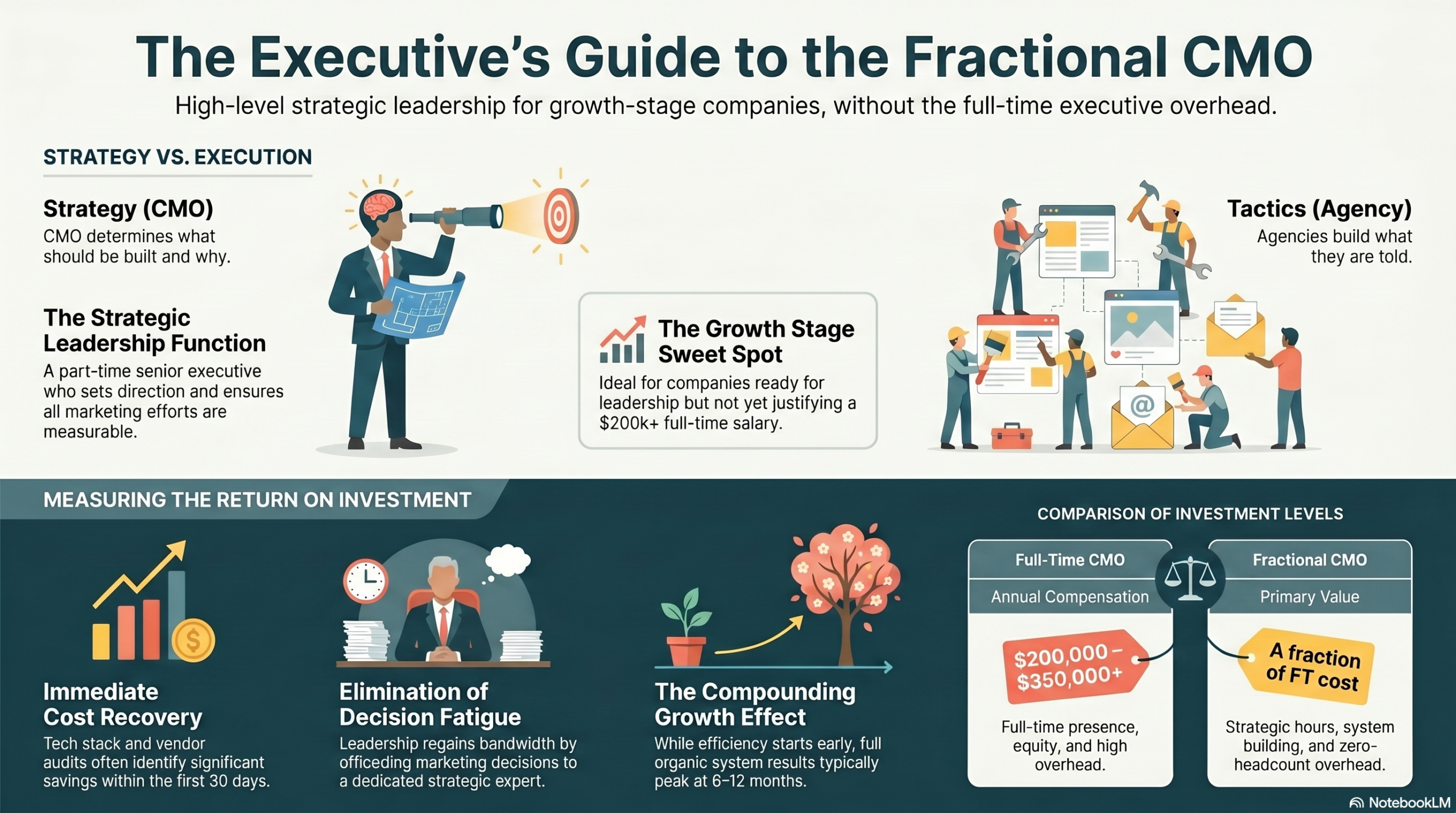
Think of it this way. An agency builds what you tell them to build. A fractional CMO figures out what should be built and why, then either directs the agency or builds the internal capability to execute it.
Many companies need both. A fractional CMO oversees strategy and often assesses whether existing agency relationships are actually delivering value.
Who is a fractional CMO engagement designed for?
The model works best for businesses that have grown past the startup stage and are ready to invest in marketing leadership, but are not yet at the scale that justifies a full-time CMO salary and benefits package. It is also a strong fit for companies that have a marketing team or contractors in place but lack the senior strategic direction to make their efforts cohesive and measurable. If your marketing currently feels scattered, reactive, or disconnected from business outcomes, that is a signal the model is worth exploring.
How much does a fractional CMO cost compared to a full-time hire?
A full-time CMO with meaningful experience typically commands a salary in the range of $200,000 to $350,000 or more annually, plus benefits, equity, and overhead. A fractional CMO engagement is a fraction of that investment because you are paying for strategic leadership hours rather than a full-time employee. The exact cost depends on scope and hours, which is established during the engagement conversation. The financial case is straightforward: you get senior marketing leadership without the full-time headcount cost.
The ROI Questions
How do we measure the return on a fractional CMO investment?
The ROI of a fractional CMO engagement comes from multiple directions simultaneously, which is part of why it is significant and part of why it takes a few months to fully quantify.
The most immediate and often overlooked ROI source is decision fatigue elimination. When your leadership team is making marketing decisions without strategic expertise, those decisions consume time and mental bandwidth that should be going toward delivering value to your clients. A fractional CMO removes that burden. Your team stops making uninformed marketing calls and starts executing clearly directed work. That shift in focus and efficiency has real business value even before a single piece of content goes live.
The second ROI source is organic reach expansion. Most companies I work with have zero functioning organic social media strategy when they come in. Implementing a systematic organic social media marketing framework from scratch produces measurable reach growth that compounds over time. Audiences that did not know you existed begin finding you through content. That reach is durable in a way that paid advertising is not.
The third source, and one that surprises most leadership teams, is cost recovery from the tech stack and vendor assessment. I conduct a thorough review of every tool and vendor relationship in the marketing operation. In most cases I find technology that is underutilized, redundant subscriptions, or vendor relationships where the performance does not justify the price. On one engagement, I identified a vendor that was overcharging and underperforming to the tune of $2,500 per month. That savings covered most of the retainer cost and we found it on the discovery call, before the engagement even started. That kind of audit is standard, not exceptional. Most businesses that have been growing reactively have accumulated marketing infrastructure that quietly costs more than it should.
How long until we see results?
The honest answer is that it depends on which results you are measuring. The tech stack and vendor cost savings are often visible within the first 30 days. Organic social media engagement and reach metrics start showing up in month two. Meaningful organic search traction from content compounds over three to six months. The full system operating at peak efficiency, including the Trial Reels framework and content cluster strategy, is most visible at the six to twelve month mark.
Businesses that expect immediate results equivalent to paid advertising will be disappointed. Organic marketing is a compounding asset, not a quick return. The businesses that see the most significant outcomes from a fractional CMO engagement are the ones that commit to the timeline and trust the system being built.
The Team Questions
We do not have the internal marketing staff to support this. Is that a problem?
This is one of the most common concerns I hear and it is not the obstacle it appears to be.
The reality is that most companies hiring a fractional CMO do not have a fully staffed marketing team. That is often precisely why they need one. Part of the fractional CMO role is assessing what execution capacity currently exists, identifying the gaps, and building a plan to fill them.
That might mean helping the company hire the right people. I am involved in that process when needed, including evaluating candidates against the specific skill sets the marketing framework requires. It also means training whoever joins so they are operating inside a clear system rather than figuring things out independently.
I meet every team member involved in marketing as part of the onboarding process. That assessment is not just about skill level. It is about understanding how people work, whether they are positioned in roles that suit them, and whether the team structure makes sense for the marketing operation being built. Getting the right people into the right roles is as important as building the right strategy.
How does a fractional CMO work alongside our existing team without creating confusion about authority and direction?
This is a legitimate structural question and it deserves a direct answer.
A fractional CMO sits above the execution layer as a strategic leadership function. The team executes. The fractional CMO sets direction, makes strategic decisions, and is accountable for the overall marketing framework. That hierarchy needs to be clear from the start, and establishing it is part of the onboarding process.
Where it gets complicated is when companies have existing vendors, agencies, or contractors who are accustomed to operating without strategic oversight. Part of the fractional CMO’s job in the first 90 days is assessing those relationships and establishing clear lines of accountability. Some of those relationships will be restructured. Some will be terminated if they are not delivering value. That process requires leadership support to execute cleanly.
What happens to our team’s current workload during the transition?
The first month is the most intensive period for the team because it involves a lot of information gathering, access setup, and alignment conversations. After that, as systems are established and roles become clearer, the team’s experience typically shifts from scattered reactive work to focused execution within a defined framework.
The goal is not to add to your team’s workload. It is to make their existing effort more strategic and more measurable. A team that was posting content without a system is now posting content with clear goals, clear formats, and clear performance metrics. That shift tends to reduce anxiety and increase productivity, not the other way around.
The Strategy Questions
How does a fractional CMO approach building a marketing strategy?
The starting point is always assessment, not assumption. Before any strategy is built, I need to understand what currently exists: the tech stack, the vendor relationships, the content history, the search presence, the team structure, and the gaps across the eight marketing pillars I use as a marketing strategy framework.
Those pillars cover the full customer journey from attracting new audiences through organic content and SEO, to capturing and converting that attention into leads, nurturing those leads through email and content, making the sales process frictionless, and building the referral and advocacy systems that turn satisfied clients into a growth engine.
Most businesses are operating well in one or two of those pillars and almost completely absent from the others. The assessment tells us exactly where the highest-value work is so we are not applying a generic template to a specific business situation.
From that assessment, we build a prioritized roadmap. The top three priorities get addressed first. Everything else follows in a sequence that makes strategic sense rather than a sequence based on what feels most urgent in the moment.
Will the marketing strategy be built around our specific business or is this a templated approach?
Every engagement starts with a thorough discovery process for exactly this reason. The marketing strategy framework I use provides the structural architecture, but the content strategy, the channel priorities, the keyword targets, the content pillars, and the execution plan are built specifically around your business, your audience, and your competitive position.
A hospitality business and a professional services firm need fundamentally different content strategies even if the underlying framework is the same. The framework is the architecture. The strategy is custom.
How does organic social media fit into the overall marketing strategy?
For most businesses I work with, organic social media is one of the highest-leverage areas we address because the starting point is usually zero. No functioning strategy, inconsistent posting, no content system, and no measurable leads coming from social channels.
Implementing a systematic content operation that includes Instagram Trial Reels, feed content, carousels, and stories natively posted and repurposed across platforms produces compounding reach that builds month over month. The content cluster system, where one to three long-form pieces per week fuel an entire social media content ecosystem, is what makes high-volume content production sustainable without requiring the team to create from scratch every day.
For businesses that have never had this system in place, the reach expansion from implementing it is often the most visibly dramatic result of the first 90 days.
The Confidentiality and Risk Questions
How do we protect sensitive business information during this engagement?
This is a standard concern and it is addressed through a formal agreement at the start of every engagement. Non-disclosure agreements covering business strategy, client information, financial data, and any other sensitive material are standard practice. A fractional CMO who does not have clear protocols around confidentiality is not someone you should be working with.
What happens if the engagement is not working out?
The three-month minimum engagement exists in part to protect against premature conclusions. The first month is primarily infrastructure and assessment, which does not look like dramatic output. Evaluating an engagement at 30 days is like evaluating a construction project when the foundation is being poured and wondering why there is no building yet.
That said, if there are genuine alignment or performance concerns, those conversations happen directly and early. Transparent communication about what is working and what is not is part of how a professional engagement functions.
How do we ensure we are not dependent on you long term?
This is actually one of the most important questions a leadership team can ask and it reflects the right way to think about the engagement.
The goal of a fractional CMO engagement is not to create dependency. It is to build a marketing system, train the people who operate it, and establish the strategic clarity that allows the business to run its marketing operation independently. Everything I build is documented. Every system I implement is trained. Every framework I establish is designed to outlast my direct involvement.
What typically happens at the end of an initial engagement period is a transition to a smaller advisory retainer. The systems are running, the team is trained, the strategy is established, and ongoing involvement shifts to a lighter oversight and strategic advisory function rather than active day-to-day leadership. That structure keeps me accessible for strategic decisions and course corrections without requiring the same level of involvement as the build phase.
The businesses that benefit most from this model are the ones that approach it as an investment in building internal capability, not an outsourced function they will always need to pay for at the same level.
The Practical Questions
How many hours per week does a fractional CMO work with our company?
This varies by engagement scope and evolves over the course of the relationship. The first month typically involves the most time because of the volume of assessment, access setup, and alignment work required. As systems are established and the team has clear direction, the fractional CMO’s involvement often decreases to a more advisory cadence.
Scope and hours are established during the discovery and onboarding process based on the size of the operation, the extent of the gaps being addressed, and the execution capacity available on the client side.
Do we need to have our marketing infrastructure already in place?
No. Most businesses that hire a fractional CMO do not have clean marketing infrastructure in place. That is part of what the engagement builds. Google Search Console setup, analytics connections, platform access, scheduler configuration, keyword research, and content architecture are all things that get established in the first phase of the engagement.
What matters more than having infrastructure in place is being ready to provide access, be responsive during the setup and assessment phase, and support the structural decisions that come out of the tech stack and vendor audit.
What is the minimum commitment for a fractional CMO engagement?
The minimum engagement is three months. That is the floor for completing a meaningful assessment, building the initial infrastructure, and launching the content systems with enough runway to generate real performance data.
Six to twelve months is strongly recommended for businesses that want the full marketing framework to develop, the organic social media compounding effect to become visible, and the team to be fully trained and operating independently within the system.
How do we get started?
The starting point is a discovery call. That conversation covers what you are currently doing, where the gaps are, what the tech stack and vendor landscape looks like, and whether the engagement model makes sense for your specific situation. It is also where the financial case gets established, including what cost savings are immediately identifiable before any strategy work begins.
You can find the full scope of what the engagement includes and book a discovery call through my Fractional CMO services page.
Q: What is a fractional CMO? A: A fractional CMO is a senior marketing executive who provides strategic leadership for a company on a part-time or project basis. They set marketing direction, build systems, assess vendors and technology, and align the team around measurable outcomes, without the cost of a full-time executive hire.
Q: How much does a fractional CMO cost? A: A fractional CMO engagement costs significantly less than a full-time CMO hire, which typically ranges from $200,000 to $350,000 or more annually. The exact cost depends on scope and hours, established during the discovery process. Cost savings from tech stack and vendor audits often offset a significant portion of the retainer.
Q: What is the ROI of hiring a fractional CMO? A: ROI comes from multiple sources: elimination of marketing decision fatigue that frees leadership to focus on client delivery, organic reach expansion from implementing a systematic content strategy, and direct cost savings from tech stack and vendor assessments. One vendor audit identified $2,500 per month in unnecessary spend during a single discovery call.
Q: What if we do not have a marketing team in place? A: A fractional CMO can help identify, hire, and train the right team members as part of the engagement. Most companies hiring a fractional CMO do not have a fully staffed marketing team. Building that capacity is part of the work.
Q: What happens when the fractional CMO engagement ends? A: The engagement is designed to build internal capability, not dependency. All systems are documented and the team is trained to operate them. Most clients transition to a smaller advisory retainer once the initial build phase is complete, maintaining strategic access without the same level of active involvement.
Q: How long does a fractional CMO engagement last? A: The minimum engagement is three months. Six to twelve months is strongly recommended for businesses that want the full marketing system to develop, the team to be trained, and organic content compounding to become visible in measurable results.
Q: How does a fractional CMO differ from a marketing agency? A: A marketing agency executes specific tactics. A fractional CMO provides the strategic leadership that decides which tactics to pursue and why. Many businesses need both: a fractional CMO to set direction and agencies or contractors to execute within that direction.
Q: Is our business information kept confidential? A: Yes. Non-disclosure agreements covering business strategy, client information, financial data, and sensitive operational details are standard at the start of every engagement.
Leave Your Comment