
One of the first questions I get from business owners who are seriously considering hiring a fractional CMO is some version of this: what is actually going to happen?
They have read enough about fractional CMO services to understand the model in theory. They know it is not a full-time hire. They know it is not a typical agency retainer. But the specifics of what the first 90 days look like, what gets built, what gets fixed, and when they will actually see results, those details are rarely spelled out anywhere.
So I am going to spell them out here.
This is an honest, phase-by-phase breakdown of what the first 90 days look like when you bring on a fractional CMO. Not the polished version. The real version, including the parts that feel slow before they click.
Before Day One: The Discovery Call
The first 90 days technically begin before you sign anything.
Every engagement I take on starts with a discovery call. This is not a sales pitch. It is a working conversation where I go through what you are currently doing, what is working, what is not, who your vendors are, what technology you are running, and where the most obvious gaps and inefficiencies live.
That last part matters more than most people expect.
On one discovery call, I identified vendor overlap and unnecessary subscriptions that the business had been paying for without realizing there was a better, consolidated solution available. We found $2,500 per month in savings in that single conversation, before I had been hired. That kind of clarity is not unusual at the discovery stage. Most businesses that have been operating for a few years have accumulated marketing tools and vendor relationships that made sense at the time and have since become expensive dead weight.
The discovery call sets the baseline. It tells me what we are working with and gives you a clear picture of what the first phase of work will actually involve.
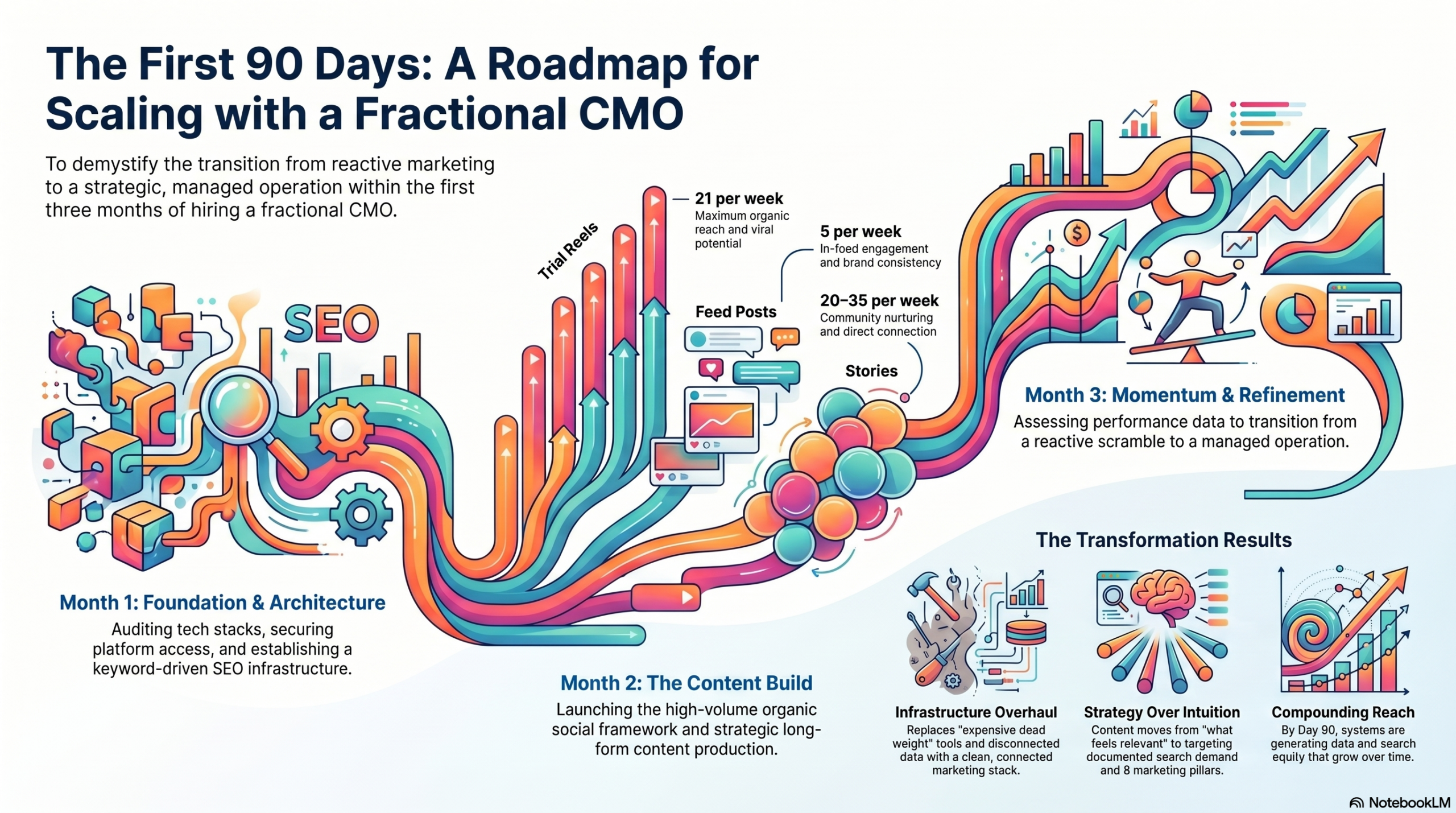
Month One: The Foundation Phase
The first month is not about content output. It is about clarity, access, and architecture.
I want to be straightforward about this because it is the part that can feel slower than expected. Month one is primarily a data-gathering and infrastructure month. We are not yet running at full content volume. We are building the foundation that everything else runs on.
Here is what that looks like in practice.
The onboarding call comes first. This is where we go behind the scenes. I need access to everything: website backend, Google Analytics, Google Search Console, all active social media platforms, your email marketing platform, your CRM, your scheduler, and any other tools in your marketing stack. If access has not been set up, we make a list and work through it systematically. If certain platforms are not yet active or need to be launched, we identify those and add them to the priority queue.
Most businesses are surprised by how much of this work has never been done cleanly. Google Search Console is either not set up, not verified, or not connected to Analytics. Social media platforms exist but have inconsistent branding. The website has plugins and tools running that nobody remembers installing. Getting clean access to a fully connected marketing infrastructure is genuinely foundational, and it takes time to do it right.
The tech stack audit follows. I am looking at every tool you are paying for and evaluating whether it is earning its place. What is redundant? What is underused? What is creating friction rather than solving it? What is missing? This is also where we assess current vendor relationships and their effectiveness. Agencies, contractors, freelancers: everyone who touches your marketing gets evaluated against what they are actually delivering.
Keyword research and search infrastructure come next. Before we create a single piece of content, we need to know what your target audience is actually searching for. Most businesses that come to me have never done real keyword research. They have been creating content based on what feels relevant rather than what has demonstrable search demand. We fix that in month one so that every piece of content we build from month two onward is targeting real opportunity.
The 8 marketing pillars assessment shapes our priorities. I use a marketing strategy framework built around eight core pillars: Attract and Engage, Capture and Convert, Nurture Relationships, Book and Close, Paid to Perform, Deliver and Delight, Upsell and Cross-Sell, and Amplify the Love. In month one, we assess where you currently stand across all eight. Most businesses are strong in one or two pillars and almost completely absent from the others. Understanding that map tells us exactly where the highest-value work is.
From the pillars assessment, we identify the top three priorities. For most clients, those priorities are Google Search Console and SEO infrastructure, organic social media creation and repurposing, and long-form content such as blog posts and newsletters. But every business is different. The assessment tells us what your specific gaps are so we are not applying a generic template to a unique situation.
AI integration gets dialed in during month one as well. I spend time understanding how the team is currently using AI tools, where they are underutilizing them, and where we can build workflows and prompts that make the team more efficient. This is not about replacing the team. It is about making sure everyone is using available tools at their full capability so that human effort goes where it creates the most value.
We meet a lot in month one. That is intentional. I am learning the team, understanding who does what, and identifying where communication and execution gaps exist. I need to understand the business from the inside before I can build the right marketing architecture for it. The meeting frequency pulls back significantly in month two as systems are established and the team has clarity on their roles within the new framework.
The honest reality of month one is that it can feel like a lot of setup with not much visible output yet. That is normal and it is correct. The businesses I have seen try to skip the foundation phase and jump straight to content production end up rebuilding everything later anyway. The month one investment in infrastructure and clarity is what makes months two and three actually work.
Month Two: The Build Phase
Month two is where the system starts coming to life.
By the start of month two, we have clean access to everything, a clear keyword strategy, a prioritized list of gaps across the marketing pillars, and a content architecture built around your core topics. Now we build.
Organic social media content production starts in earnest. This means implementing the full content framework: 21 Trial Reels per week, five feed posts, two carousels, and 20 to 35 stories, all created natively for Instagram and then repurposed via scheduler across your other active platforms. If you want to understand how that content framework generates over 1,500 pieces of content per month, I break down the full system in detail in my organic social media marketing overview. The Trial Reels component specifically is one of the highest-leverage organic reach tools available right now, and I cover the full strategy in my Instagram Trial Reels viral framework.
Long-form content production begins. Blog posts and newsletters get built around the keyword targets we established in month one. These are not generic pieces. They are strategically structured to target real search demand, build topical authority in your niche, and serve as the source material for your social content clusters. One strong blog post or newsletter becomes the anchor for an entire week of social content across every platform.
We also have real data to work with now. Month one gave us a baseline. Month two gives us the first performance signals. Which content formats are resonating? Which platforms are showing early traction? Which keywords are starting to index? That data shapes the ongoing execution decisions so we are not operating on assumptions.
Any infrastructure gaps that were identified in month one get addressed. If a website needed updates, we are working on that. If platforms needed to be launched, they are live. If tech needed to be consolidated or replaced, that process is underway. Month two is execution mode.
The meeting cadence drops in month two. Instead of frequent check-ins to gather information and set direction, we move to a more structured rhythm focused on review, adjustment, and forward planning. The team has clarity. The systems are running. The work shifts from building to operating.
Month Three: The Momentum Phase
Month three is when the compounding effect begins to show up.
Content that was published in month two is starting to index in search. Social content is generating engagement data. The repurposing system is running. The team is operating inside a clear framework rather than reacting to whatever feels most urgent on any given day.
This is also the phase where we assess and refine based on three months of data. What is performing? What is underperforming? Which marketing pillars that were gaps in month one have been addressed, and which still need work? What is the next priority layer?
By the end of month three, a business that came in with disconnected tools, inconsistent content, patched-together technology, and no clear content strategy has a functioning marketing system. Not a perfect one. Marketing is never finished. But a system that is running, generating data, and building compounding organic reach rather than starting from zero every month.
That shift is significant. It changes how the business approaches marketing from a reactive scramble into a managed, measurable operation.
What Most Businesses Actually Look Like When They Come In
I want to be honest about this because it affects expectations.
Most businesses that hire a fractional CMO are not starting from a clean slate. They are starting from a complicated one.
The most common picture I walk into looks like this. No Google Search Console setup or a setup that has never been verified. Analytics that exist but are not connected to anything actionable. Social media platforms that are partially active, inconsistently branded, and posting without a content strategy. A technology stack that has grown through addition rather than intention: tools that overlap, tools that are not being used, subscriptions that are costing money without delivering value. A team that is working hard but without a clear framework connecting their individual efforts to business outcomes.
None of this is a failure. It is what happens when a business grows and marketing gets built reactively around immediate needs rather than strategically around long-term architecture. The fractional CMO role exists precisely to bring that architecture in without requiring a full-time executive hire.
Some businesses will also need to make more significant changes in the first 90 days. Website rebuilds or significant updates are not uncommon. Platform migrations happen. Vendor relationships that are not serving the business need to be restructured or ended. These things take time, and they are worth doing correctly rather than quickly.
The timeline I have outlined accounts for these realities. Month one is explicitly designed to uncover and address them.
What You Should Reasonably Expect at 90 Days
Let me be direct about what 90 days does and does not produce.
At 90 days, you should have a clean, connected marketing infrastructure with proper access and tracking in place. You should have a keyword strategy and a content architecture built around real search demand. You should have an organic social media system running at meaningful volume. You should have a library of long-form content that is beginning to build search equity. You should have clarity on where all eight of your marketing pillars stand and a prioritized roadmap for the ones that need development.
What you will not have at 90 days is full organic search traction. SEO is a longer game. The content you build in months one through three will continue earning traffic for months and years after it is published, but the compounding effect takes time to show up in search rankings. Setting realistic expectations around that timeline is part of the work.
You also will not have a system that runs entirely without attention. Marketing is a living function. It requires ongoing management, adjustment, and optimization. What the first 90 days gives you is the architecture and momentum to make that ongoing work efficient and strategic rather than reactive and exhausting.
Is a Fractional CMO Right for Your Business Right Now
The fractional CMO model works best for specific business situations. It is worth being honest about what those are.
You are a good candidate for this engagement if you have a marketing budget that justifies strategic leadership but cannot yet support a full-time CMO salary. You are past the stage of figuring out your core offer and are now focused on scaling your reach and marketing effectiveness. You have a team or contractors who can execute once direction is clear. And you are ready to build systems rather than just produce more content.
If your business is earlier stage and still validating its offer, a fractional CMO may be premature. If you are looking for someone to execute content rather than architect strategy, an agency or contractor may be the better fit. The fractional CMO role is a strategic leadership role. It is most valuable when the business is ready for that kind of leadership.
If you are not sure where you fall, that is exactly what the discovery call is for.
The Right Time to Have the Conversation
The businesses that get the most from the first 90 days are the ones that come in ready to share access, ready to assess what is not working honestly, and ready to build before they see results.
If that describes where you are, the conversation is worth having.
You can learn more about how I work and what the engagement looks like through my Fractional CMO services page. Or if you are ready to have the discovery call, you can book directly from there.
The first conversation costs you nothing. It might save you more than you expect.
Frequently Asked Questions
What happens in the first 90 days with a fractional CMO? The first 90 days typically move through three phases: foundation in month one, where infrastructure, access, and strategy get established; build in month two, where content production and systems launch; and momentum in month three, where the system begins compounding and data starts informing ongoing decisions. The specifics vary by business, but the sequence is consistent.
How quickly will I see results after hiring a fractional CMO? Early signals, engagement data and initial content performance, start showing up in month two. Meaningful organic search traction typically builds over three to six months as content indexes and compounds. The first 90 days builds the architecture that makes results possible; the compounding payoff arrives in months four through twelve and beyond.
What does a fractional CMO actually do day to day? In the early months, a fractional CMO is primarily building infrastructure, establishing strategy, directing content production, assessing vendors and technology, and aligning the team around a clear marketing framework. As systems mature, the day-to-day shifts toward oversight, optimization, and strategic decision-making based on performance data.
Do I need a team in place before hiring a fractional CMO? Not necessarily, but it helps. A fractional CMO is a strategic leadership role, not an execution role. The more execution capacity you have in place, whether that is internal team members or contractors, the faster you can implement what the fractional CMO is building. If you have no execution resources, that gets addressed in month one as part of the infrastructure assessment.
How much does it cost to hire a fractional CMO? Fractional CMO engagements vary significantly based on scope, hours, and the specific needs of the business. The model is designed to provide executive-level strategic leadership at a fraction of the cost of a full-time CMO. The discovery call is the right place to discuss whether the investment makes sense for your specific situation.
What is the difference between a fractional CMO and a marketing agency? A marketing agency executes specific tactics: content creation, paid advertising, SEO work, social media management. A fractional CMO provides the strategic leadership that directs those tactics. Many businesses need both: a fractional CMO to set direction and oversee strategy, and execution resources including agencies or contractors to implement it. In the first 90 days, part of the fractional CMO’s job is often assessing whether existing agency relationships are delivering value.
How many hours per week does a fractional CMO typically work? This varies by engagement. Early months tend to be more time-intensive as infrastructure is being built and the business is being assessed. As systems mature and the team has clarity, the fractional CMO’s involvement often shifts to a more advisory cadence. Scope is established during the discovery and onboarding process.
What should I have ready before the first onboarding call? As much access as possible. Login credentials for your website, Google Analytics, Google Search Console, all active social media platforms, your email marketing tool, your CRM, and your scheduler. If you do not have access to some of these or they are not set up, that is fine. Identifying what is missing is part of what the onboarding call is for.
Leave Your Comment