

Everyone wants to know the best time to post on Instagram. Type that question into Google and you will get a hundred articles telling you to post at 9 AM on Tuesdays or 6 AM on Wednesdays, each one citing slightly different data and each one missing the most important point.
Timing matters differently depending on what you are posting and who you are trying to reach.
For Trial Reels specifically, the timing conversation is more nuanced than it is for regular feed content. Trial Reels are shown to non-followers first, which means you are not just trying to reach people who already know you. You are trying to reach cold audiences who have no existing relationship with your brand. That changes the calculation.
In this post I am going to walk through what the current data says about the best trial reels posting time, what Instagram’s new scheduling capability means for your strategy, and the one eligibility requirement you need to hit before any of this is relevant to you.
What Trial Reels Are and Why Timing Works Differently
Before we get into timing windows, a quick foundation for anyone who is new to the feature.
Trial Reels are a distribution option Instagram launched in December 2024. When you post a Trial Reel, Instagram shows it to a sample of non-followers first, before it ever goes to your existing audience. You get data on how that cold audience responds: completion rates, likes, shares, saves, profile clicks: and then you decide whether to push it to your main feed or let it run as a test.
If you want the full breakdown of how Trial Reels work and how to build a strategy around them, I cover that in detail in my Instagram Trial Reels viral framework.
For timing purposes, the key distinction is this: regular feed content is initially shown to your followers, people who have already opted into your content and are predisposed to engage with it. Trial Reels are shown to strangers. Strangers have shorter attention spans, lower tolerance for content that does not immediately hook them, and no existing reason to stop scrolling for you.
That means when you post a Trial Reel, you need that cold audience to be in a receptive, scrolling mindset. Not rushed, not distracted, not multitasking through a lunch break. You need them to have time to watch.
That context shapes everything that follows.
The other element most people don’t know is the first 72 hours are the window that will show you what you need to know.
If it hits the first 24-48 DO NOT post it to your feed. Wait the full 72 hours it can go viral here with no other push.
If you release it to your feed or post it natively one of two things will happen. You post on your feed will compete with the post in trials or you will kill the viral in your trials.
I personally wait the 72 hours if it hits acceptable engagement I then post the winner to my feed. I don’t usually release it unless:
You have an extremely viral post you need to attach automations to. I had a clients reel reach 250 comments and I needed it to have automated follow up so it got released and automated for that purpose.
The 1,000 Follower Requirement: Your First Milestone
This is the piece most articles skip over, so I want to address it directly before we go any further.
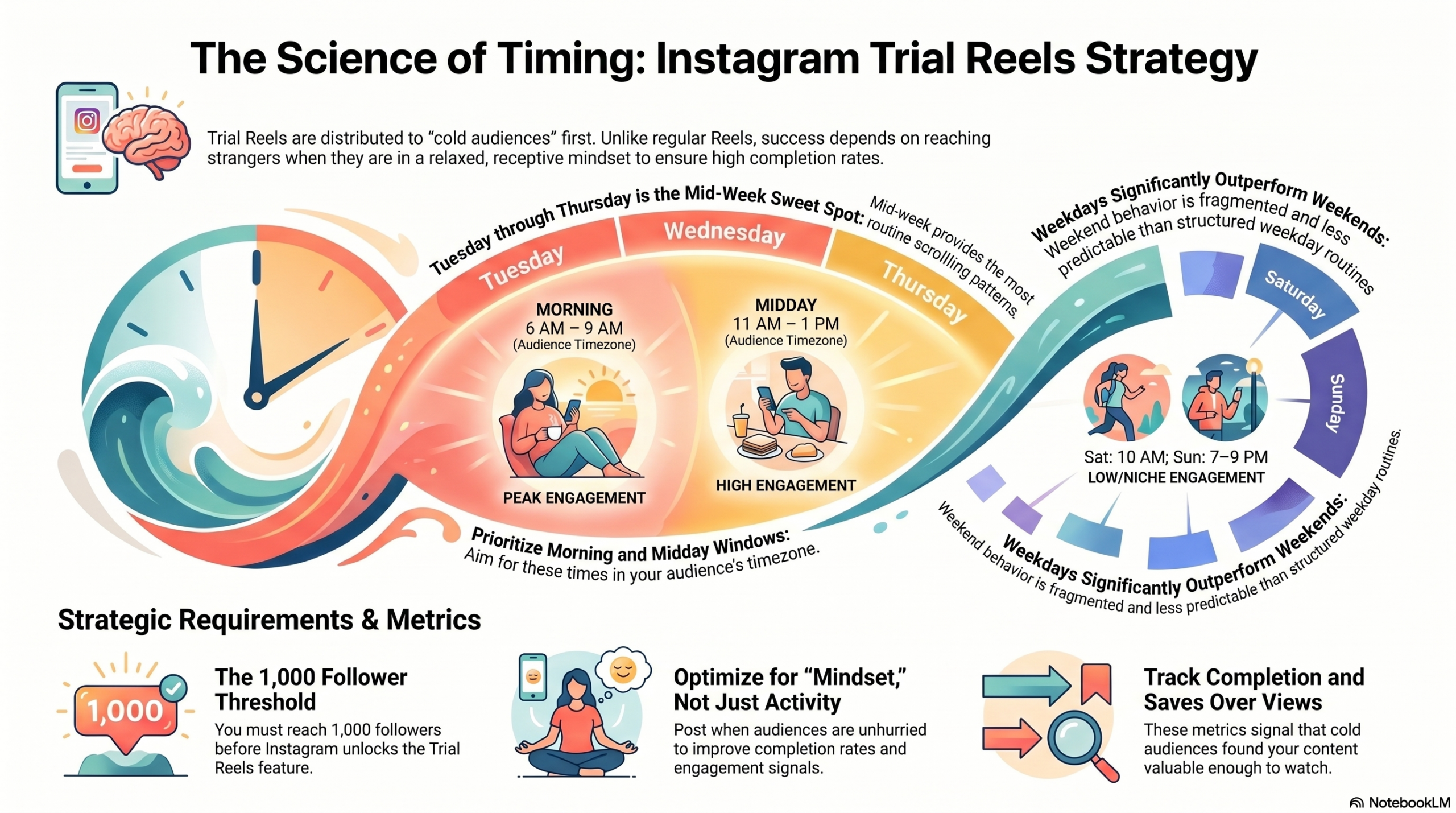
Trial Reels are not available to every Instagram account. To access the feature, you need a minimum of 1,000 followers. This is Instagram’s eligibility threshold, and there is currently no workaround for it.
If your account is below 1,000 followers, your immediate priority is not optimizing Trial Reels timing. Your immediate priority is building to that threshold so the feature unlocks. That means consistent posting, strong hooks, content that earns follows rather than just views, and an organic social media marketing strategy designed to convert new viewers into followers.
Once you cross 1,000 followers, Trial Reels become available and the timing conversation becomes relevant.
For accounts that are already past that threshold, keep reading. For accounts that are not there yet, bookmark this post and come back when you are.
What the 2026 Data Says About the Best Time to Post Reels
Let me be upfront about something. There is no universal best time to post Trial Reels that applies to every account, every audience, and every niche. Anyone telling you otherwise is oversimplifying. The right time for your account is ultimately determined by when your specific audience is active, which you find in your Instagram Insights.
That said, there are clear patterns across large datasets that give you a reliable starting point. Here is what the current 2026 research consistently shows.
Weekdays significantly outperform weekends. Across multiple studies analyzing hundreds of thousands of Reels, Monday through Thursday deliver the most consistent engagement. Weekend reach is lower and less predictable because audience behavior fragments: people are out, traveling, running errands, checking their phones in shorter, more scattered bursts. The routine scrolling patterns that make weekday posting so reliable simply do not exist at the same level on Saturdays and Sundays.
If you must post on weekends, Saturday mid-morning between 10 AM and 11 AM and Sunday evening between 7 PM and 9 PM tend to be the strongest windows.
Tuesday, Wednesday, and Thursday are the strongest days. Midweek is when people are most settled into their routines, most likely to be taking genuine breaks, and most likely to engage with content in a sustained way rather than just scrolling past it.
Morning windows perform well for a specific reason. Posting between 6 AM and 9 AM means your Reel is already in circulation when your audience starts their day. Many creators post at 11 PM or midnight specifically so their content is waiting in feeds first thing in the morning. The logic is that early indexing by the algorithm, combined with a fresh morning audience, gives the Reel its best shot at building early momentum.
Midday remains a strong window. The 11 AM to 1 PM window captures lunch breaks and mid-morning scrolling sessions. Research from multiple platforms consistently identifies this as one of the highest-engagement windows of the day, particularly for business and professional audiences.
Early afternoon holds up. The 3 PM to 4 PM window performs reliably, capturing the mid-afternoon energy dip when people reach for their phones.
Avoid the late-night dead zone. Engagement rates drop significantly between 10 PM and 6 AM. There are exceptions: some niches with global audiences use late-night posting strategically to hit overseas peak hours: but for most accounts targeting U.S. audiences, this window is the weakest.
To summarize the starting framework: post Trial Reels on Tuesday, Wednesday, or Thursday, between 6 AM and 9 AM or 11 AM and 1 PM in your primary audience’s time zone. That gives you the best statistical chance of landing in an active, scrolling feed with a receptive cold audience.
Then let your own Insights data refine from there.
Why Trial Reels Timing Has a Layer That Regular Reels Do Not
Here is where Trial Reels diverge from standard timing advice.
When you post a regular Reel, Instagram’s algorithm first distributes it to your followers. That initial engagement from people who already know and like you signals to the algorithm that the content is worth pushing further. Your existing audience is your launch pad.
When you post a Trial Reel, that follower launch pad is temporarily removed from the equation. The initial audience is cold. They do not know you. They have no reason to give your content extra charity.
This means the algorithm is evaluating your Trial Reel entirely on the merit of how strangers respond to it. Completion rate. Saves. Shares. Profile clicks. Those signals have to come from people who have never seen you before.
The practical implication for timing is that you want to post Trial Reels when cold audiences are most likely to watch all the way through. That generally means posting when people are in a relaxed, unhurried state rather than rushing through a quick scroll.
A Trial Reel posted at 6:30 AM on a Tuesday has a better chance of being watched through by someone having their morning coffee than the same Reel posted at 12:45 PM when someone has seven minutes left on their lunch break.
This is not a hard rule. But it is a behavioral reality worth factoring into your scheduling decisions.
Instagram Now Lets You Schedule Trial Reels
In March 2026, Instagram rolled out the ability to schedule Trial Reels in advance. This is a meaningful update for creators and businesses running a high-volume Trial Reels strategy.
Previously, you had to post Trial Reels manually in real time, which created friction around hitting optimal posting windows consistently. If your best window is 6:30 AM on Tuesdays and Thursdays but you are not a person who wakes up to post content at 6:30 AM, you were leaving performance on the table.
Scheduling changes that. You can now batch-create your Trial Reels, set them to go live at your optimal times, and let the system handle the distribution while you sleep.
I want to be transparent here: the scheduling feature has rolled out to some accounts but not all yet, including mine. If you do not see the scheduling option in your Trial Reels workflow, that is normal. Instagram is phasing this out gradually, and it will become universally available over time.
When you do have access, the workflow becomes significantly more efficient. You can sit down once or twice a week, load your Trial Reels into the scheduler at your target posting windows, and run a consistent timing strategy without being tethered to your phone around the clock.
Combined with a repurposing scheduler like GHL for your other platforms, this brings your entire content operation into a managed, systematized cadence rather than a reactive posting scramble.
How to Find Your Own Best Trial Reels Posting Time
General benchmarks are a starting point. Your Instagram Insights are the finish line.
Here is the process I walk clients through when we are dialing in their Trial Reels timing.
Step 1: Check your audience activity in Instagram Insights. Go to your professional dashboard, navigate to your audience data, and look at the days and hours your followers are most active. Yes, Trial Reels are shown to non-followers, but your follower activity data is a reasonable proxy for when your target audience in general is using the platform. Start there.
Step 2: Cross-reference with the benchmark windows. If your Insights show peak activity on Wednesday mornings, and Wednesday mornings align with the general benchmark data, that is a strong signal to prioritize that window.
Step 3: Post at least three to five Trial Reels in your target window before drawing conclusions. One data point is not a pattern. You need enough Reels posted in a consistent window to start seeing whether that timing is working for your specific account and audience.
Step 4: Track the right metrics. For Trial Reels specifically, the metrics that matter most are completion rate, saves, shares, and profile clicks. These are the signals that indicate a cold audience found your content valuable enough to engage with beyond a passive scroll. A high view count with low completion rate tells you the content is getting distributed but not connecting. A moderate view count with high completion rate and saves tells you the content is resonating deeply with the people who do watch it.
Step 5: Adjust and repeat. Once you have data from 10 to 15 Trial Reels posted in your target windows, you will start to see patterns. Double down on what is working. Test adjacent windows when you have the capacity to experiment.
This is not a one-time optimization. It is an ongoing calibration.
The Timing Mistake Most Businesses Make With Trial Reels
I want to address a very common misconception before we close.
A lot of businesses approach Trial Reels timing as if it is the primary driver of performance. They spend significant energy optimizing their posting schedule and then feel frustrated when results are inconsistent.
Here is the reality: timing is a distribution factor, not a quality factor.
Posting at the right time gets your Trial Reel in front of more eyes during a higher-engagement window. It does not make weak content perform well. A Trial Reel with a poor hook, low production quality, or content that does not connect with a cold audience will underperform regardless of when it is posted.
The hierarchy is: great content first, great timing second.
When you have great content posted at great times, the compounding effect is real. When you have mediocre content posted at great times, you just get more people scrolling past faster.
Invest in your content quality and your hook before you invest in perfecting your timing strategy. Then layer timing on top as the optimization layer it is.
Putting It Together: A Trial Reels Timing Framework
Here is a simple framework to implement what we have covered.
Your default posting windows: Tuesday through Thursday, 6 AM to 9 AM or 11 AM to 1 PM in your primary audience’s time zone.
Your secondary windows: Monday and Friday in the same morning and midday slots. These perform less consistently than midweek but still outperform weekends significantly.
Weekend approach: If you are posting on weekends, Saturday 10 AM to 11 AM or Sunday 7 PM to 9 PM. Keep expectations calibrated: weekend Trial Reels tend to build more slowly.
Your scheduling workflow: Once the scheduling feature becomes available on your account, batch your Trial Reels into your target windows at the start of each week. Use your broader scheduling tool (I use GHL) for repurposing content across other platforms on the same timing logic.
Your refinement process: Check your Insights monthly and compare performance across posting windows. Adjust your default windows based on what your own data is telling you.
The goal is a consistent, data-informed posting cadence that removes the guesswork and the manual effort from your timing decisions: so you can put your energy into the content itself.
The Bigger Picture
Timing is one variable in a much larger organic reach equation. The businesses I work with that see the most significant results from Trial Reels are not the ones who have perfected their posting schedule. They are the ones who have built a systematic content operation: consistent volume, strong hooks, clear content pillars, and a repurposing system that multiplies every piece of content across platforms.
Timing optimization matters and it is worth getting right. But it works in service of a larger strategy, not as a substitute for one.
If you are building that larger strategy and want a partner to help architect it, that is the work I do as a Fractional CMO. We build the systems, set the cadence, and get the content machine running so that every Trial Reel you post is working as hard as it can.
Frequently Asked Questions
How long do Trial Reels take to get views? Most Trial Reels generate their first views within 24 to 48 hours, with the complete performance picture forming over 72 hours. Judge a Trial Reel on its full 72-hour run, not its first few hours, and resist releasing it to your main feed during that window.
What is the best trial reels posting time for maximum reach? The strongest windows based on 2026 data are Tuesday through Thursday between 6 AM and 9 AM or 11 AM and 1 PM in your primary audience’s time zone. These windows capture morning and midday scrolling behavior when audiences are most likely to watch content through to completion. Use these as your starting point and refine based on your own Instagram Insights data.
Do you need 1,000 followers to use Trial Reels? Yes. Instagram requires a minimum of 1,000 followers to access the Trial Reels feature. If your account is below that threshold, focus on building your following with consistent, high-quality content before Trial Reels become available to you.
Can you schedule Trial Reels in advance? Yes, as of March 2026 Instagram began rolling out Trial Reels scheduling to creators. The feature is not yet available to all accounts and is being phased in gradually. When it becomes available on your account, you can schedule Trial Reels to post at your optimal timing windows without having to be manually present to post them.
Does posting time matter more for Trial Reels than regular Reels? The stakes are slightly higher for Trial Reels because your initial audience is cold rather than warm. Regular Reels get their initial push from followers who already know you. Trial Reels are shown to strangers first, so you want that cold audience to be in a relaxed, engaged state when your content reaches them. The right timing window supports that.
How many Trial Reels should I post per week? I recommend 21 Trial Reels per week as part of a full organic social media strategy. That is three per day, which gives you enough volume to generate meaningful performance data while building consistent reach with non-follower audiences. If you are just starting out, begin with seven per week and build from there.
Should I post Trial Reels at the same time as my regular feed content? You can, but there is a strategic case for staggering them. If you post a Trial Reel and a feed post at the same time, you are competing with yourself for the algorithm’s distribution attention. Spacing them out by a few hours gives each piece of content its own initial momentum window.
What metrics should I track to evaluate Trial Reels timing? Focus on completion rate, saves, shares, and profile clicks. These are the engagement signals that indicate a cold audience connected with your content. High completion rates and saves with a given posting window suggest that timing is working well for your audience. Low completion rates despite strong reach suggest the content hook needs work regardless of timing.
What happens if I post Trial Reels during off-peak hours? Your Trial Reel will still be distributed, but it will compete in a less active feed environment with fewer immediate engagement signals. This can slow the initial momentum the algorithm needs to push the content further. It is not catastrophic, but it is leaving potential reach on the table. Consistent off-peak posting is a habit worth correcting.
Leave Your Comment