

Every time a new Instagram feature drops, the same question follows: does this actually work or is it just another thing to add to the to-do list?
Trial Reels is different. I know that because I have the data to prove it, and the data doesn’t lie.
If you have been wondering whether Trial Reels increases views, reach, interactions, and real business results, the answer is yes. But the more important question is not whether it works. It’s whether you are using it the right way. Because Trial Reels used strategically is one of the most powerful tools available to businesses building an organic social presence right now. Trial Reels used without a framework is just more content that goes nowhere.
Let me show you what the data shows, why it works, and how to use it as a strategic asset rather than an afterthought.
Why Reels Are the Most Important Content Format on Instagram Right Now
Before we talk about Trial Reels specifically, you need to understand the environment it operates in, because the platform-wide numbers explain exactly why getting your Reels strategy right matters so much.
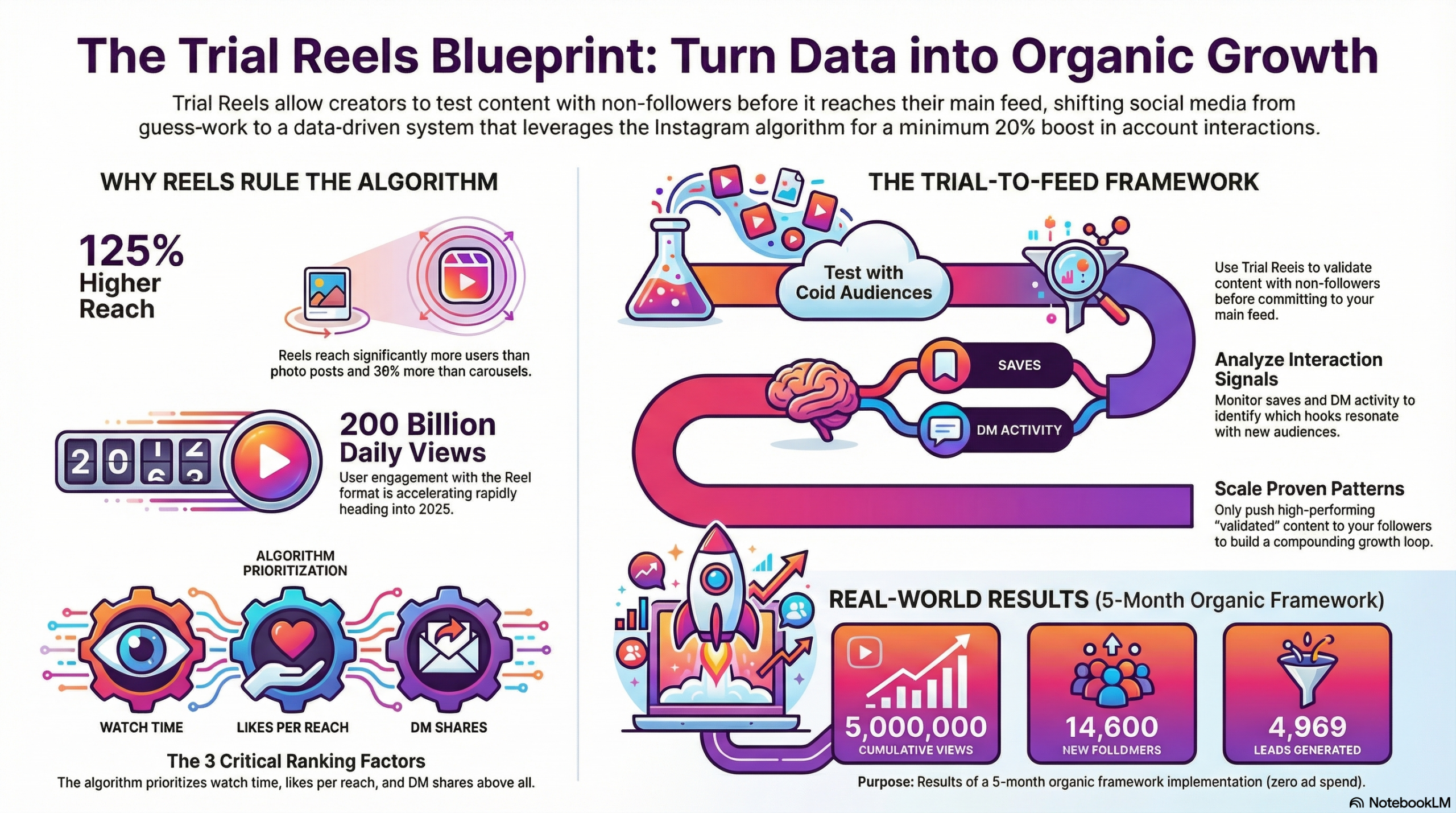
Instagram has over 2 billion monthly active users engaging with Reels. In 2025, users watch an estimated 200 billion Reels per day, up from 140 billion in late 2022. That is not a content format that is slowing down. It is accelerating.
The engagement advantage Reels holds over every other content format on the platform is significant. Reels receive 22% more interaction than standard video posts. The engagement rate for Reels sits at 1.23%, compared to 0.70% for photos and 0.99% for carousels. On average, Reels reach 36% more users than carousels and 125% more than photo posts.
Read that last number again. Reels reach 125% more users than photo posts. If your content strategy is still built primarily around static images, you are leaving an enormous amount of organic reach on the table.
The behavior data reinforces this. 80% of Reels are viewed with sound on, which means your audio strategy matters as much as your visual strategy. Reels are reshared 4.5 billion times per day through direct messages, making them the most shared content format on the platform by a significant margin.
And if you are wondering what the algorithm is looking for when it decides whether to amplify your Reels, Instagram head Adam Mosseri has confirmed that the three most important ranking factors are watch time, likes per reach, and DM shares. Those three signals determine whether your content stays small or gets distributed broadly.
One more thing worth noting if you have been confused by a recent change in your analytics: as of April 2025, Instagram replaced the separate Plays and Impressions metrics with a unified Views metric that counts any time a video appears on screen, even without playback. If your numbers look different than they used to, that is why.
Understanding this landscape is important because it is the context in which Trial Reels operates. When you use Trial Reels strategically, you are specifically optimizing for the signals that the algorithm rewards most. That is not a coincidence. It is exactly why it works.
What Are Trial Reels?
Trial Reels is an Instagram feature that allows you to publish a Reel to non-followers before it ever appears on your main feed or reaches your existing audience. Instagram distributes the Reel to people who don’t currently follow you, giving you a real-world performance test with a cold audience before you commit to posting it to your main feed.
If the Reel performs well with non-followers, you can then push it to your main feed knowing it has already been validated. If it underperforms, you can make adjustments, try a different angle, or simply move on without having exposed a weak piece of content to the audience you have already built.
That testing mechanism is one of the two most powerful things about Trial Reels. The other is what happens to your overall account performance when you use it consistently.
Does Trial Reels Increase Views and Interactions?
Yes. And the increase is not marginal.
Accounts using Trial Reels strategically see a minimum 20% increase in overall account interactions. Not just views on the Trial Reel itself, but interactions across the account including comments, shares, saves, profile visits, and follows.
That number matters because interactions are the currency the Instagram algorithm uses to decide who sees your content next. Remember those three ranking factors Mosseri confirmed: watch time, likes per reach, and DM shares. When your interaction rate goes up, your algorithmic standing goes up. When your algorithmic standing goes up, your content finds more of the right people. When your content finds more of the right people, your lead pipeline grows.
Trial Reels doesn’t just increase views on a single piece of content. Used consistently, it raises the performance ceiling for your entire account.
The reason this happens is rooted in how the algorithm works. When a Trial Reel earns strong engagement signals from non-followers, the algorithm registers that as proof the content is worth distributing more broadly. That signal carries over to your account’s overall standing. You are essentially teaching Instagram that your account produces content worth amplifying, and it responds accordingly.
The Content Testing Advantage Nobody Talks About Enough
The 20% interaction increase gets most of the attention when people talk about Trial Reels. But the content testing capability is equally valuable and significantly underused.
Most businesses post content based on instinct or trend-chasing. They spend time creating a Reel, publish it to their main feed, and then find out whether it resonates based on how their existing audience responds. If it underperforms, the damage is already done. A weak piece of content has been pushed to the people most important to their business.
Trial Reels flips that model entirely.
When you use Trial Reels as a testing system, you are making decisions based on data rather than guesses. You find out whether a hook lands before it reaches your main feed. You learn whether a particular content format drives saves and shares before you commit to creating more of it. You identify which topics generate the strongest watch time, likes per reach, and DM shares from cold audiences, which are exactly the signals the algorithm uses to determine distribution.
This is the difference between a content strategy and a content experiment. One is built on repeatable, validated frameworks. The other is built on hope.
I use Trial Reels as a core part of the content testing system I build for clients as a Fractional CMO specifically because it removes the guesswork from content decisions. When we know what works with cold audiences before it ever hits the main feed, we can build a content calendar around proven performers rather than hoping something lands.
What This Looks Like With Real Numbers: A Case Study
I want to show you what happens when Trial Reels is used as part of a complete strategic framework rather than as a standalone tactic, because that’s where the real results live.
I work with a hospitality client in a market where paid advertising is not an option. No ad budget. No boosted posts. No shortcuts. The only path to growth was organic social media, and Trial Reels became a central pillar of the framework we built.
The Build Phase
The first five months were about building the system. We established consistent content rhythms, identified the content types that drove the strongest engagement signals, and used Trial Reels to test and validate content before it hit the main feed. Every piece of content that made it to the primary feed had already proven itself with a cold audience. Nothing was published to their existing followers based on a guess.
This phase required patience. The results were compounding in the background, but the full weight of what we built wasn’t visible yet.
What the Framework Delivered
In month five, with the system fully built and firing, this client’s organic social media strategy delivered:
5 million cumulative views across content
527,000 accounts reached
167,000 interactions
14,600 new followers
4,969 leads generated
456 agent referrals
7 viral posts
Zero ad spend. Zero paid promotion. A framework applied consistently until the compounding effect took over.
Trial Reels was not the only component of this result, but it was a foundational one. The content testing capability it provided meant that every piece of content reaching the main feed had already been validated. The interaction increases it drove fed the algorithm signals that expanded organic reach. The viral posts that contributed to 5 million views were identified and amplified because the testing system told us what was working before we committed to it.
This is what Trial Reels looks like when it’s part of a strategy rather than a feature you’re using because you heard it was good.
Why Most Businesses Are Not Getting These Results From Trial Reels
If Trial Reels increases interactions by a minimum of 20% and provides a built-in content testing system, why aren’t more businesses seeing results like the ones above?
The answer is almost always one of three things.
They’re using it as a one-off tactic, not a system. Posting one Trial Reel to see what happens is not a strategy. The results come from consistent, systematic use over time. One test gives you one data point. A hundred tests over five months gives you a validated content framework.
They’re not reading the data correctly. Trial Reels gives you performance information about how non-followers respond to your content. If you’re not using that data to inform what you create next, you’re leaving the most valuable part of the feature unused. With the shift to the unified Views metric in April 2025, understanding what you’re measuring is more important than ever.
They’re posting the wrong content types. Not every content format performs the same way with cold audiences. Certain hooks, formats, and topic angles consistently outperform others when reaching non-followers. Building a testing framework around identifying those patterns is where the compounding results come from.
Trial Reels is a tool. Like any tool, what you get out of it depends entirely on how you use it.
How to Use Trial Reels Strategically
If you want to see the kind of results the data shows are possible, here is the Trial Reels framework I use with clients.
Test before you post to your main feed. Every Reel that is a candidate for your primary feed should go through Trial Reels first. This is non-negotiable if you want to build a data-driven content strategy rather than a guessing game.
Track the right metrics. With Instagram’s shift to the unified Views metric, focus on completion rates, saves, shares, and DM activity alongside views. These signals directly correspond to the ranking factors the algorithm rewards most: watch time, likes per reach, and DM shares.
Build a content validation system. After consistent Trial Reels use, patterns will emerge. Certain hooks will consistently outperform others. Certain topics will drive stronger save rates. Certain formats will generate more profile visits. Build your content calendar around those validated patterns, not around what you think should work.
Be consistent. The 20% interaction increase is a minimum threshold, not a guarantee on any single post. It reflects what accounts see when they use Trial Reels consistently as part of an ongoing content strategy. Sporadic use produces sporadic results.
Use the testing data to inform everything. What you learn from Trial Reels should influence your captions, your hooks, your content formats, and your posting frequency. It’s not just a distribution tool. It’s a feedback mechanism that tells you what your target audience responds to before you invest heavily in creating more of it.
The Bottom Line on Trial Reels and Views
Does Trial Reels increase views? Yes. But views are the beginning of the story, not the end of it.
The real value of Trial Reels is what a consistent 20% increase in interactions does to your overall account performance over time. It raises your algorithmic standing. It expands your organic reach. It compounds into follower growth, lead generation, and business results that paid advertising would cost you significantly more to achieve.
The content testing capability it provides is a strategic advantage most businesses are not using anywhere near as effectively as they could be. Knowing what works with cold audiences before it reaches your main feed is the difference between a content strategy built on data and one built on hope.
With 200 billion Reels watched every day on Instagram and Reels reaching 125% more users than photo posts, the businesses that figure out how to consistently produce high-performing Reels are the ones that will own organic reach on this platform for years to come.
Trial Reels, used strategically, is one of the fastest ways to become one of those businesses.
Frequently Asked Questions
Does Trial Reels increase views? Yes. Trial Reels increases overall account interactions by a minimum of 20%, which includes views, comments, shares, saves, and profile visits. The interaction increase feeds the algorithm signals that expand your organic reach across the entire account, not just on the Trial Reel itself.
What is the difference between a Trial Reel and a regular Reel? A regular Reel publishes directly to your main feed and is shown to your existing followers and potentially non-followers based on algorithm distribution. A Trial Reel is shown to non-followers only before it appears on your main feed, giving you a real-world performance test with a cold audience before you commit to posting it publicly.
Why did my Instagram views metric change in 2025? As of April 2025, Instagram replaced the separate Plays and Impressions metrics with a unified Views metric that counts any time a video appears on screen, even without playback. This aligns Instagram’s measurement approach with how TikTok measures performance and gives you a more consistent way to track content reach.
What are the most important ranking factors for Instagram Reels? Instagram head Adam Mosseri confirmed that the three most important Reels ranking factors are watch time, likes per reach, and DM shares. Trial Reels allows you to test and optimize for exactly these signals before your content reaches your main feed.
How long does it take to see results from Trial Reels? Individual Trial Reels provide performance data within the first 24 to 72 hours. The broader account interaction increases of 20% or more come from consistent, strategic use over time rather than from a single post. Building the full compounding effect typically takes several months of systematic application.
Can Trial Reels help my business generate leads? Yes, when used as part of a complete organic social media strategy. One hospitality client using Trial Reels as a core part of their framework generated 4,969 leads and 456 agent referrals in a single month with zero ad spend, after five months of consistently building and applying the system.
Do I need a large following for Trial Reels to work? No. Trial Reels is specifically designed to reach non-followers, which makes it effective regardless of your current follower count. It is one of the most accessible organic reach tools available precisely because it does not depend on the size of your existing audience.
What types of content perform best as Trial Reels? Content with strong hooks in the first two to three seconds, clear value delivery, and a specific call to action consistently outperforms generic content with cold audiences. With 80% of Reels watched with sound on, your audio matters as much as your visuals. The best way to identify what works for your specific business is to test consistently and let the data tell you what your target audience responds to.
Leave Your Comment