
What Is Organic Social Media Marketing?
There is a moment in almost every strategy conversation I have with a business owner where they say some version of the same thing: “We’ve been running ads but we’re not seeing the return we expected. What are we doing wrong?”
Sometimes the answer is the ads themselves. But more often than not, the real answer is that paid advertising was never the right primary strategy for their business in the first place.
That’s a hard thing to hear when you’ve already spent thousands of dollars testing campaigns. But it’s the truth, and part of my job as a Fractional CMO is to tell you what you need to hear, not what sounds good in a pitch deck.
Organic social media marketing is one of the most underutilized and misunderstood tools in a business owner’s arsenal. When it’s done strategically, with a real framework behind it and not just posting and hoping, it can outperform paid advertising on reach, lead quality, and long-term ROI. I’ve seen it happen. I have the data to prove it.
Let me show you exactly what organic social media marketing is, how it works, and how to know whether it’s the right strategy for your business.
Organic social media marketing is the practice of growing your brand, building your audience, and generating leads through content you publish on social media platforms without paying to promote it. No ad spend. No boosted posts. No sponsored placements.
Your results come entirely from the quality and strategy behind your content. The relevance of what you post, how well it resonates with your target audience, and whether the platforms algorithmically choose to distribute it beyond your existing followers.
That last part is where most businesses get it wrong. They treat organic social like a passive activity. Post something, wait for likes, repeat. That approach does not work and it never has. Organic social media marketing that actually moves the needle is an active, systematic, strategic discipline.
It involves knowing which content types perform on which platforms, understanding how algorithms decide what to amplify, building content that serves specific funnel stages, and measuring the right metrics to optimize over time.
When those elements are in place, organic social media becomes something remarkable: a lead generation engine that works around the clock without a monthly ad invoice.
Organic vs. Paid Social Media: Understanding the Difference
Before we go further, it’s worth drawing a clear line between organic and paid social media because the two are often conflated, and that confusion leads to poor strategic decisions.
Paid social media means you are paying a platform like Meta, Instagram, LinkedIn, or TikTok to show your content to a targeted audience. You define the parameters, set a budget, and the platform distributes your content to people who match your criteria. The moment you stop paying, the distribution stops.
Organic social media means your content earns its distribution through engagement signals. When people watch your videos, comment, share, save, or click through, the algorithm interprets that as a signal that your content is worth showing to more people. You build momentum over time, and that momentum compounds.
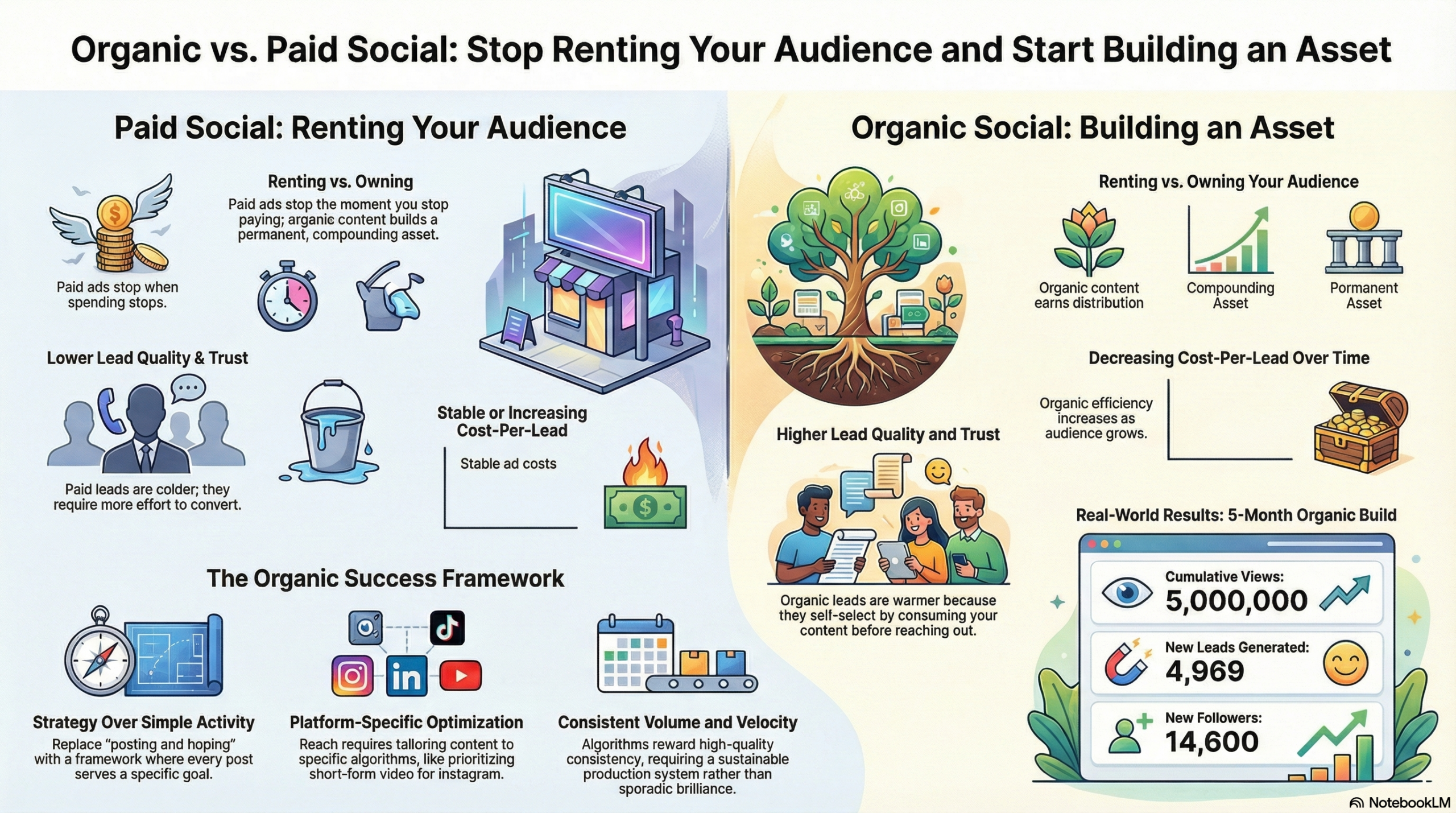
The key strategic difference is this: paid social rents your audience. Organic social builds one you own.
That distinction matters enormously for long-term business sustainability. A business built entirely on paid traffic is one algorithm change or budget cut away from losing its pipeline. A business with a strong organic social presence has an asset that continues working regardless of what happens to ad costs.
Why Organic Social Media Beats Paid for Some Businesses
I want to be precise here because I am not making the argument that organic social is universally superior to paid advertising. It isn’t. Paid ads have a legitimate place in a well-constructed marketing strategy, particularly for businesses with proven offers, clear targeting data, and the budget to test and optimize campaigns properly.
But for certain businesses and certain situations, organic social media is not just a viable alternative to paid. It is the better primary strategy. Here’s why.
1. Some Businesses Cannot Run Paid Ads
This is more common than people realize. Certain industries face platform-level restrictions that limit or entirely prohibit paid advertising. Real estate is one of the most significant examples. Travel and hospitality businesses in certain markets face similar constraints. Professional services businesses sometimes encounter compliance issues that make paid advertising legally complicated.
When paid is off the table, organic isn’t just preferable. It’s the strategy. And the businesses that treat that constraint as an opportunity rather than a limitation are the ones that build something truly differentiated.
2. Organic Social Produces Higher Quality Leads
This is something I see consistently across clients in different industries: the leads that come through organic social tend to be warmer, more qualified, and easier to convert than leads generated through paid campaigns.
The reason is straightforward. When someone finds your business through organic content, they have usually consumed multiple pieces of your content before they ever reach out. They know your voice, your perspective, your approach. They have self-selected based on resonance with what you’re saying and how you’re saying it.
A lead who has watched three of your videos and read your captions is in a fundamentally different mental state than someone who clicked an ad they saw once. The organic lead already trusts you. The paid lead is still evaluating whether you’re legitimate. That trust differential shows up in sales cycles, close rates, and client quality.
3. Organic Social Compounds Over Time
Paid advertising has a linear relationship with results. Spend more, get more. Spend less, get less. Stop spending, get nothing.
Organic social works differently. A piece of content you publish today can continue generating views, follows, and leads months or even years from now. A viral post from six months ago is still working for you today. An evergreen video that answers a common question in your industry keeps finding new audiences as long as the platform exists.
This compounding effect is one of organic social’s most powerful and least discussed advantages. The businesses that commit to a consistent organic strategy for twelve to eighteen months often find that their results in month twelve look nothing like their results in month one. Not because they got lucky, but because they built momentum that feeds itself.
4. Organic Social Is More Cost-Effective at Scale
Organic social is not free. It requires time, creative resources, and strategic expertise. If you are doing it properly, there is real investment involved. But the cost structure is fundamentally different from paid advertising.
With paid advertising, your cost per lead typically stays relatively stable or increases over time as ad fatigue sets in and audiences saturate. With organic social, your cost per lead tends to decrease over time as your audience grows, your content gets better, and your distribution builds. The longer you run the system, the more efficient it becomes.
What This Looks Like in the Real World: A Case Study in Compounding Organic Results
Check the full updated Details on this Case Study.
I want to show you what happens when organic social media is treated as a system rather than an activity, because data tells the story better than any theory.
I work with a hospitality client in a market where paid advertising is not an option. Not a budget decision. A hard constraint. No ad spend was possible. No shortcuts were available. The only path forward was building an organic social strategy that could generate real business results without a single dollar going to the platforms.
Most businesses in that situation would scale back their expectations. We did the opposite. We built a framework.
The Five-Month Build
The first five months were about construction, not conversion. We focused on building the infrastructure that would allow the strategy to compound. Establishing consistent content rhythms, training the algorithm on the account, identifying the content types that drove the strongest engagement signals, and systematically expanding reach through a viral framework built around Instagram Trial Reels.
This phase required patience and discipline. Results were building, but the real payoff hadn’t arrived yet. The machine was being assembled, not deployed.
Month five is when everything we built started firing at full capacity.
Month Five: When the System Paid Off
In a single month, with no ad budget, no paid promotion, no shortcuts, this client’s organic social strategy delivered:
5 million cumulative views across content 527,000 accounts reached 167,000 interactions 14,600 new followers 4,969 leads generated 456 agent referrals 7 viral posts
To put that lead number in context: nearly 5,000 leads in a single month is a result most businesses spend tens of thousands of dollars in paid advertising trying to manufacture. This client spent zero on ads to achieve it.
This was not a fluke. It was not a one-hit wonder built on a single piece of lucky content. It was the direct result of five months of consistent framework application. Every piece of content serving a purpose, every metric informing the next decision, every viral post building on the infrastructure we had spent months constructing.
The compounding effect I described earlier? This is what it looks like in real numbers. Five months of building a machine, and then in month five, the machine ran.
Their pipeline has not been the same since.
What Organic Social Media Marketing Actually Involves
One of the reasons so many businesses underperform with organic social is that they underestimate what a real organic strategy requires. Let me be direct about what it actually takes to do this well.
A Content Framework, Not a Posting Schedule
The first thing most businesses get wrong is confusing activity with strategy. Posting consistently is a prerequisite, not a strategy. What matters is what you post, why you post it, and how each piece of content serves a specific purpose in your overall marketing system. An effective organic social framework defines the types of content you create, whether educational, authority-building, proof-based, or conversion-focused, and maps each type to a specific audience goal. Every post should have a job.
Platform-Specific Optimization
Organic reach is not uniform across content types or platforms. Short-form video dramatically outperforms static images on Instagram and TikTok. LinkedIn rewards long-form written content differently than Instagram does. A sophisticated organic social strategy creates content optimized for the specific platform where it will live, not repurposed content crammed into a format it wasn’t designed for.
Consistent Volume and Velocity
Organic algorithms reward consistency. A business that publishes high-quality content five days a week will outperform one that publishes sporadically, even if the sporadic publisher occasionally creates brilliant content. This is why organic social requires a real content production system, with batching, templates, frameworks, and workflows that make consistency sustainable over months, not weeks.
Analytics and Optimization
The difference between a business that plateaus at modest organic reach and one that keeps scaling is data. You need to know which content types are performing, which topics resonate, what your completion rates look like on video, and which posts are driving actual business outcomes rather than just vanity metrics. I track completion rates, save rates, profile visits, link clicks, and direct lead attribution with every organic social client.
How to Know If Organic Social Is the Right Primary Strategy for Your Business
Not every business should make organic social their primary marketing channel. Here is how I evaluate whether it’s the right fit.
Organic social is likely the right primary strategy if:
- Your business operates in an industry with paid advertising restrictions or complications
- You have a strong point of view and genuine expertise that translates well into content
- Your sales cycle benefits from relationship and trust-building before a prospect reaches out
- Your target audience is actively consuming content on social platforms
- You have the resources to invest in consistent, high-quality content creation over at least six months
Organic social may not be the right primary strategy if:
- You need immediate, high-volume leads and have the budget to generate them through paid channels
- Your offer is highly transactional and doesn’t benefit significantly from a relationship-building nurture process
- Your audience is not meaningfully present on social media platforms
Organic social almost certainly belongs in your strategy regardless: Even businesses that rely heavily on paid advertising should be building an organic social presence in parallel. Organic content creates the credibility and social proof that makes your paid ads convert better. It builds the audience asset that pays dividends when ad costs rise or platforms change their rules. And it gives you a marketing channel that you own and control, not one you’re renting from a platform at an ever-increasing price.
The Real Opportunity Most Businesses Are Missing
When I look at the organic social media landscape for most small and mid-sized businesses, what I see is not a lack of effort. It’s a lack of system. Business owners are posting. They are showing up. They are trying. But they are doing it without the strategic architecture that turns effort into compounding results.
The businesses that are winning with organic social aren’t doing something magical. They have a framework for what to create. They understand the platforms they’re publishing on. They are consistent enough to let momentum build. And they are measuring the right things so they can optimize over time.
That is what a real organic social media strategy looks like. Not a content calendar full of inspirational quotes. Not a posting schedule you abandon after three weeks. A system designed to build an audience, generate leads, and grow your business without a single dollar in ad spend.
Your social media should be your hardest working salesperson. Available twenty-four hours a day, seven days a week, generating awareness and warming leads before you ever pick up the phone. For the businesses that build it right, that’s exactly what it becomes.
The proof exists. The framework exists. The results above are real, and they belong to a business that committed to the strategy when paid wasn’t an option and organic wasn’t the easy answer.
The question is whether you’re ready to stop treating social media like a hobby and start building it like the business asset it can be.
Check out Trial Reels Viral Framework Our Step One in Organic Social Media reach.
Step Two: is creating an Omnipresent Approach with Organic Social Media Reach all your other channels.
Frequently Asked Questions
What is organic social media marketing? Organic social media marketing is the practice of growing your brand, building your audience, and generating leads through content you publish on social media platforms without paying to promote it. Your results come from the quality and strategy behind your content, not ad spend.
What is the difference between organic and paid social media? Paid social media means you are paying a platform to distribute your content to a targeted audience. The moment you stop paying, the distribution stops. Organic social media earns its distribution through engagement signals like views, comments, shares, and saves. Paid social rents your audience. Organic social builds one you own.
Is organic social media marketing better than paid advertising? For some businesses, yes. Organic social produces warmer leads, compounds over time, and builds an audience asset you own. For businesses with paid advertising restrictions, like certain real estate and hospitality markets, organic isn’t just better. It’s the only option.
How long does it take to see results from organic social media? Building real momentum typically takes six to eighteen months of consistent effort. The compounding nature of organic social means your results in month twelve will look very different from month one. The businesses that commit to the system long enough to let it build are the ones that see the biggest returns.
Can organic social media actually generate leads? Yes. One hospitality client generated 4,969 leads and 456 agent referrals in a single month with zero ad spend. Those results came from five months of consistently applying a strategic framework, not luck or a single viral moment.
What does a real organic social media strategy actually require? It requires a content framework, not just a posting schedule. Platform-specific optimization, consistent volume and velocity, and data-driven analytics to track what is actually working. Activity without strategy produces noise. Strategy applied consistently produces results.
How do I know if organic social is right for my business? Organic social is a strong fit if your industry has paid advertising restrictions, your sales cycle benefits from trust-building before a prospect reaches out, or your audience is actively consuming content on social platforms. If you need immediate high-volume leads and have the budget for paid, that may be the better short-term channel. Most businesses benefit from building both in parallel.
Leave Your Comment