
Instagram Trial Reels Content Ideas: 25 Hooks + 10 Templates (2026 Guide)
Never run out of content ideas again, here are 25 proven hooks and 10 templates that consistently perform well in Instagram Trial Reels testing.
If you need more information on Trial Reels and How to use them. Check Here
You have access to Instagram Trial Reels and understand the strategic value of testing content before posting, but now you’re staring at a blank content calendar wondering what to actually test. Creating engaging Trial Reels content requires more than just recycling your regular posts, it demands hooks and formats specifically designed for testing success.
The challenge: Most Instagram content is created hoping it will work. With Trial Reels, you need content specifically designed to generate clear testing data that helps you make informed posting decisions.
The solution: We analyzed over 300 high-performing Trial Reels across industries to identify the hooks, templates, and content approaches that consistently generate strong testing metrics. Here are 25 hooks and 10 templates that will give you endless content ideas while maximizing your testing effectiveness.
Why Content Ideas Matter Specifically for Instagram Trial Reels
Trial Reels aren’t just different versions of your regular content, they serve a different purpose and require different approaches to generate actionable testing data.
Testing-Specific Content Requirements:
Clear Value Proposition: Trial audiences have shorter attention spans, so your content must communicate value immediately and clearly. Vague or slow-building content performs poorly in testing environments.
Strong Opening Hooks: The first 2-3 seconds determine whether viewers continue watching. Trial Reels need hooks specifically designed to capture attention and indicate the content’s value quickly.
Save-Worthy Elements: Since save rate is a key testing metric, Trial Reel content should include elements people want to reference later, frameworks, tips, resources, or insights.
Engagement-Generating Components: Effective Trial Reels include elements that naturally generate comments, questions, or shares, providing clear engagement data for analysis.
Testing-Friendly Structure: The best Trial Reel content follows formats that allow for easy variation testing, different hooks, various explanations of the same concept, or alternative presentations of identical information.
Understanding these requirements helps explain why certain content ideas work better for Trial Reels than others.
25 High-Performing Instagram Trial Reels Hooks
Instagram Trial Reels Resource Library. Check HERE
Educational Hooks (Consistently High Completion Rates)
Hook #1: “3 mistakes I see everyone making with [topic]”
Why it works: Problem identification creates immediate relevance. Viewers want to know if they’re making these mistakes.
Industry applications:
- B2B: “3 mistakes I see businesses making with LinkedIn strategy”
- Fitness: “3 mistakes I see everyone making with protein intake”
- Finance: “3 mistakes I see people making with emergency funds”
Testing optimization: Try variations with different numbers (5 mistakes, 7 signs, etc.) and different intensities (“biggest,” “costly,” “common”).
Hook #2: “Here’s what [industry experts/gurus] don’t tell you about [topic]”
Why it works: Creates curiosity gap and positions you as an insider with exclusive knowledge.
Industry applications:
- Marketing: “Here’s what social media experts don’t tell you about algorithm changes”
- Real Estate: “Here’s what real estate agents don’t tell you about market timing”
- Health: “Here’s what nutritionists don’t tell you about meal prep”
Testing optimization: Test different authority figures (experts vs. gurus vs. influencers) and various topics within your niche.
Hook #3: “I spent [time/money] learning [skill] so you don’t have to”
Why it works: Authority building while promising time/cost savings for the viewer.
Industry applications:
- Business: “I spent $15K on business courses so you don’t have to”
- Tech: “I spent 6 months learning Instagram ads so you don’t have to”
- Creative: “I spent 2 years mastering video editing so you don’t have to”
Testing optimization: Vary the investment amount and timeframe. Test different learning methods (courses, books, trial-and-error).
Hook #4: “Stop doing [common practice]. Do this instead.”
Why it works: Contrarian positioning immediately challenges conventional wisdom, creating engagement.
Industry applications:
- Content Creation: “Stop posting every day. Do this instead.”
- Productivity: “Stop multitasking. Do this instead.”
- Sales: “Stop pitching features. Do this instead.”
Testing optimization: Test different levels of controversy and alternative suggestions. Some audiences prefer gentle corrections, others respond to bold contrarian statements.
Hook #5: “Why [popular belief/practice] is actually wrong”
Why it works: Myth-busting creates strong engagement as people want to know what they’ve been doing incorrectly.
Industry applications:
- Nutrition: “Why eating 6 small meals is actually wrong”
- Business: “Why ‘follow your passion’ advice is actually wrong”
- Fitness: “Why doing cardio first is actually wrong”
Testing optimization: Test different popular beliefs within your industry. Some myths are more emotionally charged than others.
Behind-the-Scenes Hooks (High Authenticity Appeal)
Hook #6: “What really happened when [specific event/situation]”
Why it works: Promises insider perspective on interesting situations, appealing to curiosity about real experiences.
Applications:
- Business: “What really happened when I lost my biggest client”
- Creative: “What really happened when my video went viral”
- Personal: “What really happened when I quit my corporate job”
Hook #7: “Day in the life of [your role] (the real version)”
Why it works: “Real version” implies authenticity vs. polished social media presentations.
Applications:
- “Day in the life of a content creator (the real version)”
- “Day in the life of a small business owner (the real version)”
- “Day in the life of a freelancer (the real version)”
Hook #8: “Here’s what [time period] of [work/experience] taught me”
Why it works: Promises condensed wisdom from extended experience.
Applications:
- “Here’s what 5 years of running a business taught me”
- “Here’s what 6 months of daily posting taught me”
- “Here’s what 10 years in corporate taught me”
Hook #9: “The [mistake/failure] that changed everything”
Why it works: Vulnerability marketing—people connect with authentic failure stories and lessons learned.
Applications:
- “The client fire that changed my entire business model”
- “The failed launch that taught me about audience research”
- “The burnout that changed how I work”
Hook #10: “What I wish I knew before [starting/buying/doing X]”
Why it works: Appeals to people considering similar actions and those wanting to validate their past decisions.
Applications:
- “What I wish I knew before starting my business”
- “What I wish I knew before buying my first rental property”
- “What I wish I knew before going freelance”
Results and Data Hooks (High Credibility)
Hook #11: “[Specific number/result] in [timeframe]: Here’s how”
Why it works: Concrete numbers create credibility and promise actionable methods.
Applications:
- “50K followers in 6 months: Here’s how”
- “10 clients in 30 days: Here’s how”
- “6 figures in year one: Here’s how”
Hook #12: “I tested [number] [things] for [timeframe]. Here’s what worked.”
Why it works: Promises data-backed insights from systematic testing rather than opinion.
Applications:
- “I tested 20 hooks for 3 months. Here’s what worked.”
- “I tested 10 email subject lines for 6 weeks. Here’s what worked.”
- “I tested 15 content formats for 2 months. Here’s what worked.”
Hook #13: “[Surprising statistic] about [your industry/topic]”
Why it works: Surprises capture attention and promise new information that might change perspective.
Applications:
- “73% of small businesses fail at this one thing”
- “Only 12% of content creators actually make money”
- “68% of people quit their goals by February”
Hook #14: “This [small change] increased my [metric] by [percentage]”
Why it works: Promises high impact from minimal effort—appeals to efficiency desires.
Applications:
- “This one email change increased my open rate by 40%”
- “This posting time shift increased my reach by 60%”
- “This pricing change increased my sales by 35%”
Hook #15: “[Time period] ago I was [situation]. Now I [current state].”
Why it works: Before/after transformation stories are inherently engaging and inspiring.
Applications:
- “2 years ago I was broke and stressed. Now I run a 6-figure business.”
- “6 months ago I had 500 followers. Now I have 25K engaged fans.”
- “1 year ago I was working 80-hour weeks. Now I work 30 hours and earn more.”
Question and Poll Hooks (High Engagement Generation)
Hook #16: “Which [option A] vs [option B] would you choose?”
Why it works: Forces decision-making and naturally generates comments as people explain their choices.
Applications:
- “Which would you choose: $100K salary or $50K + equity?”
- “Which marketing strategy: organic growth or paid ads?”
- “Which content approach: educational or entertainment?”
Hook #17: “What’s your biggest [problem/challenge] with [topic]?”
Why it works: Invites audience to share personal experiences, generating comments and engagement data.
Applications:
- “What’s your biggest challenge with content creation?”
- “What’s your biggest struggle with work-life balance?”
- “What’s your biggest frustration with social media marketing?”
Hook #18: “Can you guess what happened when [scenario]?”
Why it works: Creates curiosity gap and encourages guessing in comments.
Applications:
- “Can you guess what happened when I raised my prices 50%?”
- “Can you guess what happened when I posted at 3 AM?”
- “Can you guess what happened when I stopped using hashtags?”
Hook #19: “What would you do in this situation?”
Why it works: Engages audience in problem-solving and generates diverse comment responses.
Applications:
- “What would you do if your biggest client stopped paying?”
- “What would you do if your content stopped getting views?”
- “What would you do if your business partner wanted to quit?”
Hook #20: “Which of these [options] is actually [correct/most effective]?”
Why it works: Educational quiz format that engages audience while teaching.
Applications:
- “Which of these Instagram strategies is actually most effective?”
- “Which of these business expenses is actually tax-deductible?”
- “Which of these productivity methods is actually backed by research?”
Trending and Timely Hooks (Context-Dependent Performance)
Hook #21: “Everyone’s talking about [trend]. Here’s the reality.”
Why it works: Positions you as a realistic voice amid hype, appealing to people seeking balanced perspectives.
Applications:
- “Everyone’s talking about AI replacing jobs. Here’s the reality.”
- “Everyone’s talking about the 4-day work week. Here’s the reality.”
- “Everyone’s talking about TikTok marketing. Here’s the reality.”
Hook #22: “Why [current event/situation] changes everything for [your audience]”
Why it works: Connects broader trends to specific audience impact, demonstrating relevance and foresight.
Applications:
- “Why rising interest rates change everything for real estate investors”
- “Why iOS updates change everything for social media marketers”
- “Why remote work policies change everything for freelancers”
Hook #23: “The [trend/change] everyone’s missing”
Why it works: Suggests insider knowledge about under-recognized developments.
Applications:
- “The Instagram algorithm change everyone’s missing”
- “The business opportunity everyone’s missing”
- “The productivity trend everyone’s missing”
Hook #24: “What [current situation/event] means for [your industry/audience]”
Why it works: Provides specific interpretation of broad events for targeted audiences.
Applications:
- “What the new tax laws mean for small business owners”
- “What the latest Google update means for content creators”
- “What inflation means for freelance pricing”
Hook #25: “How to use [new tool/trend] without [common mistake/pitfall]”
Why it works: Acknowledges trend adoption while providing safety guidance.
Applications:
- “How to use ChatGPT without losing your authentic voice”
- “How to use TikTok trends without looking desperate”
- “How to use automation without losing personal connection”
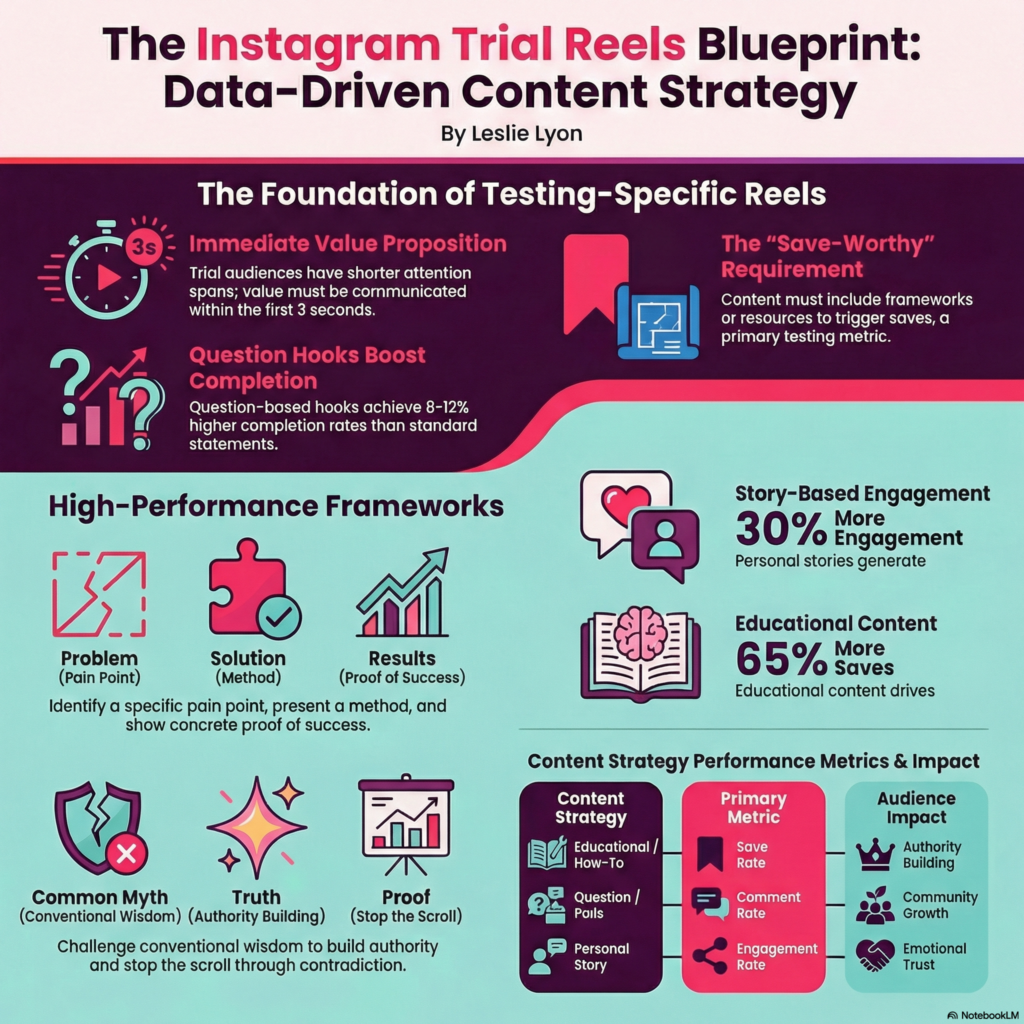
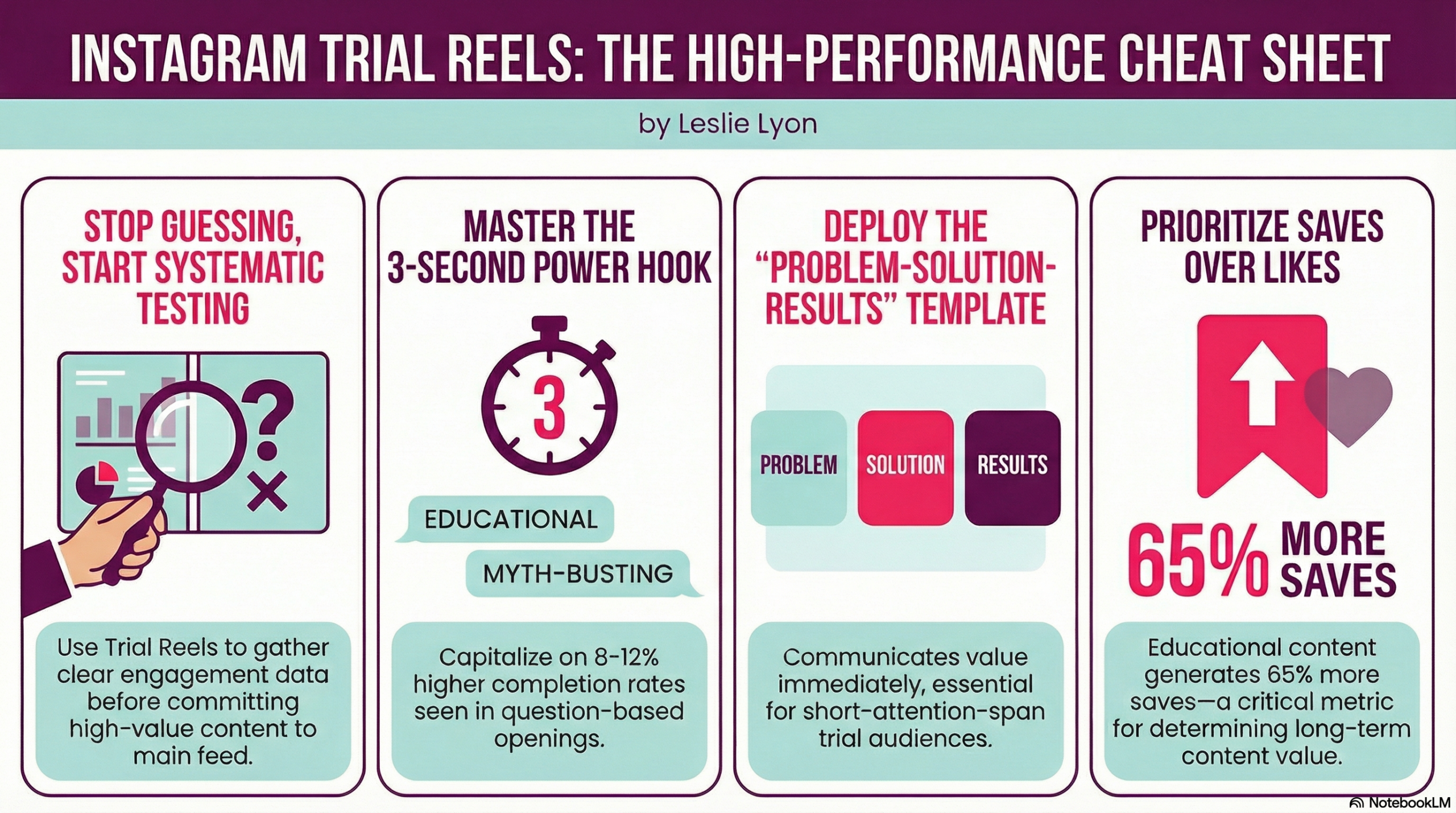
According to Social Media Examiner’s 2024 Content Report, question-based hooks achieve 8-12% higher completion rates than statement-based hooks across all social media platforms.
10 Proven Instagram Trial Reels Content Templates
How to check your metrics and assess what’s working and what isn’t.
Template #1: Problem → Solution → Results
Structure Breakdown:
- Problem identification (0-3 seconds): Clearly state the issue your audience faces
- Solution presentation (4-12 seconds): Explain your approach or method
- Results demonstration (13-20 seconds): Show outcomes, data, or proof
Why Trials Love This Format:
- Clear value proposition immediately apparent
- Logical flow keeps viewers engaged throughout
- Save-worthy due to actionable solution
- Easy to test variations by changing problem, solution, or proof
Industry Examples:
B2B Marketing:
- Problem: “Your LinkedIn posts get 12 views and no engagement”
- Solution: “Use the 3-layer value stack: insight + story + action”
- Results: “I went from 50 views to 5,000 views using this method”
Personal Finance:
- Problem: “You’re saving money but it’s not growing”
- Solution: “The 50/30/20 rule + high-yield savings + index funds”
- Results: “My emergency fund grew 12% last year instead of 0.1%”
Fitness/Wellness:
- Problem: “You work out consistently but see no results”
- Solution: “Track progressive overload + protein timing + recovery”
- Results: “I gained 15 pounds of muscle in 6 months with this approach”
Testing Variations:
- Different problems within the same solution framework
- Alternative solutions to the same problem
- Various proof types (data, testimonials, before/after)
- Timeframe adjustments for results demonstration
Template #2: Common Myth → Truth → Proof
Structure Breakdown:
- Myth presentation (0-4 seconds): State the common misconception
- Truth revelation (5-12 seconds): Explain what’s actually true
- Proof provision (13-20 seconds): Offer evidence, examples, or data
Psychology of Myth-Busting:
- Attention capture through contradiction of accepted beliefs
- Authority building by demonstrating deeper knowledge
- Engagement generation as people react to challenged beliefs
- Share potential when myths are widely believed
Industry Examples:
Content Creation:
- Myth: “You need to post every day to grow on Instagram”
- Truth: “Consistency matters more than frequency”
- Proof: “I grew faster posting 3x/week than daily—here’s the data”
Business Development:
- Myth: “More followers = more sales”
- Truth: “Engagement rate and audience quality matter more”
- Proof: “I make more with 5K engaged followers than I did with 20K random ones”
Health and Nutrition:
- Myth: “Carbs make you gain weight”
- Truth: “Calorie surplus makes you gain weight, regardless of macros”
- Proof: “I lost 30 pounds eating 200g+ carbs daily”
Research and Fact-Checking Process:
- Use reputable sources for proof (studies, official data, documented results)
- Avoid controversial myths that create negative engagement
- Focus on industry-specific misconceptions your audience believes
- Provide clear, visual proof when possible
Testing Optimization:
- Test myth popularity by gauging comment responses about which myths people believed
- Vary proof types (personal experience, studies, expert opinions)
- Adjust controversy level based on audience comfort with challenged beliefs
Template #3: Before/After Transformation
Structure Breakdown:
- Before situation (0-5 seconds): Describe starting point or problem state
- Transformation process (6-15 seconds): Explain what changed and how
- After results (16-25 seconds): Show current state and outcomes
Visual Storytelling Power:
- Immediate engagement through contrast and transformation appeal
- Relatability as viewers see themselves in the “before” state
- Inspiration factor motivating action toward the “after” state
- Credibility building through documented change over time
Timeline Considerations:
- Short-term transformations (weeks to months) for quick wins and immediate applicability
- Medium-term changes (months to a year) for substantial but achievable progress
- Long-term evolution (years) for major life or business transformations
Credibility Factors:
- Specific metrics rather than vague improvements
- Photo/video evidence when appropriate and available
- Process documentation showing steps taken
- Honest challenges encountered during transformation
Industry Applications:
Business Growth:
- Before: “6 months ago: $2K/month, stressed, working 80 hours”
- Process: “I systematized operations, raised prices, and focused on high-value clients”
- After: “Today: $15K/month, confident, working 30 hours”
Content Strategy:
- Before: “Last year: 500 followers, 20 likes per post, no business inquiries”
- Process: “I shifted from motivational to educational content and added clear CTAs”
- After: “Now: 8K followers, 300+ likes per post, 15 client inquiries monthly”
Personal Development:
- Before: “2 years ago: overwhelmed, no systems, reactive daily schedule”
- Process: “I implemented time-blocking, morning routines, and weekly planning”
- After: “Today: calm, organized, proactive approach to each day”
Template #4: Day-in-the-Life Reality Check
Structure Breakdown:
- Reality setup (0-3 seconds): Promise authentic look vs. social media highlight reel
- Actual activities (4-18 seconds): Show real tasks, challenges, and routine
- Lessons or insights (19-25 seconds): What this reality teaches about success/work/life
Authentic vs. Polished Approaches:
- Real challenges rather than perfect moments
- Unfiltered commentary about difficulties and frustrations
- Honest time allocation showing actual work distribution
- Behind-the-scenes problems that don’t make it to regular content
What Audiences Want to See:
- Time management reality (how much time different tasks actually take)
- Work-life integration challenges and how they’re handled
- Decision-making processes throughout the day
- Energy management and productivity fluctuations
Consistency Strategies:
- Weekly themes (Monday motivation reality, Wednesday workflow, Friday reflection)
- Seasonal variations showing how routines adapt
- Challenge periods (busy seasons, travel, personal issues)
- Growth documentation showing how daily life evolves
Industry Adaptations:
Freelancer Reality:
- Show actual time spent on admin vs. client work
- Include unexpected interruptions and how they’re handled
- Demonstrate client communication and project management
- Reveal income fluctuation and financial management
Small Business Owner Reality:
- Display juggling multiple roles and responsibilities
- Show decision-making processes for various business issues
- Include team management and delegation challenges
- Demonstrate work-life boundary struggles
Content Creator Reality:
- Reveal content creation time vs. final product
- Show engagement management and community building
- Include technical challenges and problem-solving
- Demonstrate business development beyond content creation
Template #5: Mistake → Lesson → Application
Structure Breakdown:
- Mistake confession (0-5 seconds): Honestly admit to specific error or failure
- Lesson extraction (6-15 seconds): Explain what the mistake taught
- Practical application (16-25 seconds): Show how others can avoid the mistake or apply the lesson
Vulnerability Marketing Effectiveness:
- Trust building through honest admission of imperfection
- Relatability increase as audience connects with human struggles
- Authority demonstration through lessons learned and growth
- Engagement boost from audience sharing similar experiences
Learning Opportunity Positioning:
- Frame mistakes as education rather than failure
- Focus on valuable lessons that benefit audience
- Demonstrate growth mindset and continuous improvement
- Encourage experimentation by reducing fear of failure
Actionable Takeaway Importance:
- Clear prevention strategies for audience to implement
- Specific steps to avoid similar mistakes
- Warning signs to watch for
- Alternative approaches that work better
Trust Building Through Mistakes:
- Specific details make stories more believable
- Emotional honesty about impact of mistakes
- Accountability rather than blame-shifting
- Follow-up showing long-term changes made
Examples Across Industries:
Marketing Mistake:
- Mistake: “I spent $5K on Facebook ads without testing audiences first”
- Lesson: “Always start with $10/day tests to different audiences before scaling”
- Application: “Now I test 5 audiences with small budgets, then scale the winner”
Business Development Mistake:
- Mistake: “I said yes to every opportunity and burned out completely”
- Lesson: “Saying no to good opportunities creates space for great ones”
- Application: “Use the ‘Hell Yes or No’ rule—if it’s not exciting, decline”
Content Creation Mistake:
- Mistake: “I copied successful creators instead of finding my authentic voice”
- Lesson: “Authentic personality beats perfect presentation”
- Application: “Share your genuine opinions, even if they’re unpopular”
Template #6: Question → Multiple Perspectives → Conclusion
Structure Breakdown:
- Compelling question (0-3 seconds): Pose thought-provoking or controversial question
- Perspective exploration (4-18 seconds): Present different viewpoints or approaches
- Balanced conclusion (19-25 seconds): Synthesize insights or provide nuanced answer
Engagement Through Curiosity:
- Immediate hook through interesting questions
- Sustained attention as viewers wait for resolution
- Comment generation as people share their perspectives
- Share potential for thought-provoking content
Balanced Viewpoint Presentation:
- Multiple valid perspectives rather than one-sided arguments
- Pros and cons of different approaches
- Context consideration for when different approaches work
- Nuanced thinking demonstration
Comment Generation Tactics:
- Ask follow-up questions in caption
- Invite personal experiences related to the topic
- Request additional perspectives not covered
- Encourage respectful debate in comments
Educational Positioning:
- Teach critical thinking by modeling balanced analysis
- Expand audience perspective beyond binary thinking
- Demonstrate expertise through comprehensive understanding
- Build discussion community around thoughtful content
Industry Examples:
Business Strategy Question:
- Question: “Should small businesses focus on one niche or diversify?”
- Perspectives: Present benefits and risks of each approach
- Conclusion: “It depends on your resources and market stability”
Content Marketing Question:
- Question: “Is it better to post daily or focus on quality?”
- Perspectives: Explore algorithm benefits vs. audience value
- Conclusion: “Quality wins long-term, but consistency builds habits”
Personal Development Question:
- Question: “Should you follow your passion or pursue stability?”
- Perspectives: Consider financial reality vs. fulfillment
- Conclusion: “Build skills in areas you enjoy with market demand”
Template #7: Trend Analysis → Impact → Action
Structure Breakdown:
- Trend identification (0-4 seconds): Name and briefly explain current or emerging trend
- Impact analysis (5-15 seconds): Discuss how the trend affects your audience/industry
- Actionable response (16-25 seconds): Provide specific steps to adapt or capitalize
Staying Current and Relevant:
- Industry expertise demonstration through trend awareness
- Forward-thinking positioning as someone who anticipates changes
- Value provision by helping audience prepare for future
- Authority building through analysis and prediction
Future-Focused Positioning:
- Early adoption advantages for audience who acts quickly
- Risk mitigation for those who might be negatively affected
- Opportunity identification in changing landscapes
- Strategic thinking development for audience
Thought Leadership Building:
- Original analysis rather than repeating common observations
- Industry-specific implications tailored to your audience
- Actionable insights beyond general commentary
- Prediction track record building credibility over time
Examples:
Marketing Trend:
- Trend: “AI content creation tools are becoming mainstream”
- Impact: “Generic content will become worthless; unique perspectives will be premium”
- Action: “Focus on personal experience and industry-specific insights”
Business Trend:
- Trend: “Remote work is becoming permanent for many companies”
- Impact: “Service businesses need digital-first approaches to compete”
- Action: “Develop online consultation and delivery systems now”
Technology Trend:
- Trend: “Voice search is growing 50% annually”
- Impact: “Traditional keyword SEO will become less effective”
- Action: “Optimize for conversational, question-based search queries”
Template #8: Process Breakdown → Tips → Results
Structure Breakdown:
- Process overview (0-5 seconds): Introduce system, method, or workflow
- Step-by-step breakdown (6-18 seconds): Explain key components and tips
- Expected results (19-25 seconds): Show outcomes and benefits
Educational Value Delivery:
- Systematic learning through structured information
- Actionable implementation with specific steps
- Skill development for audience improvement
- Reference value for future application
Step-by-Step Engagement:
- Progressive disclosure maintaining interest throughout
- Logical flow that’s easy to follow
- Visual aids when possible for clarity
- Memorable frameworks that stick with audience
Save-Worthy Content Creation:
- Reference material audience will return to
- Implementation guides for practical use
- Framework templates adaptable to different situations
- Checklist formats for easy application
Authority Establishment:
- Expertise demonstration through detailed knowledge
- Experience sharing from actual implementation
- Results documentation proving method effectiveness
- Teaching ability showcase through clear explanation
Industry Applications:
Content Creation Process:
- Process: “My 3-step viral content creation system”
- Tips: “Research trending topics, add personal insight, optimize for saves”
- Results: “This process generated 5 posts over 100K views each”
Sales Process:
- Process: “The consultation call framework that converts 80%”
- Tips: “Listen first, diagnose problems, present solutions, close naturally”
- Results: “My conversion rate went from 30% to 80% using this method”
Productivity Process:
- Process: “The time-blocking system that doubled my output”
- Tips: “Color-code by task type, include buffer time, batch similar activities”
- Results: “I complete twice as much work in half the time”
Template #9: Comparison → Pros/Cons → Recommendation
Structure Breakdown:
- Options introduction (0-4 seconds): Present alternatives being compared
- Balanced analysis (5-17 seconds): Discuss advantages and disadvantages
- Situational recommendation (18-25 seconds): Suggest best choice for different contexts
Decision-Making Assistance:
- Objective evaluation of available options
- Comprehensive analysis considering multiple factors
- Context-specific guidance rather than universal answers
- Informed choice empowerment for audience
Comprehensive Analysis Appeal:
- Thorough research demonstration
- Multiple perspective consideration
- Nuanced understanding of complex topics
- Educational value beyond simple answers
Trust Through Transparency:
- Honest assessment including negatives
- No hidden agenda in recommendations
- Balanced presentation of all options
- Situational awareness in suggestions
Purchase Decision Influence:
- Informed buying guidance for audience
- Value assessment help for different budgets
- Feature comparison for technical decisions
- Long-term considerations beyond immediate appeal
Examples:
Tool Comparison:
- Comparison: “Canva vs. Adobe Creative Suite for content creators”
- Pros/Cons: Cost, learning curve, features, collaboration
- Recommendation: “Canva for beginners and small budgets, Adobe for professionals”
Strategy Comparison:
- Comparison: “Organic growth vs. paid advertising for Instagram”
- Pros/Cons: Cost, time, control, sustainability, audience quality
- Recommendation: “Organic first to find what works, then amplify with paid”
Business Model Comparison:
- Comparison: “Freelancing vs. agency vs. productized consulting”
- Pros/Cons: Income potential, time investment, scalability, stress level
- Recommendation: “Start freelancing, build systems, then choose scaling method”
Template #10: Personal Story → Universal Lesson → Call-to-Action
Structure Breakdown:
- Engaging personal story (0-8 seconds): Share specific experience or situation
- Universal lesson extraction (9-18 seconds): Explain broader principle or insight
- Action encouragement (19-25 seconds): Inspire audience to apply lesson or take next step
Emotional Connection Creation:
- Vulnerability sharing builds trust and relatability
- Human experience connects across different backgrounds
- Emotional investment keeps audience engaged throughout
- Personal branding through authentic storytelling
Relatability Factors:
- Common experiences that audience has likely encountered
- Universal emotions (fear, excitement, doubt, success)
- Shared challenges within your industry or niche
- Growth moments that inspire similar development
Lesson Extraction Importance:
- Educational value beyond entertainment
- Actionable insights audience can implement
- Pattern recognition helping audience see principles
- Wisdom sharing from experience and reflection
Action-Oriented Conclusions:
- Specific next steps for audience to take
- Motivation provision to overcome inaction
- Community building through shared action
- Results orientation focusing on outcomes
Examples:
Business Development Story:
- Story: “I almost quit my business during my first $0 month”
- Lesson: “Success timelines are longer than social media suggests”
- CTA: “Give your current strategy 90 days before changing direction”
Content Creation Story:
- Story: “My most vulnerable post became my most viral”
- Lesson: “Authenticity resonates more than perfection”
- CTA: “Share one honest struggle you’re facing in your business”
Personal Growth Story:
- Story: “I said yes to everything and burned out completely”
- Lesson: “Boundaries are essential for sustainable success”
- CTA: “Identify one thing you need to say no to this week”
According to Buffer’s 2024 State of Social Media, story-based content generates 30% more engagement than purely educational content, but educational content generates 65% more saves.
Content Optimization Strategies for Instagram Trial Reels
Testing Variables for Maximum Learning
Hook Variations:
- Question vs. statement openings for the same content
- Personal vs. universal perspectives on identical topics
- Dramatic vs. subtle language for similar messages
- Direct vs. story-based approaches to the same lesson
Visual Style Testing:
- Text-heavy vs. minimal text presentations
- Face-to-camera vs. B-roll video styles
- Static vs. dynamic visual elements
- Professional vs. casual aesthetic approaches
Length Optimization:
- 4-7 seconds for quick hook testing
- 8-15 seconds for complete message delivery
- 16-25 seconds for comprehensive education
- Test optimal length for each content type in your niche
Call-to-Action Testing:
- Beginning, middle, or end CTA placement
- Implicit vs. explicit action requests
- Single vs. multiple action options
- Question vs. directive CTA formats
Performance Tracking and Analysis
Which Hooks Perform Best by Industry:
B2B/Professional:
- Data-driven hooks (statistics, research, case studies)
- Problem-solving hooks (mistakes, solutions, frameworks)
- Authority-building hooks (experience, insider knowledge)
Consumer/Lifestyle:
- Personal story hooks (transformation, behind-scenes, authentic moments)
- Relatable experience hooks (common struggles, shared situations)
- Aspirational hooks (goals, dreams, improvement)
Educational/How-To:
- Question hooks (curious, challenging, thought-provoking)
- Myth-busting hooks (contrarian, surprising, corrective)
- Process hooks (step-by-step, systematic, organized)
Template Effectiveness by Audience:
Engagement-Focused Audiences:
- Templates 6, 9, 10 (Question/Analysis, Comparison, Personal Story)
- Higher comment and share rates
- Strong community building potential
Value-Seeking Audiences:
- Templates 1, 3, 8 (Problem/Solution, Transformation, Process)
- Higher save rates and profile clicks
- Lead generation and conversion focus
Authority-Building Focus:
- Templates 2, 5, 7 (Myth-busting, Mistake/Lesson, Trend Analysis)
- Thought leadership positioning
- Industry expertise demonstration
Seasonal Performance Patterns
Content Themes by Time of Year:
January-March (New Year, Planning):
- Goal-setting and planning content
- Transformation and improvement hooks
- System and process templates
April-June (Growth, Implementation):
- Progress updates and behind-the-scenes
- Mistake and lesson sharing
- Trend analysis for upcoming changes
July-September (Vacation, Reflection):
- Personal story and authentic moment sharing
- Work-life balance and productivity
- Preparation for Q4 business push
October-December (Results, Planning):
- Year-end reviews and lessons learned
- Planning and strategy for following year
- Holiday and seasonal business considerations
Long-Term Content Strategy Development:
Month 1-2: Foundation Building
- Test basic templates across different topics
- Identify your highest-performing hook styles
- Establish baseline metrics for each content type
Month 3-4: Optimization Phase
- Create variations of successful content
- Test advanced hook combinations
- Develop signature templates for your brand
Month 5-6: Scaling and Systemization
- Create content calendar based on testing insights
- Develop repeatable processes for high-performers
- Build content library of proven templates and hooks
Advanced Content Development Strategies
Creating Hook Databases for Systematic Testing
More information for Trial Reels for Business.
Organize by Category:
- Educational hooks for teaching and explanation content
- Personal hooks for story and experience sharing
- Question hooks for engagement and discussion generation
- Data hooks for credibility and authority building
Performance Tracking System:
- Completion rate by hook type and industry
- Save rate patterns for different hook categories
- Engagement quality generated by various hook styles
- Audience preference trends over time
Seasonal Content Planning:
- Holiday and event hooks for timely content
- Industry seasonal patterns and relevant hooks
- Personal milestone hooks for authentic sharing
- Business cycle hooks aligned with audience needs
Audience-Specific Customization:
- Beginner vs. advanced audience hook preferences
- B2B vs. B2C hook style effectiveness
- Age demographic preferences for hook types
- Industry-specific language and reference points
Competitor Analysis Integration
Study High-Performing Content:
- Analyze successful hooks from competitors and industry leaders
- Adapt frameworks rather than copying content directly
- Identify content gaps in your industry for opportunity
- Track performance patterns across different accounts
Differentiation Strategies:
- Unique perspective on common topics
- Personal experience integration for authenticity
- Industry-specific applications of universal principles
- Contrarian viewpoints on accepted practices
Content Innovation:
- Combine successful elements from different sources
- Test unconventional hook and template combinations
- Experiment with emerging content formats and trends
- Create signature templates unique to your brand
Implementation: Building Your Content System
Week 1-2: Foundation Testing
- Choose 5 hooks from different categories that resonate with your brand
- Select 3 templates that align with your content goals
- Create 10 Trial Reels testing different combinations
- Focus on completion rate and save rate metrics
Week 3-4: Refinement Phase
- Analyze performance patterns from your initial tests
- Identify your top 3 hooks and top 2 templates
- Create variations of successful combinations
- Test advanced optimization techniques
Week 5-6: Scaling Strategy
- Develop content calendar based on successful patterns
- Create systematic process for ongoing testing
- Build content library of proven templates
- Plan long-term strategy incorporating learnings
Ongoing Optimization
- Monthly performance reviews of hook and template effectiveness
- Quarterly strategy adjustments based on accumulated data
- Seasonal content planning using proven frameworks
- Continuous testing of new hooks and templates
Ready to implement these content ideas and templates? Start with our Instagram Trial Reels Ultimate Hub for complete implementation guides and ongoing strategy support.
Want customized content ideas for your specific industry and audience? Contact our team to develop tailored Instagram Trial Reels strategies that align with your business goals and brand positioning.
Leave Your Comment